Showing posts with label calibre. Show all posts

Tuesday, November 19, 2019

Ligne or Line? It's actually - Lin

Well, that would depend whether you're French or English. Lets stick with the French.

Ligne (pronounced 'lin'), is an archaic unit of measurement commonly used in French and Swiss horology dating back to the 1700s. It is a pre-decimal unit of measurement. Basically, 1 ligne is 2.2558mm.

Watchmakers made movements in lignes where the average size was around 19 lignes (or just under 43mm in diameter). As continental Europeans moved to the decimal system, Swiss and French watchmakers refused to budge. So even today, measurements in lignes are often quoted in relation to the watch movement diameter.

Lignes as a unit of measurement is easily distinguished by metric and imperial units with the number followed by 3 primes (e.g. 18'''). For students of horology: the movement diameter is measured at the outside diameter of the bridges, not at the dial/casing flange.

Novice watch enthusiasts sometimes confuse lignes with calibre or what Americans call size. For example, the Omega movement  mentioned yesterday was calibre 19LBN, happens to be exactly 19 lignes in diameter. But this a pure coincidence. American pocket watch movements are referred to by sizes. For example, size 10 is 1.500 inches or 38.10mm or converted in lignes, 16 and 7/8s. Clearly, the relationship between lignes, millimetres, inches and sizes is not 'blindly obvious' and to covert between we need help of tables.

To this day, the French and Swiss stick with lignes and Americans with sizes, and neither side is willing to adopt the logical decimal unit of measurement.
Being Australian watchmakers ourselves, we simply state that our NH2 movement is 36.60 mm in diameter.  Which would make it just over 16 lignes and just under size 8. 

Friday, May 8, 2009

When money is not an issue

Have you ever asked yourself what is the most expensive part inside your Rolex ? Taking into consideration that almost all movement parts are essential (except for a screw or two), it would be unfair to single out any particular bit. However, for the sake of simplicity, let's assume that all parts are equally important and from that, the most expensive part would be the one with the best dollar/weight ratio.

The escape wheel is the last and the lightest wheel in watch train and one of the 3 vital parts responsible for timekeeping and accuracy. Together with pallets and the balance wheel, it is really the 'heart' of the watch mechanism - a 'device' that makes your Rolex tick & tock.

The photo below shows the escape wheel from Rolex calibre 3135 placed on digital scale.
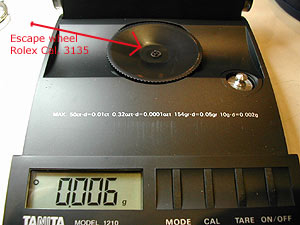


The weight of the wheel is 0.006 gram. In other words, the total of 167 wheels would have a combined weight of 1 gram. With a price of US$ 28 per wheel, 1 gram of escape wheels is worth US$ 4,676.00 !

Do you know of any other machine made and mass-produced piece of metal worth 4,6 million US dollars per kilogram? That's why the Swiss don't bother about making hammers and screwdrivers. If they did, you'd have to be Warren Buffet to take up carpentry as a hobby.