Showing posts with label clockmaker. Show all posts

Wednesday, July 8, 2020

David E Walter

David Walter is the first person to successfully recreate the Woodward Free pendulum clock, W5 in 2006 followed by an improved edition of Breguet No.3671 Double Pendulum clock in 2010 and further development in 2012 added the complications of Daniels Perpetual calendar with retrograde date and sunrise/sunset indications. These great achievements firmly place David Walter not only as one of the greatest clockmakers ever to have lived and the greatest living clockmaker as well as the only clockmaker to have ever made both versions of double pendulum clock, The Free Pendulum (D)W5 and the Double Pendulum Resonance Clock.

And what would you say if I tell you that David Walter is an Aussie?

Quite frankly, I was hoping for and would be more than happy with a fifteen minute chat with David. Generously and kindly, he allocated over two hours to share with us his amazing story.

For your enjoyment here is Part One of the 'Raw and Uncut' interview with David E Walter.
https://www.youtube.com/watch?v=1b6OuIYnJb0&feature=youtu.be

Thursday, July 2, 2020

Reclaiming the Horological Grounds

Let's be brutally honest: mechanical watchmaking is a dying trade. The small pockets of activity are centred around mega brands who themselves go through cycles of boost and bust. Consequently the lack of interest from youngsters to join the trade and devote a decade or two in an exclusive but fast declining industry is quite understandable. The carcass has been decaying for a while - but thanks to the new world of fast communication and social media, we are witnessing an unusual development: horology being hijacked by vocal outsiders. Enthusiastic social media amateurs, watch forums, influencers financed by brands, startups, peddling the $20 Chinese watches while waving the banner of "new horology for the young,  modern man". The real watchmakers - the nerdy introverts - who actually sit behind the workbench, who make and repair watches and clocks - and invest a substantial amount of time training and passing their knowledge, are watching silently, slowly sliding into irrelevance.

Last night I spent nearly 3 hours conversing with Tommy Jobson, a thirty five years young English clockmaker. An hour and a bit of that conversation has been video recorded - for your enjoyment. Tommy is a down to earth, skilful and pedantic restorer trained in both watches and clocks. And we've discovered we have one thing in common: admiration to the best living clockmaker in the world - who nowadays, out of all places, resides in Australia!

The interview with Tommy is yet another attempt to reclaim horology by two students of horology, as we proudly call ourselves. It is yet another humble attempt to reverse the tide, to excite and re-focus your attention to things that matter. Ultimately, to lift your appreciation of horology to another level.

Next week we will surprise you with another guest so make sure to stay tuned in and to subscribe to our YouTube channel.

Interview with Tommy Jobson, Bespoke Clockmaker: 
https://www.youtube.com/watch?v=YMWU1xLbUlQ

Friday, June 26, 2020

There is a cure

This happens about once per year. And it happened last night. But I swear on George Daniels’ grave- it won't ever happen again.

The game is simple: a man in his late thirties calls to make an appointment. To a logical and very servile question "which watch is of interest?" he replies with a vague "I am not sure, what do you have in stock?" My assistant suggests a visit to our website where our entire (fairly modest) range of watches is listed in detail. Unfortunately, the caller refuses to take up the suggestion, determined to make an appointment to "discuss the matter in person" and inspect "whatever it is in stock".

Of course, in most cases that is not a problem, I am happy to help. But when that 'customer' arrives with a bunch of friends who are there to 'help', and when the crowd realizes that I am a small dealer who doesn't have any steel Daytonas, Hulks, or Batmans - or for that matter any watches on display - the buyer and his mates quickly become arrogant, agitated, and verbally abusive.

The mob is always of the same appearance: three white males, aged 30-40, wearing semi-designer clothes and Panerai, Hublot and Rolex watches. Big mouths, always in a pack, trying hard to insert their dominance, while faking disappointment.

Fruitless. Because trying to intimidate and frustrate a 57 year old, chubby, glasses-wearing watchmaker is as cowardly as it gets. It serves no purpose.

Over the decades I have had countless dealings with tens of thousands of men and women, of all ages, status and social backgrounds. From directors of multibillion dollar corporations, politicians, and bankers, to man who wears firearms for a living, and those who can settle any matter with one hit. With men of modest physique, but with great charm, a sense of humour and sense for fashion. Sophisticated alpha males. Great leaders. Decision makers. Tough men and women who work hard to make an honest living doing mundane jobs. Men of integrity and experts in their fields of activity - who all have one thing in common: a love for watches. And that dealing was and is always, without exception, based on mutual trust and mutual respect. Alpha males can achieve whatever they want (which is always a win-win outcome) without resorting to intimidation, abuse, aggression or cheating.

Men who gain pleasure by abusing the weak, who waste time, who get 'upset' over invisible scratches, men who are on a constant quest for perfection - while so painfully obviously imperfect themselves - who start the conversation with 'so what is your best deal' and who send 10 emails to complain about delayed shipping - all those men have one thing in common: they 'act' tough because they are impotent. And there is nothing more pathetic than three impotent, anonymous, ignorant men trying hard to intimidate a watchmaker.

The bad news is that joining a Rolex Forum or visiting local dealers and watchmakers ‘doing rounds’ will not solve the problem. However, the good news is that nowadays, erectile dysfunction can be treated with non-surgical methods. Yes, it may cost a Hublot or two, or even a Hulk, but if this is the price to be paid to sort out frustrations - it would be worth it, for sure.

Until then: take your frustrations elsewhere, visit by appointment only, and if you show up in a group of three or more – sorry, no entry.

Nicholas Hacko,
Master Watchmaker

Sydney

Case polishing explained

Last week we published a photo of before and after of a Rolex case polishing job undertaken by Bobby, second year apprentice.
The polishing was done by hand using just various grades of emery paper and a wooden stick, with mirror finish achieved on a rotating buff wheel (cotton disc and polishing medium).
The end result speaks for itself. We posted the photos on Instagram inviting our followers to rate the job anywhere between 6 and 9 out of 10. As we expected, almost all marked the job with top grade.  What we didn't expect: this photo was one of the three most liked posts with over 600 likes.

Yet a couple of watch enthusiasts couldn't help but to offer rather strange opinions on the matter. There were two complaints:
1. Case polishing is bad because it removes patina
2. Hand polishing and especially buffing on the wheel is a 'bad' method. Watch cases should be lapped, not polished.
Yes, for some, case polishing is a controversial issue.  Allow me to defuse it for you and help you understand the fundamentals.
Once you understand those fundamentals then you will be able to make an educated decision.

What is patina?
Patina is a green or brown film on the surface of bronze or similar metals, produced by oxidation over a long period. Patina is also a gloss or sheen on a surface of antique furniture resulting from age or polishing.
Please note: we use same term to describe completely different effects created in different manner on two different surfaces: bronze and wood. Yet in both cases, it is the patina - whether it is the sign of natural ageing, polishing with shellac and oxidation- which gives an object the distinctive 'naturally aged' shine and colour.
It takes no expert to appreciate that a fine bronze sculpture should not be polished (only dusted!), neither should a fine French polished antique table be stripped down to bare wood or attacked with aggressive polishing agents. We leave bronze and wood alone- to age naturally.
Stainless steel which is used in modern watches is a different story altogether. Ideally, stainless steel does not oxidize - so it cannot develop any patina whatsoever. The oxidation process of steel is simply called rust. Pitting is actually worse than surface rust - it is a nasty corrosion which kills the water resistance of watch cases. Since almost all modern watch cases are nowadays made of stainless steel, titanium or precious metal, we don't associate the term 'patina' with watch cases.  To use the term 'patina' on any watch case except bronze, is grossly inappropriate.

Stainless steel cases leave the watch factory with a variety of surfaces: polished, gloss, mirror finish, brushed, sand blasted. General expectations with modern watch servicing are to at least improve the condition of scratched cases, if not to return them to as close to original finish where possible. Again, not to preserve any patina - because there is no patina to be preserved.

"Please don't polish - I like my scratched case!"
Fair enough! If your wish is to have all the bruise marks, dents and scratches 'preserved' than who am I to argue with your choice? Indeed, some watch owners are very particular in this respect. However, it is important to point out the obvious:  a vast majority of MODERN watch owners would prefer polished cases and bracelets, restored it to 'like new condition'.  Scratches are bad and undesirable. Disagree? Would you intentionally scratch your new car? Or a brand-new laptop, mobile phone - or a brand-new watch? Removing scratches is DESIRABLE. It's good. It's fine. Removing scratches is difficult, and we don't do it just for fun or to impress you, so relax and enjoy your new polished surface!
However - there is an exception to this rule: unlike modern watches, rare, high value vintage watches SHOULD NOT BE POLISHED. Not because they are worth more when scratched, but because polishing - and in some cases even cleaning- could significantly reduce chances of assessing the originality of both external and internal parts. All the scratches, dings and dents help us to determinate if the watch is original or a Frankenstein put together from new and old parts, or a watch which has been restored correctly - or not.

Polishing is an inferior alternative to lapping
Yes, it is true that almost all modern stainless-steel watch cases and bracelets are polished with the help of modern multi-million-dollar CNC machinery, fully automated, in a process which no longer involves human touch. The final step of that polishing process is lapping. Lapping is a technique where a liquid polishing medium is applied between the work-piece (watch case) surface and a lapping plate. Due to the nature and geometry of those lapping plates, as well as highly controllable lapping action, this automated process produces very uniform surfaces which retain geometry. In other words, polished ‘edges’ are crisp, defined and 'sharp'. They look like they have been defined and polished by robots - which they are.
In other words, when it comes to case finishing, nothing beats machine lapping. Unfortunately, lapping is highly specialized process and your independent watchmaker is either not set for lapping, or when he is able to offer such service, it is only to a limited number of watch cases / shapes / brands. It is a trade in itself - and quite frankly, has nothing to do with watchmaking. To expect your independent small watchmaker to offer case refurbishment service equal to those of mega-brand is simply unrealistic: the same as expecting everyone to fly first class or drive a Ferrari.

"Oh NO! You've polished my watch and rounded the lug! I am devastated!!"
Unfortunately, we live in an imperfect world, and we have to put up with compromise. Watch polishing is ALWAYS a compromise. At the end of the day, you have to answer this question for yourself: which one would I prefer - "before" or "after"? Because this is all we can offer. Polished cases could mean some very minor 'rounding'. This is just a nature of the polishing process, especially when done by hand. However, an experienced polisher is well aware of the process and will do everything possible to keep the wheel buffing action just for the final mirror finish. When we remove scratches, we use a range of abrasive papers and films, in various grades, which takes a majority of polishing time and this is why our results are as per photo.
Not good enough for you? Well, the best polished case is - case replaced. For that, you need to talk to your watch brand service department. We can consistently offer; 6, 7 or 8 out of 10. On a good day - even a solid nine. For perfection see our competition.

Conclusion
There is no such thing as patina on steel cases. Scratches are bad, so take a good care of your watch and you won't need frequent polishing. Polishing is time consuming, requires skills- therefore expensive. Learn to live with small imperfections -life is not perfect. Be happy with the end result - returning the watch case to 'brand new condition' is impossible!

The most abused horological masterpieces

are pocket watches. Butchered, slaughtered, molested then discarded. Being larger than wrist watches, pocket watches are simply a magnet for 'wannabe watchmakers'.
Here is a perfect example of a 1920 pocket watch made by Moser and Cie. Heinrich Moser was a famous watchmaker who set up his shop in St. Petersburg. His clients included Russian princes and members of the Imperial court. Lenin also owned a Moser watch.

The original click (ratchet locking lever) was most likely missing and while the intentions were good, the lack of skills and watchmaking tools is evident.

Yet bizarrely, this crude, oversized click functions - and the watch works!

I happen to have another Moser pocket watch in my collection, so you can see how the original click looks like.

But then again, perhaps, there could be another side of this 'less than perfect' restoration. What if the owner of the watch was positioned on a remote Siberian island? Or even worse - if he was a prisoner in Stalin's gulag, maybe an engineer who understood what the function of the click spring was, but had no tools - other than crude workshop tools - to make a sophisticated replacement?

We should be not too quick to judge and ridicule. And sometimes, trying to 'fix the wrong' could cause even more injustice to our appreciation of humanity and history.

My rule is simple: whatever it is - if you didn’t make it, you have no rights to destroy it. If you really feel compelled to destroy something, then here is a suggestion - start with destroying your own masterpieces.            
             

Wednesday, May 20, 2020

From Apprentice Corner: Brian Loomes

Brian Loomes is a horological historian, genealogist, and a prolific author and best-known expert on British clocks. As Britain's longest-established clock dealer, his name is known by everyone connected with antique clocks.

Through his own original research in ancient records into the life and work of clockmakers he has compiled thirty reference books and hundreds of articles about antique British clocks and their makers. Several of them have become definitive texts and are used as standard reference books by museums, libraries, auction houses and collectors the world over. So much so that even many of the terms today in general use to describe certain types of clock features were first coined in these books.

Brian Loomes is not a watchmaker by trade, but our young apprentices are expected to immerse themselves into the work of Loomes, discover his style, methodology, attention to detail, and relentless pursuit of penning down horological history which would otherwise remain unpreserved.

This week we are studying ‘The Concise Guide to British Clocks’, and our apprentices are required to write down technical words and terms they have not heard before. We discuss them the following day, and we learn together.

The first four words we discussed yesterday were:

Fusee
Hood pillar
Spandrels
Foliot


(These were Chloe's picks)

Do you know what these terms refer to, without looking them up? I have to admit, I tripped up on 'spandrels' and had to ask Bobby to look it up for us. Not to make any excuses, but if the word had been in context, I am sure I would have worked it out. If you too are struggling to work it out then here is a tip- there are four on the dial of a traditional English long case clock.                          

The runaway apprentice


APPRENTICE RAN AWAY. Penrith 24th of 12th month 1790. Whereas John Thompson (son of John Thompson of Wigton, Clockmaker) an indentured apprentice to William Wilkinson (late of Wigton) Clockmaker, ran away from his said Master some time ago...Notice is hereby given that whoever harbours or employs the said Apprentice, shall be prosecuted as the law directs...William W.

However, the apprentice's father was not content to let it pass at that, but took an advertisement himself shortly after. 

TO THE PUBLIC. Whereas an advertisement appeared in the Cumberland Pacquet of the 29th Ult (previous month) under signature of WILLIAM WILKINSON of Penrith, Clockmaker, charging his apprentice John Thompson... with having some time ago deserted his apprenticeship, The said apprentice;s father will give a sufficient indemnity to any person who may employ or harbour his son and take every method to chastise Wilkinson's insolence; and that the public may not be deceived by his fictitious advertisement, the following facts are laid before them, viz. The young man in March 1787 under necessity of leaving his master, for want of victuals and other bad treatment and about that time a Magistrate (the late Dr Dunn of Lowther) on hearing both parties, ordered him home to his parents with a severe reprimand to Wilkinson ho has ever since known where the said apprentice was, and whose term elapsed the 5th of April last and shortly after Wilkinson directed the gentleman who had the custody of the indentures to cancel them, without (before or since) making any demand of the young man as his apprentice, till very lately, when he saw him at work with Mr Lough, watchmaker, in Penrith when a jealous and malevolent disposition instigated his insolent advertisement. John Thompson Senr. Wigton. Jan 8th 1791.

Extract from 'The Concise Guide to British Clocks' by Brian Loomes

Monday, March 30, 2020

The Holy Trinity of Smiths and 'Artes Mechanicae'

We started shaping metal 12,000 years ago: copper, bronze and gold. The first metal objects were created for their artistic value. After all, the soft copper and gold were no replacement for utilitarian stone tools, perfected over tens of thousands of years.


The discovery and smelting of iron was a game changer, but it would take another 3000 years before we entered 'the iron age'. The issue holding us back was the high melting point of iron (1530 deg C). The ancient kilns were unable to produce temperatures above 900 C.  However, with technical advancement in smelting furnaces, the iron which could be found in abundance replaced the bronze. It was also lighter, cheaper and most importantly stronger metal, suitable for anything from weapons to ploughs.

Romans were first true metal smiths, who skilfully used silver, zinc, iron, mercury, arsenic, antimony, lead, gold, copper and tin as numerous other alloys. However, with the fall of the Roman empire, many of those metallurgy skills were lost for next 1000 years, until the 'Vandals' rediscovered the lost craft.

And then, it all exploded in Europe once again in the late Middle ages and Renaissance. With the fall of Constantinople and rediscovery of ancient scientific texts - and invention of printing which democratised learning-   great advancements occurred in physics, astronomy, mathematics, engineering and manufacturing.

The Holy Trinity of Smiths - locksmiths, gunsmiths and clockmakers - gave birth to fascinating utilitarian objects.  Artes mechanicae (mechanical arts) were based on the practice of skills. While ungratefully called servile and vulgar by those who practiced academic disciplines and "liberal arts", mechanical arts changed and shaped the modern world in an amazing, practical way.

A few months ago, a book titled 'American Genius' landed on my desk. It is one of those very special books, so narrowly focused on a subject that you would never have a need to look for. A book that finds you, not the other way around; a book which provides an amazing answer to a question rarely asked: what happens when a locksmith and a clockmaker work together, when two geniuses collaborate, strive, improve, innovate - and give a birth to an object whose purpose becomes irreplaceable for hundreds of years, yet invisible to the common eye?

“American Genius: Nineteenth-century Bank locks and Time locks” reads as crime novel. Two trades - both deeply rooted in secrecy - not without a reason - and their colourful Masters with magical skills to help a locked-out banker, who spent nights trying to pick competitor's locks, to learn each other’s secrets while doing anything humanly possible to be known as the inventors of 'unpickable locks' themselves.

Take for example one Harry Miller, who in 1924 entered the trade as a locksmith apprentice at age 12. Only a few years later, Harry developed his expertise in opening the best and most complex safes and locks of the era. He was called upon to open safes for the US Military, the safe in the White House for President Roosevelt, and even a gold bullion chest for Chiang Kai-shek. Harry was known as 'the most dynamic and knowledgeable' figure in the history of American vaults. His secret? He was able to understand the weaknesses of safes and learn from them.  

Here is another gem: around 1800 Bramah and Co were the makers of the 'most secure lock' of the time.  Bramah was so confident that his lock was unpickable that their Piccadilly shop in London offered a reward of 210 pounds for anyone who could pick a Bramah padlock - a challenge that would go unanswered for more than 50 years. And then, in 1851, an American by the name of Alfred C Hobbs arrived to London. It took him 20 minutes to open the padlock and claim the massive reward. The defeat was felt by the entire nation, as recorded by Times of London:

"We believed before the exhibition opened we had the best lock in the world, and among us Bramah and Chubb were reckoned quite as impregnable as Gibraltar - more so, indeed, for the key of Mediterranean was taken by us, but none among us could penetrate into the locks and shoot the bolt of these makers".

Yes, no lock or vault is impervious to theft. A safe or vault can however be made impossible to crack without arousing alarm. And in this game, time itself is of the essence. The need for locks fitted with a clock mechanism which would prevent the opening of the safe even if the combination is known to burglars was a major advancement in safe protection. It came about as a result of a rather unpleasant event, the 1867 robbery of Northampton National Bank, Massachusetts:

"The so-called Great Burglary began not at the bank but soon after midnight at the home of John Whittelsey, a bank cashier, two thirds of a mile away. Seven robbers, one for each resident, burst into the house and tied up the Whittelsey family, demanding that John divulge the combination to the banks safe, and when he gave them the numbers, they diligently took then down. After the short period, they demanded that he repeat the combination, but having given the false one made up on the spot, he could not recall it now. The robbers tortured Whittelsey, obtaining the true combination, stealing more than $500,000 in banknotes, stock certificates and bonds. Three of the perpetrators were later captured and all the money was recovered, but the message to the banking industry was clear: with the newest combination locks, the weak point in the security system was now the human element. Bankers would need a lock that would keep out not just the robbers, but bankers as well".

From this- the time lock was born. Designed to protect the riches from every threat, these beautiful devices embody the evolution of locks technology. These handcrafted masterpieces are elaborately decorated with intricate engravings and castings despite the fact that they will be never seen by public.
"American Genius" is a feast for the eyes. With hundreds of high-quality photos and detailed descriptions of time locks, it covers the golden century of American craftsmanship. It is a must read for a technically minded and curious enthusiast, from an apprentice to an engineer, from a locksmith to a watchmaker, and perhaps, the most, from a banker and his antithesis - the lock picker. 
                     

Friday, August 21, 2015

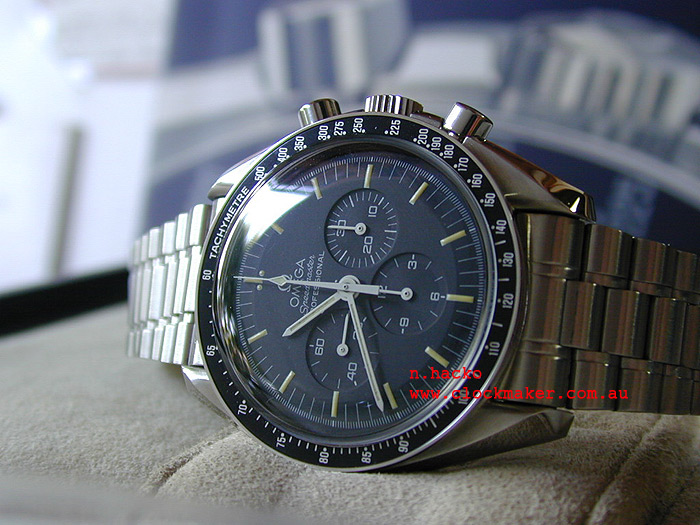
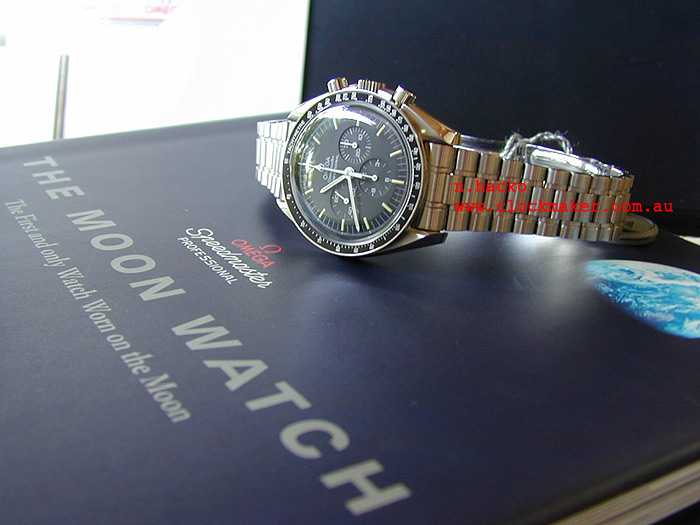
Omega Speedmaster Moon watch - MIR 3596.50 The most exciting discovery of the year!

Yes I know we still have the better part of five months left in 2015, but there is no doubt in my mind that this watch will be our most important find for the year. I am very excited to be able to share a sneak preview of it with you just before departing for Switzerland.
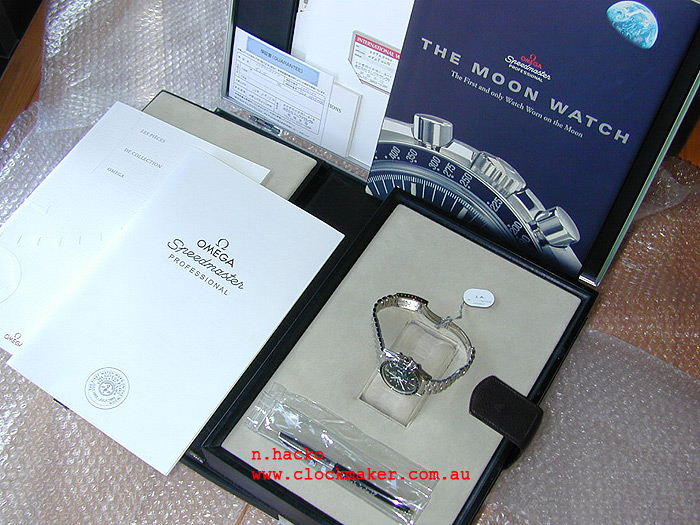
The ability to source this watch was a direct result of a 12 year relationship with an overseas supplier, and months of negotiation between three parties. It took a lot of work, but today this watch is officially part of the collection of Clockmaker.com.au.
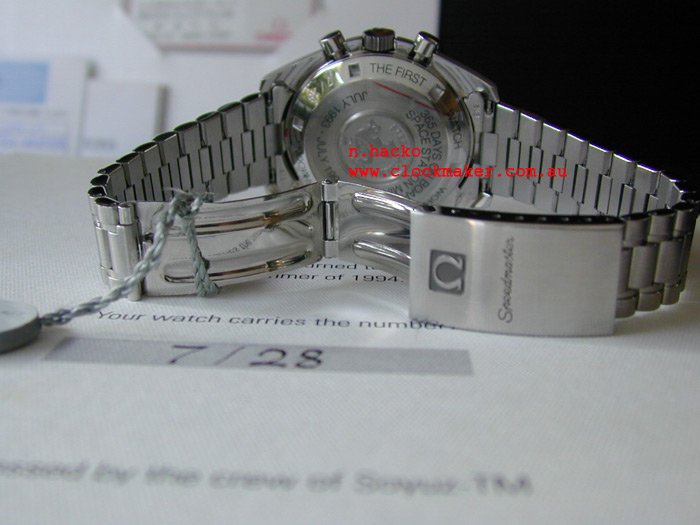
This Omega Speedmaster Moonwatch Ref 3596.50 is one of 28 pieces that spent the year 1993/1994 aboard the Mir Space Station. The Omega MIR story is fascinating in its own right, a batch of 28 Speedmaster Moonwatches were sent to the station for a year as part of a research project into the impact of magnetic fields upon mechanical watches. Some were gold cases others were stainless steel. In 1995 some of those watches were offered to private collectors,  and it goes without saying that any such piece was the crown jewel in any collection. To my knowledge this is the first time in 20 years that one of those watches has reappeared on the collectors market. This particular piece is number 7 of 28, it is in unworn condition and comes in a complete set.