Showing posts with label gold. Show all posts

Friday, October 17, 2025

Watching history happen


The queue is massive, spiralling around the block. Photo taken 15 minutes ago. And no, they are not waiting for a Rolex shop to open.

As predicted a few weeks ago: the bubble has arrived — the big, beautiful bubble called the run on gold merchants.

An onlooker unfamiliar with the situation might wonder: what are all these people lining up for? To sell their gold and take advantage of high prices? To buy more, fearing that money will soon be worthless? Yes, a few are queueing for those reasons. But the vast majority are simply desperate to collect actual gold — to convert an “I owe you” piece of paper into real, physical metal.

The frenzy and the urgency? Simple: there’s far more paper, more promissory notes, more contracts, than there is actual gold in the entire world.

And as the price of gold continues to bubble, there will be more demand, more pressure — until the pressure cooker finally blows its lid, and Lima beans hit the ceiling fan.

Back in June 2015, when a batch of twenty Rebelde 18k gold watches was delivered to Rebelde ambassadors, history was made. The first steel model had been released only 13 months earlier — and it was the first time in Australia that a microbrand, still in its infancy, released massive 18k yellow and rose gold watches. And massive they were: 135-gram monsters — not hollowed-out or gold-clad cases, not cheaply cast, but thick, heavy, solid-gold, three-piece machined cases.

The retail price was $13,980. Today, those 18k Rebelde watches are worth twice that.

And their value is not set by me, or by Chrono24, or an auction house, or a group of cashed-up collectors who worship microbrands. That’s the price any gold merchant — anywhere in the world, from Mumbai to Moscow, Hong Kong to Johannesburg, or Buenos Aires — would pay for my watch. Not because they value my horological genius, my name, or the “Australian brand.” For that, they couldn’t care less. They pay for the gold itself.

To my ambassadors who invested wisely in Rebelde: well done — you’ve doubled your money. Plus, you’re wearing a watch of genuine horological significance. You were backers of a project that will never be repeated — or at least not in the next decade — by any Australian microbrand.

When someone once asked, “Why would anyone invest in a gold Rebelde?” I answered in a blog post — more than 10 years ago.
Today, that answer has been fully validated — and it’s as relevant as ever.
What a journey!

https://nickhacko.blogspot.com/2015/06/a-post-in-forum.html

I promised, and I delivered. Handsomely. Smartly. And much faster than anyone could have anticipated. Myself included.

Down the Rabbit Hole of Gold


Over the past few days, a number of subscribers have reached out wanting to sell their gold watches. With gold hitting an all-time high, this is hardly a surprise. In fact, I'll probably be doing the same myself in the near future.

First of all, we're talking about scrap gold, not your shiny Rolex Presidents. Scrap gold comes from broken watches, bracelets, links, and jewellery - sent to a refiner to be melted down and reused. And yes, now is the perfect time to turn junk into gold.

However, the process of turning scrap into bullion is a bit tricky, to say the least. Having gone through this journey a number of times, I speak from experience.

Basically, you have two options:
Sell your scrap to businesses that buy scrap gold, or deal directly with a refinery.

In the first case, the easiest way is to find a local buyer online, make an appointment, and show up with your scrap.
The problem? They'll rip you off. You won't get anywhere near what an online gold scrap calculator might estimate. The price they pay is significantly lower than the gold spot price. They'll also complain about all sorts of things - purity, carat, content - all being "unknown" or "too risky." But you'll walk away with cash in hand.

Dealing with refiners directly comes with its own challenges. The most obvious one: as wholesale businesses, they're primarily interested in large quantities of scrap metal. One broken watch and a couple of earrings aren't worth their trouble.

There are also numerous "fixed costs" associated with refining. The assay fee - a charge to test and determine the purity of your gold - can be either a flat rate or a percentage of the total value. Some refineries waive assay fees for large quantities, while others charge for incoming weight, retention, and handling, in addition to the assay itself.

Then there's the refining time. It can take weeks to get your 24K gold back. But what really makes me nervous is the downright dodginess of the process. You're expected to place complete trust in the refiner, while having no leverage or oversight whatsoever. You leave your scrap - and whatever comes out of it is what it is.

For example, the common procedure is to have your scrap pre-sorted (9K, 14K, 18K, 24K), weighed, and recorded, then weighed again at the refinery. However, the last time I handed over my metal, I was simply asked to leave it behind - to be weighed later - because, apparently, "the scales weren't working." And I did. There's no point arguing with a refiner. It's a take-it-or-leave-it deal.

The upside is that, at the end of the refining process, you'll receive a lump of pure 24K gold (plus some silver), and you'll have the option to sell it on the spot at the actual market rate, have it stored, or take physical possession. You'll also receive a proper receipt.

To be fair, gold merchants and refiners are constant targets for forgers and crooks, so their lives aren't easy either. Dealing directly with them requires experience - and strong nerves. And yes, they're all the same.

Of course, if you have an 18K gold watch you'd like to sell for scrap, or any fine modern or vintage piece similar to our current stock, feel free to reach out. I'll be happy to make you an offer upon inspection.
But then again, selling any watch for its metal value feels almost sacrilegious. Take, for instance, this 1920s gold pocket watch - broken, missing parts, far beyond restoration. And yet, on its weary case back, a tender engraving remains: two birds hovering over a nest, guarding a single egg. The message could not be more heartfelt - a young family, full of hope, awaiting new life. One can almost imagine it: a father-in-law's gift, his blessing engraved in gold.

So, to scrap it, or not?

You tell me.

Friday, June 2, 2023

Here it is!

A photo of the NH Fifty Five Timascus Guilloche has been just released on Instagram, so here is one for you as well. Thank you for your patience! 

Truly humbling: the Instagram followers went crazy; over 600 likes, 60 comments, orders and shares. All we can reply with is: thank you for your support. 

We are already onto the next step: as we speak, ten new Timascus dials are being made, one at a time, to be released in the most vibrant colours you can imagine. Then, ten movements in matching colours will be produced as well.
What will happen after that - is yet to be determined. But we'll keep you informed.
Check out the Instagram post here: 
https://www.instagram.com/p/Cs596s6JVP-/

Tuesday, May 11, 2021

The most advanced manual focus camera ever made by Nikon.


In the late 70’s to early 80’s, camera technology had started to move towards computer aided functionality. Camera companies, who used to rely solely on mechanical ingenuity, now had to invest in the research and development of microprocessors capable of reacting and working in the same way a professional photographer shooting manually would do. It was no small task, but this period saw the development and introduction of many technologies we take for granted today, one of these is that of exposure metering.

Now if you aren’t familiar with what Exposure metering means, the job of ‘metering’ in a camera is to evaluate what you’re shooting and determine the correct exposure settings for your image. 

In 1983, Nikon and Olympus, two Japanese powerhouses for innovation, were fiercely fighting it out in a neck and neck battle to produce an intelligent system for exposure metering, which would greatly aid the amateur and professional photographer alike. While both carried out technical innovations of exposure control, their ideas were quite contrary to one another.

Olympus’s technology, ‘Multi-spot metering’, introduced in the OM-4, took a sample of multiple ‘spots’ on the image and then set the exposure accordingly. This still required manual input from users as it was a somewhat basic idea and sometimes inaccurate, as it only took small samples and didn’t account for the whole image. 

Matrix metering on the other hand, the technology developed by Nikon and implemented in the FA, aimed to minimise user's judgment of the exposure compensation entirely, by breaking the entire image up into grid like segments and taking an average, it could determine precisely the exposure compensation required without the need for manual input. The technology was such an advancement for cameras, that the Nikon FA went onto win not one, but two of the camera industries most coveted awards - The Camera Grand Prix and the European camera of the year, specifically for this development. 
Matrix metering is now commonplace in almost all professional and consumer grade cameras, and is even the basis of exposure metering in smartphones being made today - and it’s all thanks to this development from Nikon.

In commemoration of winning the "Camera Grand Prix" prize in 1984, Nikon decided to release a limited edition FA, covered in 24 karat Gold. It’s usually silver coloured parts, such as the top and bottom plates, were covered completely in gold, with Lizard skin used for the leather detailing. 

During production of this limited edition camera, the engineers at Nikon, wanting to make the best product they could, consulted jewellers on how to create the perfect gold lustre on their camera. It is easy to see that their advice was of great benefit, the Gold body shimmering like brand new, still, after almost 40 years. They even went to the effort of gold-plating the coupling ring of the lens, as well as the Nikon logo on the lens cap - talk about attention to detail. 

Nikon had made only a few gold-plated cameras before the FA, in small quantities, which were reserved as commemorative gifts to their dealers. But the FA Gold was the first gold-plated model available for sale to the public, set aside for only the most premium customers. This model was only sold in Japan; it was sold as a fully functional ‘Trophy’ camera for Nikon loyalists or die hard Japanese patriots. 

It was a limited edition of only 2000 sets, housed in a crafted box made of the Japanese paulownia wood, and priced at 500,000 Japanese Yen, or around $7,500 AUD in todays money.
On today's offer we have a spotless Gold Nikon FA for sale, priced at $3,300. I can not think of a better and more affordable luxury camera to put on display in your home or office. it would also make a sophisticated present for a friend or business partner 'who has it all'. Think big- and you will be surprised! 

K7665 - Nikon FA 84’ Grand Prix

Limited production of 2000 units
35 mm SLR
Nikon F Mount 
Matrix metering
Electronically assisted mechanical shutter
Shutter speed up to 1/4000
Nikkor 50 mm f/1.4 with gold embossed lens cap
Manual aperture adjustment from F1.4 to F16

Comes with the original wooden display box and outer box

Overall condition: 9/10; very good


Friday, May 8, 2009

Rolex gold bracelet: Fake or Real ?

Rolex President bracelets are stamped with hallmarks and other markings including Rolex logo, Geneve, Swiss Made, 18K, bracelet reference number etc on the inside of the folding clasp, as shown below.

On the counterfeit bracelet, you will notice how marks and markings lose their detail when viewed under magnification. Genuine President bracelets stampings are perfect in detail and quality.

The photos below show genuine 18K white gold Rolex bracelet and fake 18K yellow gold bracelet. In this particular case, the counterfeit clasp is actually 5mm longer than a genuine one but this would be difficult to spot without having the genuine bracelet next to it. The clasp hinge cut-out is also shaped differently.

On the original clasp, the Rolex crown ( coronet ) is finely detailed.

The quality of stamping or lack of it is obvious.

In this particular case, the clasp reference number is omitted.

Note the difference in the thread of link screws.

Hallmarks: the control or inspection of precious metals was an ancient concept of examination and marking, by means of inspection stamps (punch marks). In 1424, the French Archbishop Jean de Brogny, after having consulted with a council of eight Masters Goldsmiths from Geneva, enacted a regulation on the purity and hallmarking of silver objects following the French standards for application in Geneva. Today in Switzerland only gold metal watch cases must be hallmarked. Under the current law, on all gold, silver, platinum or palladium watches cases made in Switzerland or imported into Switzerland, must bear : Maker's Responsibility Mark and his indication of purity, the official Hallmark and since 1995 the head of a Saint-Bernard dog (illustrated below). Prior to 1995. the official Swiss hallmark was a lady's head.

Finally, inside the ear of St Bernard dog there is a small letter 'g' !

Blue watch, gold crown: Rolex 16613

For some strange reason, I have always thought that the Rolex 16613 winding crown is made out of solid 18K gold.

You too? Really? Small world...

We'll have a closer look then. The guinea pig is a Rolex crown removed from a 16613 Sub (W serial).


... and here is the close-up:


Very strange indeed. The crown is actually not a solid piece at all!


It is actually a 'gold cap' over some other metal...


... which does not really look like gold at all :-( The top layer weighs just over 0.2 gram.
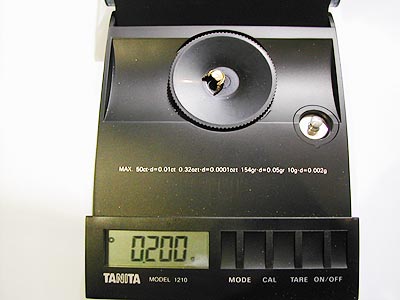


So what is the base metal? Maybe just a lower carat gold? Let's test it !


Small amount of metal dust from gold cap and crown body is taken as sample. Plus an amount of brass as control material - from a brass clock key :-)


To test the metal for its gold content, apply a drop of 'carat' test acid and watch for the chemical reaction. If the metal dust is 'eaten away' then it does not contain gold.


In our case the top 'cap' layer is 18K gold. Unfortunately for gold lovers the rest of the crown is not made out of gold at all.


Conclusion: Since the total weight of base metal and 18K gold cap is 0.672 gram, the amount of pure 18k gold in Rolex Sub crown is approximately 33.6 %.

But is this good or bad news?
Good news indeed!

If the crown was made entirely of solid gold, then the locking tread would be way too soft - which could possibly compromise water resistance of your Submariner.

Update: here is the comment received from a Rolex serviceman:
In the production of the cases, bezels and bracelets (whether full gold or TT, solid or hollow links) it IS SOLID GOLD, no plating, bonding etc.... All gold models tubes are also made of gold. The only time when gold is bonded in any way shape or form is on the clasps of TT watches and in the past in the production of winding crowns... As has been shown already the winding crowns of watches produced before approximately 2 to 3 years ago were "capped" with a thick gold cap. Models produced after this time are fitted with "monobloc" crowns. As the name suggests, these are made of solid single blocks of gold, NOT capped."

In order to confirm above statement, I have examined the latest model crown .

Crown removed from of Y5 serial 16613.


The new crown (monobloc) certainly looks different than the old one. However, in this case monobloc is fancy name for something that is .... hmmm.. how to put it...HOLLOW. Although the crown is made of solid 18K gold, it is really very lightweight.

I would hate to rip this one apart, but it is obvious that the gold mass is still under 1 gram. Hardly a MONOBLOCK to me.