|
Showing posts with label collecting watches. Show all posts
Showing posts with label collecting watches. Show all posts
Monday, May 10, 2021
What is watch collecting, and why should you take it seriously?


Monday, December 23, 2019
The best thing that happened to Sydney!
"You will not believe who just opened a boutique in Martin Place" said Bobby,
"FP Journe?"
"No, guess again"
"Richard Mille"
"No, think bigger and more exciting"
"No way! Seriously?"
As a watch collector, the opening of the A. Lange & Söhne boutique in Sydney is like all my Christmases have come at once. Lange is my second favourite watch brand, and one that is so easy to fall in love with.
Of course, Bobby and myself could not miss the opportunity to poke our noses into the ALS Boutique, first thing Monday morning. With no specific expectations - except for a fireworks display of amazing horological pieces - we were simply blown away with the warm reception from the Boutique manager, Mr Delwyn Dass. "Welcome to the second largest Lange boutique in the world!" - he proudly proclaimed.
Make no mistake: Lange is unstoppable. When it comes to workmanship, quality, finishes, complications and impeccable performance, the German watchmaker has very little competition at the very high end of haute horology. The pulling power of Lange is irresistible. It takes the will power of Ghandi to say no to the fresh, mint, and spotless 1815 Chronograph ref. 414.031 which is still the most affordable of all Lange chronographs ($73,000).
"What would you rather have- Lange or...?" is the game Bobby and I played all day. Almost every time, no matter what brand or model was mentioned, Lange was the preferred choice.
You see, unlike with most other brands, Lange is all about inner beauty; pure, traditional watchmaking; and impeccable craftsmanship. This is not a watch brand that attracts kids, or snobs, or flippers, or Instagram influencers, or those empty souls who constantly seek "external validation". This is a brand which patiently waits for patronage of true watch aficionados.
You buy and wear Lange because you want it and because you appreciate it - and because you could not care less what everyone else wears, wants, collects and buys. Lange owners simply do not care.
Mr Dass is both a knowledgeable and passionate watch dealer who is happy to explain and listen, but for the entire hour that we spent together, there was not the slightest attempt to over sell the brand, a watch, or his fine service. Unlike any Swiss brand watch representative I've encountered in the past, he was genuinely interested to find out more about our 'Australian manufactured' project. We felt a bit embarrassed to talk about NH watches in a Lange Boutique, but it was clear that when it comes to things that matter - inner beauty - our inspiration and aspiration comes from makers like Lange who share those same traditional values, firmly rooted in haute horology.
Lange's current stock range has around 40 models, of which quite a few are available for immediate delivery. Of course, some examples are made in very limited quantity and others have a delivery time of around 9 months. There is nothing boastful or arrogant about Lange's production and supply policy; no artificially created demand, no silly waiting lists, no patronising - simply an honest, straight forward "here is what we can do for you" approach.
As you walk into Lange's Sydney boutique, the very first thing you need to visit is their art installation known as the 'Wall of Components'. The entire wall is covered in 1316 individual watch parts which, assembled together, are the contents of a calibre L133.1 powering The Tourbograph Perpetual 706.025 (in actual fact, L133.1 contains 1319 components, but the last 3 parts are not on the display - for a very specific reason!). The 'Wall of Components' is precisely what Lange's mission is all about; to excite us all and leave us speechless - from a novice to a collector; an apprentice to a watchmaker. The true art of watchmaking comes from the inner beauty.
The Tourbograph Perpetual 706.025 is from the famous Pour le Mérite line. "For Merit" was one of the highest orders in the Kingdom of Prussia, and later, German Empire. It was awarded strictly as a recognition of extraordinary personal achievement, rather than as a general marker of social status or a courtesy-honour. The connection is obvious: when in 1994. ‘newly rebirthed ’ Lange offered it’s first Tourbillon 'Pour Le Mérite' the bar of extraordinary excellence was set. The Tourbograph Perpetual 706.025 released this year is the sixth 'Pour Le Mérite' in 25 years. I'll stop right here though, as I don't want to spoil anymore for you.
I strongly suggest the following: go and visit all Sydney watch boutiques, inspect the stock on offer, talk to the dealers - and then visit the Lange boutique last. Then ask yourself just one question: if you invest in Lange, would you really want any other watch on your wrist?
This brief review of Lange boutique is unsolicited feedback and a tribute, not a paid article. If you happen to deal with Mr Delwyn or Mr Andrea, feel free to mention my name, it would be mutually appreciated.
Wednesday, July 19, 2017
Shaping prestige, tooth by tooth
You can spend your entire working life behind the watchmaker’s bench - and even call yourself a watchmaker - without the need to ever use a metal file. Indeed, most watchmakers don't make watches but repair them by pulling them apart, solving problems, replacing worn out or broken parts and then putting them back together. It’s only once you start making individual components by hand that you realise that your most essential tool is no longer a screwdriver or tweezers but files, drills and polishing stones, which is now clearly obvious to me.
What is less obvious is the following: What type of file is a true watchmaker’s file? One which will allow you to craft a precision component, a file made to last for many years, even when used daily?
If there is one thing intrinsically more Swiss than Milka chocolate it has to be the custom of naming a product by the name of the village it was manufactured in. Then - a few decades later thanks to the product's quality and longevity - that geographical place becomes a synonym for the product itself…or even an entire industry.
Here are a few examples: To most watchmakers, Marvin, Cortebert, Tavannes, Orvin, Peseux and Fleurier are watch brand names but, for everyone else, they are just names of some tiny picturesque Swiss villages. Just like when you say: "I left my Montblanc on the desk", you are obviously referring to your pen, not the Mont Blanc; the highest mountain in Switzerland and Europe.
To me, Vallorbe always means just one thing: a watchmaker’s file. Well, as you've guessed, I was wrong…partially, at least. Vallorbe is not a village but a tiny municipality near the Swiss-French border where, since the late 1890s, the Vallorbe file factory is located. In their vast range of precision files for various industries, watchmakers’ files are branded under the name Glardon.
So which glardon would be best suited for a job?
The answer would depend on a number of factors, all to be carefully taken into consideration. Firstly, which metal you are working on: steel, brass, titanium or some other exotic alloy? Next, the file profile, which should correspond to the shape of the component you are making, with many dozens to choose from. Then comes the grade selection which ranges from very coarse to extra fine (000, 00, 0, 1, 2 ,etc, up to 10). There are different types of files for different stages of part production: from roughing to precision work, polishing to shaping, down to very specific operations like escape-wheel teeth work. Then there are high-speed steel and coated glardons, diamond embedded ones, carbon fibre files; down to special shaped files designed to reach unreachable spots.
Vallorbe claims to manufacture "the hardest files in the world" with a coating of 72 on the Rockwell Hardness Table. Since I am not an expert in hardness I had to look up this value only to find that 72 is the highest value on the list. I guess I shouldn't be surprised... sometimes you do get what you pay for.
While a modest set of Vallorbe watchmaker’s files could easily cost over $500 this investment is worth every cent. Yes, there is something magical about shaping the metal - and if you prefer to do it by hand in style - then do it with glardons.


Friday, May 29, 2009
A tribute to Frankenstein
Here is a rare beauty that you won’t see often: a stunning IWC Portugueser, dating back to the early 1930s. The 48mm steel case seems like it has been manufactured only yesterday – a timeless design!
This impressive watch is fitted with an 8-day power reserve, manual wind movement.


Before you rush to click on my email button to ask the proverbial "how much for cash" question, allow me to disclose one minor detail: this watch is unfortunately fake!
Yes, the watch’s movement is indeed a genuine IWC movement from the 1930s; but it is designed and manufactured for a pocket watch! In addition, the completely fake dial is accompanied with original hands and the stainless steel case has been recently manufactured either in India or China.
Some sophisticated con artist might call this a tribute to IWC watches or a marriage but to me, this is nothing but fraud because it was produced to deceive.
For a watch to be a genuine piece, all of the components need to be created under the same workshop by the same maker at the same time. Unscrupulous "watchmakers" who assemble watches from new, old, inappropriate of after-market parts remind me of Dr. Frankenstein, the man who created a monster.

This impressive watch is fitted with an 8-day power reserve, manual wind movement.
Before you rush to click on my email button to ask the proverbial "how much for cash" question, allow me to disclose one minor detail: this watch is unfortunately fake!
Yes, the watch’s movement is indeed a genuine IWC movement from the 1930s; but it is designed and manufactured for a pocket watch! In addition, the completely fake dial is accompanied with original hands and the stainless steel case has been recently manufactured either in India or China.
Some sophisticated con artist might call this a tribute to IWC watches or a marriage but to me, this is nothing but fraud because it was produced to deceive.
For a watch to be a genuine piece, all of the components need to be created under the same workshop by the same maker at the same time. Unscrupulous "watchmakers" who assemble watches from new, old, inappropriate of after-market parts remind me of Dr. Frankenstein, the man who created a monster.
Monday, May 25, 2009
Australia's Greatest Art Fraud
A criminal investigation is under way into the art dealer's affairs after he vanished with at least $30 million in artworks and money.

According to the Sydney Morning Herald, three customers "bought the piece (the above paint) from (dealer) and are adamant they own it. Yet none is in possession of it and collectively they are missing $120,000".
http://www.smh.com.au/national/australias-greatest-art-fraud-20090523-biv6.html?page=-1
You must read the entire article - it is definitely and eye opener into murky inner workings of Australian art trade.
You might ask yourself, "how can someone scam so many people with just one single painting?". Well, nobody knows for sure, but my first guess would be abuse of trust and accountability as a plausible factor that could induce people in being conned.
Almost every day, I receive phone calls from prospective customers who wish to sell their watches. In essence, this type of transaction is a straight-forward one - upon inspection, I would make an offer to purchase the watch for a certain amount of money. If the offer is accepted, the personal details of the customer as well as the serial number of the watch are recorded and filed, and a cash-cheque, payable at the Bank across the road, is issued.
Nevertheless, clients sometimes ask me if I would agree to take a watch on consignment. The answer is always NO. And I have more than one reason for not wanting to be involved with consignments.
A consignment is an agreement between the seller and the dealer, where the title of the goods (ownership of the watch) remains with the seller, yet the watch is physically in the dealer's possession. The dealer is entitled to sell the watch on behalf of the seller, keep a profit margin from the final sale amount and pay the rest to the seller.
For laypersons, it would seem that consignment is indeed an advantageous agreement for the dealer: the latter does not need to spend a cent in the process and if the watch does not find an owner, he can always return the unsold item to the seller.
Unfortunately, this is not always the case: When entering into a consignment agreement, the dealer takes on full responsibility for the watch in case of loss or theft, accepts to undertake any eventual repair or restoration and provides a guarantee on performance to the buyer. Being 'locked in price' and 'left at the mercy' of the seller, who can at any time opt out of the consignment contract for any reason whatsoever, is like walking on thin ice. And if I didn't have enough money to buy that watch in the first place, then obviously I cannot afford it (and obviously should not be trusted to take care of it!)
But there is still one more fundamental reason why I would never consider consignment:I do not want to be trusted unconditionally. Taking care of other people's goods is nothing but a burden.
So here is my advice to sellers and fellow dealers that could help everyone save time, money and headaches:
limit your level of trust to an absolute minimum - or even better: trust no one! Always exchange your goods for a real and tangible asset - cash.
"I owe you" is as bad as "you owe me".
Tuesday, May 19, 2009
Pendule de Voyage
The reasons why carriage clocks are so popular amongst horologists are many: they are decorative, old and interesting, entirely practical as timekeepers with a reasonable degree of accuracy (some keeping better time than your modern Rolex watches!) With charm and fascination of their own, fine examples are becoming more valuable with every year that passes.
After the last post and recommendation on a watch book referred by me as 'Watch Bible', a number of subscribers asked if there was a similar book about carriage clocks.
Before answering this question, let me just say that it is important to understand that unlike wrist watches which are produced for less than 100 years, domestic clocks have been around for at least 600 years. Although modern carriage clocks became fashionable in the early 1800s, the history of carriage clocks is far from being fully documented. Therefore, a proper reference book on the subject is yet to be written.
However, a keen student of Horology should make every effort to acquire the book by Charles Allix and Peter Bonnert "Carriage Clocks - their history and development". This rare and hard-to-find book was published in 1974.
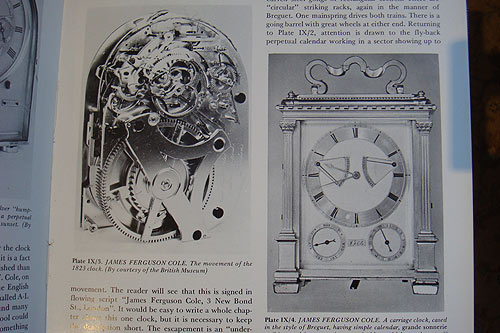
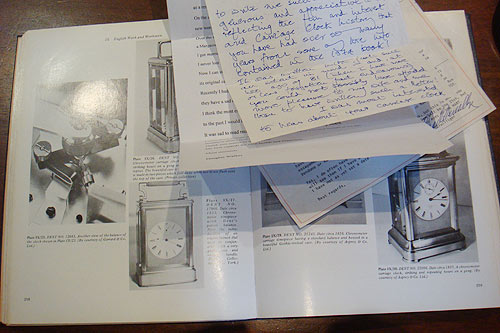
A couple of years ago, I was fortunate enough to receive Allix's book from a fellow horologist, Mr. Doug. Not only is he a keen collector, but also a true gentleman. Doug personalised my copy in a manner that truly reflects his kindness:
"Dear Nick - here, at last, is the carriage clock book. Charles Allix only published one edition. I sincerely trust that you will get as much pleasure and add to your store of knowledge as did I over the 25 years that I collected carriage clocks. Regards, D W."
With the book, I also received letters that Doug exchanged with Allix which provided further insight about the fascinating world of collecting. I take the liberty to quote just one paragraph from Doug's letter below:
"...whilst there (London, 1978) I bought two miniatures (carriage clocks) from Charles Frodhsam On the day I was leaving to return to Sydney I saw your book in a book store and a whole new world opened to me, thanks to you. Over the next 9 years I acquired 22 clocks including quarter strike by Leroy, a Jacot, a Margaine and Drocourt... I can't stress enough the pleasure and education that you have brought to me and countless others over the years..."
As A.G. Randalll wrote, "all who can recognise a labour of love when they see one will find in the Axells book clear evidence of more hard work, devotion to detail and sheer love of the subject than they have come across for a long time."
And that's what horology should be all about!
After the last post and recommendation on a watch book referred by me as 'Watch Bible', a number of subscribers asked if there was a similar book about carriage clocks.
Before answering this question, let me just say that it is important to understand that unlike wrist watches which are produced for less than 100 years, domestic clocks have been around for at least 600 years. Although modern carriage clocks became fashionable in the early 1800s, the history of carriage clocks is far from being fully documented. Therefore, a proper reference book on the subject is yet to be written.
However, a keen student of Horology should make every effort to acquire the book by Charles Allix and Peter Bonnert "Carriage Clocks - their history and development". This rare and hard-to-find book was published in 1974.
A couple of years ago, I was fortunate enough to receive Allix's book from a fellow horologist, Mr. Doug. Not only is he a keen collector, but also a true gentleman. Doug personalised my copy in a manner that truly reflects his kindness:
"Dear Nick - here, at last, is the carriage clock book. Charles Allix only published one edition. I sincerely trust that you will get as much pleasure and add to your store of knowledge as did I over the 25 years that I collected carriage clocks. Regards, D W."
With the book, I also received letters that Doug exchanged with Allix which provided further insight about the fascinating world of collecting. I take the liberty to quote just one paragraph from Doug's letter below:
"...whilst there (London, 1978) I bought two miniatures (carriage clocks) from Charles Frodhsam On the day I was leaving to return to Sydney I saw your book in a book store and a whole new world opened to me, thanks to you. Over the next 9 years I acquired 22 clocks including quarter strike by Leroy, a Jacot, a Margaine and Drocourt... I can't stress enough the pleasure and education that you have brought to me and countless others over the years..."
As A.G. Randalll wrote, "all who can recognise a labour of love when they see one will find in the Axells book clear evidence of more hard work, devotion to detail and sheer love of the subject than they have come across for a long time."
And that's what horology should be all about!
Sunday, May 10, 2009
What to Collect?
"What should I collect?" is question often asked by both novice watch enthusiast and seasoned collector.
With so many attractive watches to be collected settling for a single brand or style is always difficult. To put things in perspective, let me just say that wrist watch collecting is still a relative novelty. For at least 300 years of timepiece collecting, collectors were predominately fascinated by mechanical aspects of timekeeping and their inner beauty and to lesser degree by a maker itself. Since late 1800s to 1970s a "true horologist" would have in his possession mainly pocket watches and fine carriage clocks.
With very little information available to the general public, one would spend countless hours investigating, reading and researching specific topics but for many, the piece in itself was of lesser importance compared to the knowledge. Joining a collectors' club, traveling around the country and establishing relationships with dealers and auctioneers was essential part of collecting.
With the introduction of battery-operated watches, mechanical watches became less and less popular and eventually, many collectors dropped the hobby of collecting them. With no new entrants into the game, prices dropped and those who heavily invested in watch collecting suffered unrecoverable losses. The next 20 years were the dark era of Horology.
A new age of watch collecting begun in mid 1990s, thanks to the Internet. All of a sudden, we stepped into the most exciting period of human history - an era of Free Knowledge. For the first time, many discovered the fascinating world of mechanical watches.
Online communities of collectors and auctioneers like eBay quickly shaped up the market. For the first time since the 1950s, mechanical Swiss watches were not just a technical curiosity but a sign of refinement, status and potential investment. Swiss manufacturers re-entered the mechanical watch market with the introduction of "new-old" models. The feeding frenzy was so massive that some manufacturers not only reproduced old mechanical movements but also entire watch brands. In order to sell, a handful of them even re-wrote history to suit their advertising needs.
Which bring us back to our original question: "what to collect in 2009?" I believe the new renaissance will result in more than one trend in watch collecting. Some will prefer investing in 'blue chip' watches like vintage sports Rolex or military watches. Others might specialise in one brand, like Omega or Patek. Some might go back to the roots of horology: quality vintage pocket watches and fine carriage clocks. And the remaining lot might buy whatever they personally find intriguing and beautiful
Investing time and effort for the purpose of developing knowledge is the most fundamental aspect of watch collecting, regardless of which paths and ways you personally undertake. During your journey, you can expect fellow collectors to criticise your appreciation on your preferred style or brand and you might find yourself on a solitary and isolated path but anyhow, you will develop a better understanding and appreciation for inner-beauty, which is quite normal. After some time, the small, external imperfections will not be the only factors that will grab your attention as you will then definitely pay more (attention and money!) to factors that are not easily spotted or appreciated.
Stay focused - a pile of watches does not make a good collection, regardless of how much you originally paid for them. The rule-of-thumb is not to rush as there is always a "good deal" coming up and those who possess patience and knowledge would be consequently rewarded.
If you are new to collecting, you should stay away from unreasonable eBay bargains and restoration projects. Do not fall into the trap of over-commitment such as borrowing money to invest in watches, unless your ultimate goal is to provide quality stock at discounted price to fellow collectors!
In conclusion, here is an example of what, in my opinion, is a perfect watch to collect - especially if you are on a tight budget.
The New South Wales Government Railways (NSWGR) was the department in charge of the NSW Government's railways from 1855 to 1972. After a major railway incident that occurred in the US, the NSW Government ordered that every train driver and station master to be issued with a precision time-keeper - a pocket watch. Batches of railroad watches were ordered from the American Watch Company - Waltham, Massachusetts as the NSWGR expected only the best railroad watch money can buy for their staff.
Every issued pocket watch in NSW had its individual number engraved on the case back and some examples also had the owner's name. In addition, train drivers were also issued with a gun, bearing the same number as one engraved on their watch. Indeed, those times were turbulent.
Here is a photo of the NSWGR pocket watch from the year 1901.


Since my arrival in Australia in 1994 I have personally worked on not more than 3 or 4 examples of the NSW issued railroad watches for overhaul purposes. As you might imagine, those time pieces are fairly rare nowadays, but those who know what they are looking for can still find good working examples of the NSW issues railroad watches.
But that is not all: If luck is on your side, you might even find one NSW GR watch for under $500! So what more could you ask for? A great watch with a great history, fitted with a superbly manufactured mechanism at a bargain price! And enjoyment and satisfaction of doing research on such a fascinating subject is a priceless experience in itself.
If you are ready to immerse yourself into fascinating world of vintage timepieces then you MUST have good reference guide. Although plenty of information is already available on the Internet, nothing come close to learning from the real watch Bible: Complete Price Guide to Watches by Shugart, Engle and Gilbert.

There is no need to buy the latest 2009. edition: basically any post-1990 edition will do the trick and you can find one online for US$5 - $20.
Happy collecting!
Subscribe to:
Posts (Atom)