Saturday, June 11, 2016

Watchmaker's Apprentice Wanted: Sydney Watches Pty Ltd / rebelde

Watchmaker's Apprentice Wanted

* Hands-on training by third-generation Master Watchmaker
* CAD training
* Prestigious Culwulla Chambers workshop in the middle of Sydney CBD
* Above-industry wages
* In conjunction with Sydney TAFE Diploma - 3 years course
* Guaranteed employment for the right candidate
* Opportunity to be part of an Australian watch brand story
* Endless learning opportunity: work on high grade mechanical watches
* Introduction to top Australian watch collectors
* Further career opportunities: Micro-Engineering, Design, overseas studies.

We are SPECIFICALLY looking for young and enthusiastic apprentices to undertake 3 years of Watchmaking study, aged 16-19 years. There is the possibility of accommodation assistance available for an interstate candidate. However we will consider all other applicants, regardless of age.

Send your CV/Resume to nick@clockmaker.com.au


Monday, June 6, 2016

Up and Running

***The second round of interviews is scheduled for Thursday but I think I've already made up my mind.
Yes, I am talking about the first two rebelde apprentices who are to commence their training on July 1.

I am looking for a very certain profile and I think I've found what I am looking for. The first applicant would be perfect in the customer service area - he thrives on 'knowing things' but also on fixing things. 


 The second guy is probably a bit of an introvert, which is one of the core properties of a successful watchmaker. As a team, the two of them would be just perfect.
But the search is still open. I've been around long enough to know that things are not always as they appear to be. Nevertheless, I am very excited about new people joining the rebelde team.


Which propels us into a hive of activity in order to get us ready.


Yesterday we went to see Joao Joe Santos, our colleague and watch tools supplier.
And by us, I mean all of us! We've made it a Sunday affair, all with lunch at the Sultans Table.


I love dealing with Joe. He is the prodigious prototype of an anti-salesman.

Every tool and piece of equipment I wanted to add to my basket was questioned, assessed, taken out (I would put it back), and re-assessed. "Why do you want this particular tool? Are you sure? Wait, I'll have a better one in a few weeks’ time and it will be also cheaper."
You get the idea: Joe is not really interested in taking your cash. He simply loves what he does and he does not care about making profit. Which makes him a true asset to the Australian watchmaking community.


Who can say 'no' to a super-light ball-bearing fitted set of screwdrivers? Or pass on an unbeatable deal of Dumont tweezers? Do I need yet another hand removal tool @ $100? No, so I'll take two. How about this cool screwdriver sharpener? And my goodness, the punch tool for the Rolex rotor axel replacement is back in stock - so that goes in the basket as well.
"So you will let your apprentices use the finest Swiss tweezers?” asks Joe. Probably not, or at least, not for the first week, but they do need to see what is here, to tell the difference between non-magnetic, steel and some space-technology alloy. After all, watchmaking tools are a major part of the fun of being a watchmaker.


We loaded ourselves nicely and left Joe in the pouring rain, but excited about the new project.
Of course, there is a long list of tools on order, with more arriving in the next few weeks.
An automatic Swiss cleaning machine will be delivered by sea freight – a massive piece of equipment I have always wanted yet found no need to buy because the old manual one is still working just fine. A major capital investment, but hey - we need to get ready for rebelde watch servicing and we want to turn our workshop in a modern, well equipped facility, at least as good as major Swiss brands.


The Bergeon set of bezel removing tools was probably one piece of equipment I can live without. $1,250 for a set which will most likely sit unused for many years. But then again, it only takes that one job where you need a specialist tool - a job which will separate us from the rest of the crowd.

So here we are - ready to get back into action. Yes, the availability of spare parts is a major issue, and we don't expect any improvement any time soon. But with two new apprentices, there are still things we can and we should do. For example, we can easily get back into the battery replacement business.
We can offer very competitive prices and extremely fast turnaround times - something you simply don't get in the City. Young apprentices would need the opportunity to learn this relatively simple task and offer valuable service.

Let's be honest: battery replacement is not rocket science.

Many years ago, I was able to replace batteries in any type of watch – except Breitling Emergency Mission (this one requires a certified procedure) and a few obscure plastic-cased digital timepieces which are not really meant to be pulled apart.


So if you wish to keep my soon-to-arrive apprentices busy, then go through your drawers and find those 'dead' watches. Bring them in, mention this newsletter, and we’ll do you a very special deal: five watches/battery replacements for $50. This deal is for common timepieces like Seiko, or Swiss stuff under $1000 value.

Naturally we will charge more for Omega and TAG and similar pieces, and even more for Cartier and other luxury pieces of course, but still significantly less than the authorised service centres. And here is the beauty of this offer: if your watch needs a new seal or winding crown, or any other repair - we will let you know upfront and will quote accordingly. We will give you a CHOICE and this is what independent watchmaking is all about: a choice of who you deal with and choice of how much you will spend on a repair.


Yes, interstate jobs are welcome and we'll throw in free returns via registered shipping on any repair over $100.

Happy collecting,
Nick 


Friday, June 3, 2016

Watch Talk Night Review

***Watch Talk Night: a brave bunch!


A special 'thank you' to the ten brave watch enthusiasts who made their way to rebelde headquarters last night.
T
o say that we had fun would be an understatement: it was, once again, one of those evenings when we all talked, listened, learned, exchanged ideas and really, had two hours of good time. Actually, it was well past 8:30pm when one of attendees invited me for a beer. After two and half hours of talks, he was ready for some more! My excuse was that I really don't drink - and he said - neither do I :-) I took this offer as a huge compliment and confirmation that there is a great need for us to get together more often. And yes, we will do more of 'WTN' horology this winter season.

The 'core' of the meeting was this crazy idea of the ‘responsible watch owners test'. After we together reviewed my first 6 lessons on basic horology, I asked the attendees to undertake the test. I have to say that I was bit nervous, and I guess some of the students were nervous too. But they put on their brave face and enthusiastically got into it.
Needless to say, they all passed with glowing colours: anyone who is keen to learn more about watches, time, horology and precision is already a winner.


I cannot speak in their name, but it was obvious that we managed to open that big box called watchmaking, to peek inside and get at least a glimpse of what horology is all about. Tanya and I arrived home at 10pm completely worn out but extremely pleased that we can host nights like this and enjoy the company of like-minded people.

Oh yes - I was really humbled when Aaron presented me with a Russian watch. Thank you mate - I really didn't expect this (nor saw it coming). I've spent a good 10 years repairing Russian watches and to this day I don't really know whether I like them or hate them :-). However Russian watches have their well-deserved place in the world of international horology and we should really talk more about them!


Happy collecting,
Nick

Monday, May 30, 2016

Lesson 6: Waterproof Watches Myth-Busting

***Waterproof Watches Myth-Busting


A few years ago I said that there is no such a thing as a waterproof watch. 

Little did I know that this statement would upset so many watch enthusiasts! The avalanche of replies could be summarized in one sentence: my Rolex/Omega is waterproof, and has been so for decades - so Nick, you don't know what you’re talking about.


But let me explain what I meant.

The whole idea of making a waterproof watch is really a novelty. For 500 years, watch and clock makers - and their customers - never really thought about 'waterproofing' timepieces. There was no need for waterproofing, and even if there was - one crucial element was missing: the high-tech materials capable of 'sealing' two surfaces. Nowadays, synthetic rubber o-rings are commonly used in many water-resistance applications, but the rise of o-rings was really a post-WW2 affair.

Another modern watch sealing material is Teflon - which really kicked into mass use in the 1970s. Teflon is commonly used as sealant between glass (crystal) and metal, and rubber as sealant between two highly-polished steel surfaces.

True water-resistant watches hit the market in the 1960s. The market leader was Rolex and Omega - and both companies are still regarded as makers of true divers’ watches. Of course, the competition has increased in the last two decades.

There are two myths associated with water resistance. The first one is the 'depth' in meters printed on the watch dial. In reality, that information is often the result of ambitious marketing rather than factual engineering. The second myth can be formulated like this: "Once waterproof, always waterproof". The truth is that for a watch to remain water-resistant, frequent maintenance is required: a new set of seals must be fitted at least every 3 years. In addition, a new winding crown (which contains o-rings inside) should be replaced as well. Only then will your watch be suitable for serious water-related activity.

No maintenance = no water resistance.

Vintage watches (watches older than 30-40 years) should NEVER be worn in the water. Avoiding shower and sauna is sign of sophistication and good-care practice.

Complete the blanks:


A responsible watch owner does not wear their watch in the ______________.

Seal replacement and water resistant test should be carried at least once every _____ years.


____________ watches should never been worn in water.

Happy collecting,
Nick

Friday, May 27, 2016

Lesson 5: The Missing Link

***The Missing Link

The loss of lives and goods was disastrous – yet tragically this man-made disaster was completely avoidable. On April 19 1891, a fast mail train known as the No4 and a passenger train were sharing the same track. The engineer and conductor of the passenger train were given written orders to let the fast train pass at Kipton, a small station near Cleveland, Ohio.

As the train was leaving the station, the telegraph operator ran to the platform and verbally cautioned the engineer and conductor: "Be careful, the fast No 4 is running on time!"
The conductor replied: "Go to hell, I know my business".


What he didn't know was that engineers watch – the official timekeeper – had stopped the previous night for 4 minutes, then started ticking again. Shortly afterwards the two trains meet their destiny; the passenger train somehow managed to stop, but the fast mail train didn't even make an attempt to brake.

Following this disaster, the US Rail authorities found that many conductors on freight trains used cheap alarm clocks as master timekeepers. While the railroad service was expanding at a fast pace, the accuracy of railroad timepieces was completely inadequate.

From the ashes of the Ohio train disaster the phoenix rose in the form of the greatest American timekeeper: the great American railroad pocket watch; a watch unrivalled in quality and reliability. 

By 1893 the General Railroad Standard for pocket watches were adopted:
"Be open face, size 16 or 18, have a minimum of 17 jewellers, adjusted to at least 5 positions, keep time accurately to within a gain or loss of only 30 seconds a week, adjusted to temperature of 34 to 100 Fahrenheit, have a double roller, steel escape wheel, lever set, micrometric regulator, winding stem at 12 o'clock, grade on back plate, use plain Arabic numbers printed bold and black on a white dial, and have a bold black hands".


The railman was required to buy a pocket watch more accurate than many scientific precision instruments used in laboratories, and the American pocket watch industry was compelled to produce such instrument. And to its credit, amazingly, it did.

For the next 50 years American railroad watches were amongst the finest, most accurate timepieces one could acquire. Produced to the highest standard, finely manufactured, perfectly adjusted, outshining and outperforming any Swiss mass-produced competitors.

Even today, a hundred years later, most Swiss wrist watches are just a pale shade of the American railroad pocket watches.

For many years, fine pocket watches were the mainstream of horological collections.

In comparison to pocket watches, most wrist watches produced between 1930s and 1960s were pathetically inferior, and as such, completely rejected by serious watch collectors.

Sadly, this trend has been reversed and the reviewal of pocket watches is highly unlikely. Modern Swiss manufacturing primarily focuses on mass-produced, average-quality, over-hyped and overpriced timepieces.

However even a novice watch enthusiast should at least have one pocket watch in his collection.
The pocket watch - the 'missing link' between the marine chronometer and your wrist watch - is out there, waiting to be 'discovered'.

In the early 1960s a Swiss watch movement manufacturer called Unitas developed a pocket watch mechanism which was regarded as robust and reliable, yet affordable enough to be fitted into pocket watches sold to the mass market.

Unfortunately, like a few similar pocket watch movements, this mechanism arrived on the horological scene too late. By the 1960s pocket watches were already out of fashion and further development on a mass scale made no financial sense. The movement was largely dormant, but thanks to its size, it was widely used as a learning tool for novice watchmakers. When large wrists watches became fashionable in the late 1990s, this very mechanism was 'discovered and resurrected' by Panerai and a couple of other small boutique brands who successfully reintroduced it to watch enthusiasts.

And this is the very same Unitas movement that ticks in your rebelde.

Complete the blanks:

Railroad _______________ are high quality precision timepieces, built to last for many generations.


Happy collecting,
Nick

Lesson 4: The Fundamentals of Horology

***The Fundamentals of Horology

We have reached a point where I simply have to beg you for bit of patience!

Please bear with me and allow me to present my case.


Lesson 4 is not only the most important piece of 'knowledge' I can share with you but it deals with the very foundation of horology. Everything you will learn about watches and timekeeping from now on hinges around it and if you don't understand it properly you will never be able to create 'the big picture' - you will wander around, jumping from watch to watch, from forum to forum, gathering bits of knowledge here and there, yet unable to complete the puzzle.

However, if you understand the very core, everything else will fall in place, effortlessly.
I will keep it as brief as possible.

Suppose I am a Christian and I was asked by someone who never heard about Christianity to explain in one sentence the 3 pivotal, most important, fundamental parts of my beliefs.

I would offer this as an answer: An everlasting and omnipotent God created the world, sent his son to redeem humans and he will return to take us all to heaven. (If you are Christian you would probably agree with this, and your answer would be very similar to mine).


Now, if you ask me to define what horology is all about, and to present my case in one sentence, then my answer is this:


From the earliest days of history, humans have been desperately trying to master time: to measure it and record it as precisely and as accurately they can, undertaking one of the most exciting scientific and engineering challenges on which they have spent enormous amount of time and effort to achieve it.
 

There are 3 crucial moments in the history of horology.

1. Improvement of timekeeping of clocks by the application of a pendulum.


It was the Dutch scientist, Christiaan Huygens who, in 1656, first attached the pendulum to a clock mechanism.

By this ingenious marriage (clock + pendulum) the timekeeping of clocks was improved from 4-5 minutes per day to 1 second per month. This was an amazing, history-changing event and until the 1930s precision clocks were the most accurate timekeepers known to humans.

Note that clocks had already been around for hundreds of years, and the pendulum had been around for thousands of years, but it was Huygens who put the two together and enabled humans to master time at an unprecedented level.


2. The second most important horological event was watchmakers ability to create a portable clock which would be as accurate as Huygens stationary clock.

In order to achieve that, a new heart (mechanical oscillator) had to be invented and then improved. A number of watchmakers achieved this almost simultaneously in the late 1700s / early 1800s with the creation of the ship chronometer. This portable marine clock allowed humans to navigate the sea, to reach every corner of the world (and return home safely with spoils!).

The ship chronometer was really the global positioning system (GPS) of the time, a truly revolutionary milestone in the history of horology. Your mechanical wrist watch is an indirect descendant of this marine chronometer.

3. The third crucial achievement happened in 1949 when humans created the heart of the atomic clock.

The atomic clock took timekeeping and precision measurement to an exponentially new level. With our ability to measure time at this unprecedented level, we reached the moon and started solving mysteries of the Universe. The atomic clock opened a new era of human development and, in a way, we've become masters of our own time.


So there you go my watch enthusiasts. From now on, everything you learn about horology will relate to these 3 pivotal events. The more you understand the importance of these events, and the technical development and engineering challenges around them, the less you will focus on a particular brand of a watch, the colour of the dial, or a sales-pitch by an over-enthusiastic "authorized dealer". Actually, most watch dealers, shop keepers, watch forum guys and your fellow collectors are not even aware of the very foundation of horology or can name a single crucial event outlined above.  But you now are, and you can name all 3 of them.

Every wrist watch you look at or consider buying would either fit in this big picture - or not.


TO DO: visit the exhibition on ships chronometers at the Australian National Maritime Museum.

www.anmm.gov.au/whats-on/exhibitions/on-now/ships-clocks-stars

This is about the fundamental point 2 on my list so is absolutely a MUST.

Once again, I am dead serious: if you want to put your name down for my rebelde watch but you cannot name the 3 most important historical horological events then you are just kidding yourself.

Fill in the blanks:

The first horological pivotal event was reached when Dutch scientist Huygens improved timekeeping of clocks by attaching the __________.

The second major event was the invention of the ________________ which enabled navigation at sea.

The final leap in human ability to measure time precisely was the invention of the ___________ clock.


Happy collecting,

Nick

Wednesday, May 25, 2016

Lesson 3: Timekeeping is (almost) irrelevant

***Timekeeping is (almost) irrelevant
 

I am not a sailor. Actually I have been known to get seasick riding on the E69 bus over the Spit Bridge.

But many of you are familiar with sailing and will appreciate the analogy.


Suppose I hire you (and your small sailing boat) to take me from Sydney to Hobart.
My only request is that we arrive there in exactly 3 days, 14 hours and 51 minutes.


"Ridiculous" - you say. "That is absolutely impossible! We may get there bit sooner or bit later, but certainly not at any predetermined time!"


And of course my request is ridiculous. The mighty forces of the wind and waves will make the journey over 1,170 km at a constant speed impossible.


The same is true for the ability of a mechanical watch (precisely: its heart) to tick at a steady beat when you constantly move your arm around. And not only you move your arm, but also when you hammer, play golf, ride a bike, play sports, shake hands, gesticulate and run - just to mention a few of your daily activities you don't even think about.


This constant movement of your arm create a mighty havoc [tsunami!!] of random forces which, in a fraction of a second, accelerate or slows down that little mechanical heart throwing it around like a tiny dingy on rolling seas.


As any sailor can testify: staying on a course to Hobart is a huge challenge in itself, let alone arriving there at a certain predetermined time.


Yet somehow, you expect your mechanical watch to overcome random man-created forces at a predictable rate – not mentioning gravity, variation in temperature, state of lubricant and internal forces which power the movement.


Despite all of that, mechanical wrist watches do actually keep remarkably accurate time. Out of 86,400 seconds per day most watches miss only a handful, resulting in accuracy of 99.99946 percent!


Watch enthusiasts who demand 'perfect timekeeping' are missing the point:
the journey to Hobart is all about arriving to the destination, conquering the mighty forces.
Getting there at any particular point of time is as irrelevant as it is impossible.


Time keeping is not about achieving perfection. Rather, it is a continuous horological attempt to reduce imperfection.

A $50 Seiko can be as accurate as a $50,000 Patek and a $10,000 Rolex can be as inaccurate as a $10 Raketa. Money cannot buy happiness, and as you now know, it cannot buy accuracy either.

Questions: there are _________ seconds in a day.

Considering the obstacles they have to overcome, mechanical watches are remarkably ________ timekeepers.


Happy collecting,

Nick


Lesson 2: It's YOUR responsibility!

***It's YOUR responsibility!

We live in a day and age when shifting the responsibility to someone else is an art form.
However, when it comes to your watch, the responsibility for the performance and longevity cannot be delegated to a third party: the watch is yours and you are fully responsible for it.


The better you look after it, the longer it will last and the better it will perform.


Your mechanical marvel of engineering is built to last for decades and it will easily outlast me and you, and most likely a couple more generation of owners.
That is: if you take proper care of it.


For hundreds of years watchmakers have worked hard to design and construct timepieces which will withstand a significant amount of force, water pressure and variation in temperature.
Today, we've reached a stage where wrist watches are extremely robust and durable.


Yet they are not unbreakable. That little ever-ticking, ever-lasting mechanical heart needs as much love and care as it can get. If you abuse, drop or knock your fine timepiece, you will bear the consequences: your watch will lose its ability to keep time accurately.


In most cases the damage is irreversible. The repair process usually means replacement of vital parts which is both expensive and time consuming.


Fine mechanical watches are not guaranteed for damage caused by abusive use, lack of care, negligence or accidents. External components like the winding crown, bezel, crystal, pushers and bracelet are not covered by any guarantee. You break it, you pay for it. Watchmakers design, assemble, adjust and perfect: you wear it and you look after it.


Instead of asking "How far can I push it without causing serious damage?" you should really ask "What can I do to ensure that my watch will last for a hundred years?"


A responsible, sophisticated watch owner is proud of his precision instrument and does his absolute best to protect it from damage. 


Fill in the blanks:

A mechanical wrist is a __________ instrument.


Accidental damage and external components including the _____________________________________________________________________________________________________________ are not covered by the manufacturer's warranty.


Happy collecting,
Nick


Tuesday, May 24, 2016

Sink or Surf : Lesson 1.

***Sink or Surf

The list of stuff I am completely clueless about is endless. For example, I have no idea what the difference is between AFL and NRL. I cannot tell a $500 bottle of wine from a $5 one, or even name 2 beer brands, because I don't drink. And here is another area I know nothing about: recreational drugs. I would struggle to tell a Panadol pill from ecstasy - actually I have never seen a real drug pill in my life. And embarrassingly the list goes on: from golf to surfing, from literature to classical music.

Make no mistake: I guess I can easily afford a bottle of wine, a rugby jersey or a set of titanium golf clubs and a cool surf board but the mere possession of these objects would not make me any more enlightened - until I actually make some effort to study the matter, I will remain a clueless fool. Sadly, many of watch enthusiasts - even those with large watch collections and those who can easily afford $15,000 pieces - are completely ignorant of horological matters. And even more sadly, many of them make no effort to familiarize themselves with even elementary facts. Such bizarre attitude is a twofold disaster: they do no service to themselves, nor to me.

My message is simple: learn and respect, or go away.

In today’s day and age when information is both cheap and readily available, there is no excuse to remain ignorant. To buy a $5,000 watch and doing ZERO research is simply irresponsible. To strap on your wrist a fine timepiece without having the slightest clue of what it does, how to use it, or how to properly care for it, is a sign of the utmost arrogance and stupidity. And quite frankly, I have had enough of dealing with idiots. I would rather go broke than to sell a watch to someone who talks over me, does not listen or does not care. Instead I will double my efforts to educate and provide my services to those who care and who are willing to enhance their appreciation of watches.

And if you were in my position, you would do exactly the same.

Here is the plan:
For the next few weeks I intend to produce a few short 'lessons' on elementary horology. If you are new to watches then you will appreciate them and learn a lot. If you are an advanced collector, you will still find them interesting. At the end of the lesson, there will be couple of questions so you can quiz yourself and self-assess your progress.

Lesson 1: Your mechanical wrist watch is a marvel of micro engineering

The wrist watch you wear today is nothing but a mechanical miracle.
It is the result of over 500 years of painstaking development. Countless numbers of very clever watchmakers and scientists spent their lives designing the inner mechanism; to shrink it so it could fit on your wrist and to perfect it so it can keep accurate time. There is no other mechanical device out there which is as accurate as a wrist watch, that can operate constantly for decades with no maintenance, and that can be used deep under the water or on the Moon.

The finely designed and precisely executed heart of the watch is called the escapement. This mechanical oscillator ticks five times faster than your heart, it is adjusted to compensate for change in temperature, to overcome forces of gravity, to withstand shock. Missing just one tick every 30,000 ticks would create an error greater than 4 seconds per day. No other mechanical device designed in human history can perform at such level of accuracy for so many years, 24/7. And here is one more detail: a comparison between your wrist watch and your mobile phone or your computer would not be a fair proposal. Why? Because your mobile phone is not really a watch.

Your mobile phone is merely a display, a device which displays time generated by an atomic clock, far away. On the contrary, your mechanical wrist watch actually generates its own time. This is in itself is an amazing achievement, and for that reason alone, a sophisticated watch owner would appreciate it more than any other gadget. In other words, we wear mechanical watches because they are highly sophisticated mechanical devices, which, consequently, make us bit sophisticated as well.

Take a good look at your watch. Admire it. Enjoy it. And above all - respect it.

Fill in the blanks:

A mechanical wrist watch is product of ________ years of watchmaking development.
The heart of mechanical watch is called the _________________ .

So this is it: your first lesson on horology. Stay tuned for more and if you intend to add yourself to the list of proud rebelde owners, write your answers down and memorize them.

From now on, anyone wishing to order a rebelde watch and to call himself a proud owner of a rebelde watch must be able to correctly answer these and a few more questions.

A rebelde watch is simply too precious to be handed to an ignorant owner. I also invite existing rebelde owners to voluntary undertake the 'rebelde owners test' in a few weeks time. You will pass it, you will love it and you will be proud of yourself.

Happy collecting,
Nick

Friday, January 15, 2016

Tintin Speedmaster Moonwatch

***A Tintin Speedmaster? Maybe.

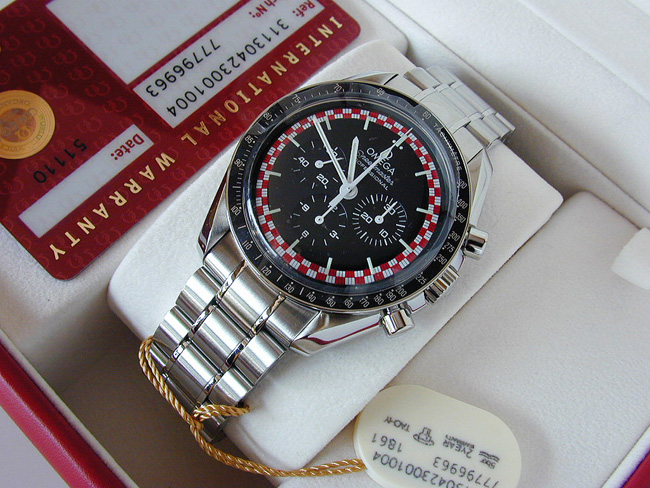
A few years ago Omega released a special edition “racing” Speedmaster. It was initially met with hesitant approval by much of the Omega community, and it certainly did not rocket off the shelves. Recently Omega’s Head of Product Development, Jean Claude Monachon released a statement saying that the red and white striped minute track of the “racing” Speedmaster was appropriated from the colours of Tintin’s rocket. That left a few people quite confused, but the story behind the striped minute track developed as more information was released.

‘Destination Moon’ and ‘Explorers on the Moon’ were two Tintin comics that were issued in 1950 and 1954 respectively. They featured Tintin, Haddock and Professor Calculus travelling to the moon, and ultimately saving the world. The most notable feature of each of these comics was the rocket- it was the daydream of every teenage boy during the 50s. Its red and white colour palate was striking, yet the soft curves were sleek and slender. The rocket embodied the mad rush during the cold war/space-race era. Keep in mind that this was nearly 20 years before the moon landings and 8 years before a manned space mission.

Omega approached the publisher of Tintin with a prototype of their Speedmaster, as an homage to those Tintin comics. This prototype featured Tintin’s rocket as the salient feature on the dial, as well as the red and white minute track. Unfortunately, the publishers did not agree with Omega’s design and collaborative effort, so the prototype was dismissed. In its wake, a “racing” Omega evolved, no rocket, but the red and white stripes remained. This piece is a great addition for any collector. The story behind the watch adds enormous value; it is physical proof that Omega cannot stamp every ‘moon’ related event as its own. Adding to its value for a collector is the fact that that the case back inscription is red, the only Speedmaster Moon watch to have this detail. Snatch this one up while you can! Price on inquiry.

Friday, August 21, 2015

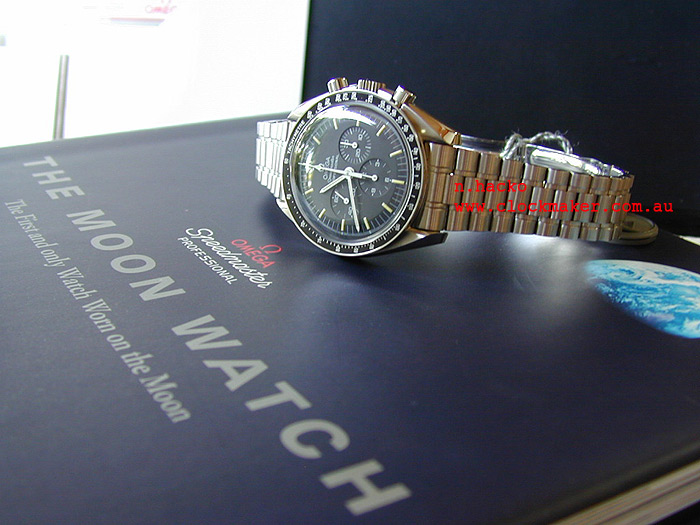
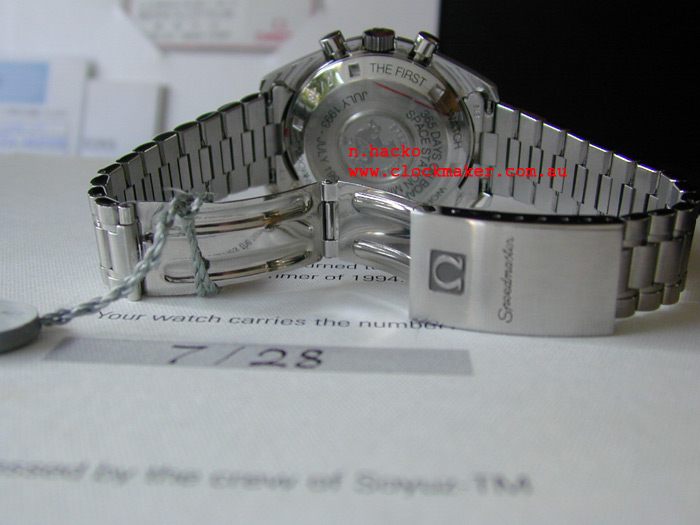
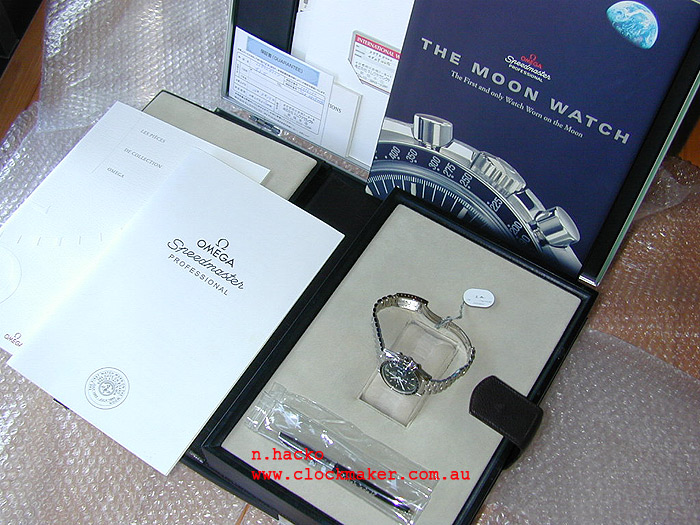
Omega Speedmaster Moon watch - MIR 3596.50 The most exciting discovery of the year!

Yes I know we still have the better part of five months left in 2015, but there is no doubt in my mind that this watch will be our most important find for the year. I am very excited to be able to share a sneak preview of it with you just before departing for Switzerland.
The ability to source this watch was a direct result of a 12 year relationship with an overseas supplier, and months of negotiation between three parties. It took a lot of work, but today this watch is officially part of the collection of Clockmaker.com.au.
This Omega Speedmaster Moonwatch Ref 3596.50 is one of 28 pieces that spent the year 1993/1994 aboard the Mir Space Station. The Omega MIR story is fascinating in its own right, a batch of 28 Speedmaster Moonwatches were sent to the station for a year as part of a research project into the impact of magnetic fields upon mechanical watches. Some were gold cases others were stainless steel. In 1995 some of those watches were offered to private collectors,  and it goes without saying that any such piece was the crown jewel in any collection. To my knowledge this is the first time in 20 years that one of those watches has reappeared on the collectors market. This particular piece is number 7 of 28, it is in unworn condition and comes in a complete set.


Tuesday, July 21, 2015

The only thing that matters: 50 years

If I had to sum up what I do then this would be it:
I am building a watch designed to be worn daily for the next 50 years.

Nothing more, nothing less. This is my mission statement. This is the only thing I should have on my mind, from dawn to dusk.

And this is precisely what rebelde is all about: robust, reliable, repairable.

If I fail on any of those 3 accounts than I've failed miserably.

Everything else is well- how should I put it- unimportant. The watch size, strap colour, dial design, the shape of the hands. Price, delivery time, quantity and number of pieces assembled, the material: steel, titanium, gold. Even what name is written on the dial. Completely and utterly unimportant.

Why am I telling you this? Because it is easy to get distracted. It is easy to shift the focus from what really matters to things that don't matter at all.

Every now and then I need to remind myself of why I have taken up the rebelde project. Today is one of those days, when I am expecting a blogger who wishes to write about rebelde. I will be tempted to venture into those areas of unimportance, trying to self indulge - or even worse- trying to impress people who have never heard of rebelde and most likely will never wear one.

Focus. Focus!

I am designing and assembling a watch which will last for 50 years.
Fifty years from now, we will have the luxury of looking back, and with plenty of time to assess the watch and judge it on it's own merits: we will see how robust, reliable and repairable it really was.

Friday, July 17, 2015

Dumb vs. Smart

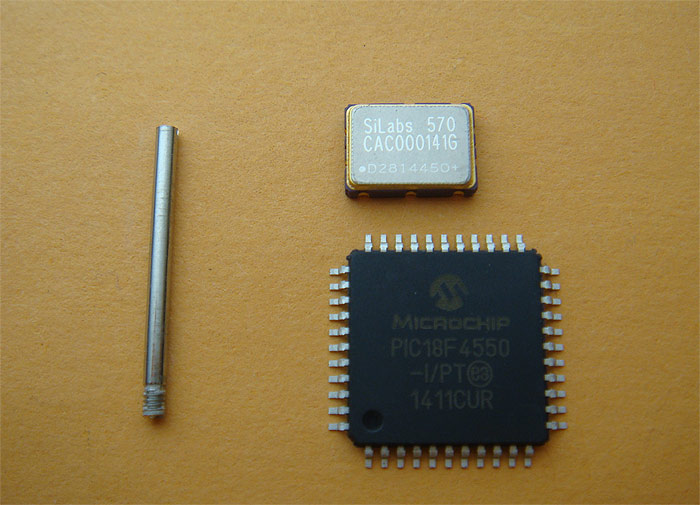
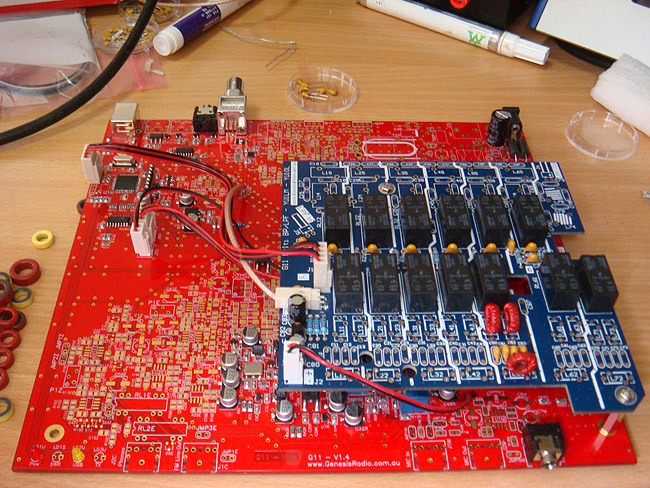
On the left side of this picture is a Rolex link screw. A piece of stainless steel wire with a slot on one end and a thread on the other.

On the right are two electronic components.

The top one is a Silicon Labs Si570 "any frequency oscillator".

Basically a clock. Or to be precise, a super clever, super smart and super accurate clock featuring proprietary DSPLL technology. A fully programmable oscillator with tuning frequency resolution better than 80 parts per trillion.

The component below is a Michrochip microcontroller PIC18F4550. Like the Silabs component it is state of the art, a nanoWatt interface with programmable memory.

The two electronic components on the right paired together can do a miracle: their usage and application are only limited by your imagination and programming capabilities. You can build equipment which will allow you to communicate, measure, time, process and do unimaginable things; allow you to unleash your genius and creativity.

The two components on the right cost $4.50 each and they are available by the truck load from manufacturers, wholesalers and even hobbyists who sell them online. SiliconLabs and Microchip invested countless hours designing them yet they really don't care who can use them and for what application. They have no desire to restrict their supply.

Why would they? They want you to buy those components, learn, build, engineer, have fun and develop gadgets which you can play with or sell for profit.

Rolex didn't invented the screw. Rolex didn't invent the screw making tools.

Rolex didn't make one single improvement in functionality or design of the screw. Actually, the Rolex screw is the same as any other screw out there, like any other link screw manufactured by any other screw manufacturer in the past 50 years. It takes no brain to screw that screw into a link. I can train you to screw it in 5 seconds. Actually, you already know how to screw it.

Yet somehow, Rolex refuses to supply that STUPID screw to you. You can not buy a Rolex screw. It does not have a price because it is simply not available for sale. Sure, Rolex will install that screw for you (and charge you $40) but they will not supply it to me or to any other Australian watchmaker. Why? Because apparently I am not qualified to screw a screw.

According to Rolex I am dumb and untrainable.

When I approached Silicon Labs and Microchip to place an order for the two above components, neither company asked what I intend to do with them. I was not required to provide proof that I am smart enough to install them as per their specification or to prove that I possess programming knowledge.

Neither corporation restricted access to parts or access to instruction manuals, charts, operational parameters, evaluation boards. All the technical information are available online and the only restricting factor is my ability and capacity to learn. I am free to buy their components and engineer equipment, sell that equipment and make profit. They simply don't care.

This morning I've asked my assistant to make a call to Rolex to see if we can buy a link screw for a Submariner. A dumb piece of steel wire with a slot and thread. The answer? We can not give you a price, we can not sell you the screw, you have to bring the watch in. He insisted to be provided with the estimate on how much would screw cost, and Rolex refused to answer. "Bring the watch in, bring the watch in" was the only answer.

But what if I am located in a country town somewhere in the middle of Australia? What if I can not physically bring my watch in, even if I want to? Do I really need to ship my $8000 watch to Rolex just to have one screw installed?

I am a watchmaker. I can even design some of my own watch components and have them manufactured per my specification. I have proven to you, and to anyone else who cares to listen that I am good at what I do. I am not stupid nor unqualified. I can build complex electronic equipment despite a lack of formal engineering education. I AM NOT STUPID.

So why does ROLEX refuse to supply watch parts to watchmakers? According to Rolex, Australian watchmakers can not perform.

The general manager for Rolex said that Rolex wants to "control the quality of repairs". But who gives Rolex the right to CONTROL anything if that control breaches our right to practice our trade? There is a huge difference between controlling the quality of workmanship and imposing a total ban on the supply of parts.

Mr General Manager: have you actually assessed my skills or for that matter the skills of ANY AUSTRALIAN watchmaker? And would you at least disclose to us what your standards are?

Do we at least have the right to know what make us unqualified to work on Rolex watches?

When in 2012 Rolex Australia closed the last two parts accounts, they simply informed those two last watchmakers that their account will be closed. There was no explanation why Rolex made that decision. The decision was not based on any performance review. Those two watchmakers didn't fail any accreditation test or any skill/performance test. They were just discarded after 50 years of loyal service to the brand.

The door was slammed in their face. The door has been slammed into the face of all other watchmakers who aspired to learn, be trained and repair Rolex. This issue is driving me nuts. I am unable to focus on my business because I feel insulted. This injustice is irritating and I can't stop thinking about it. I can not accept that Rolex can get away with it.

But what makes the things even worse is the fact that almost every other Swiss watch manufacturer is now following the trend. Even the crappiest brand out there feels powerful enough to follow Rolex's practice.

Three years ago, we predicted that if the trend continues, Australian watchmakers will be out of business. Not because we are lazy, unqualified or stupid. I know that some of you have watched this video but I invite you to watch it again: then ask yourself does the watchmaker in this video look unqualified, lazy and stupid to you?

Today, it is easy to predict that 3 years from now, you, the watch owner, will have absolutely no say or no rights whatsoever in making the decision over who can repair your watch. Like in the case of Rolex, there will be only one point of call, only one service centre to take your watch for repair. The monopolistic grip will be unbearable and you will ask yourself: what the hell just happen?

Today, we are just weeks away from another major development: Swatch group (the owner of Omega, Longines and number of other brands and the owner of ETA movements) will completely stop supply of parts to watch wholesalers and parts distributors.

Hundreds of small watchmakers who make their living repairing low and mid-range Swiss brands and who source parts through those wholesalers are facing uncertainty. Any watch fitted with ETA movement will be affected in some way- whether it is an IWC, Breitling, TAG or Tissot. Modern or vintage - the ban will be universal and complete. You local watchmaker will have no say, and most likely as of January 1 2016 he won't be able to help you anymore. Swatch Group is mysteriously quiet on the issue but I doubt that their solicitors are drafting a Set Of Standards for accreditation of independent watchmakers. Like in the case of Rolex, they will just assume that we are all stupid and unqualified and incapable of repairing the watches we have been repairing for the past 50 years.

Right now, ACCC believe that Swatch Group will do the right thing in spite of all the evidence and precedents set by other Swiss brands. Make no mistake - right now, this issue is not just an issue of independent watchmakers vs. big brands.

We are out, discarded and written off. It is not an issue between you and the brand because as an individual watch owner you have no say or power over the Swiss brands.

This is the issue between YOU and YOUR GOVERNMENT because only the ACCC has the power to prevent further deterioration and degradation of your consumers rights.

And remember: you are not asking for MORE rights, you are just asking that your existing rights are not taken away from you completely. Many of you have suggested that I should reinvigorate the Save-the-time campaign, to start an online petition or lead some sort of action. As I said before, I am out. I am not interested and I don't want to stick my neck out.

If you want a change, then YOU, a consumer and watch owner, must take action. If you feel that you have something to say on a matter then say it. The ACCC is set up to listen to you. Let the ACCC know how YOU feel. Regardless what you say, make sure that you introduce yourself properly:

"Dear ACCC my name is [.]and I am an owner of [1,2,3,5,30] Swiss watches with the total estimated value of [$]."

The rest is up to you.

Be polite and factual and don't send multiple emails. One email CCed to all should be sufficient. Do use your influence and expertise to word the letter professionally.

The ACCC directory is here:
http://www.directory.gov.au/directory?ea0_lfz99_120.&&56183875-7b64-445e-aa3e-386b5469c45c

For those who care, here is the photo of my project incorporating both Silabs and Microchip components. The two boards contain around 900 additional parts and the total cost of the lot is under $200 or the equivalent of two stainless steel bracelet links. All those components are soldered by hand, and they do exactly what they are designed for. And I am doing this for fun. When I play with electronics, I feel smart, but when I am restricted to obtain a screw, I feel dumb.

So Rolex and all other Swiss corporations: do you seriously believe that we, Australian watchmakers could not pass your 'quality control' test if we were only given the opportunity?

Bring it on- we are ready!

Nick

Wednesday, July 15, 2015

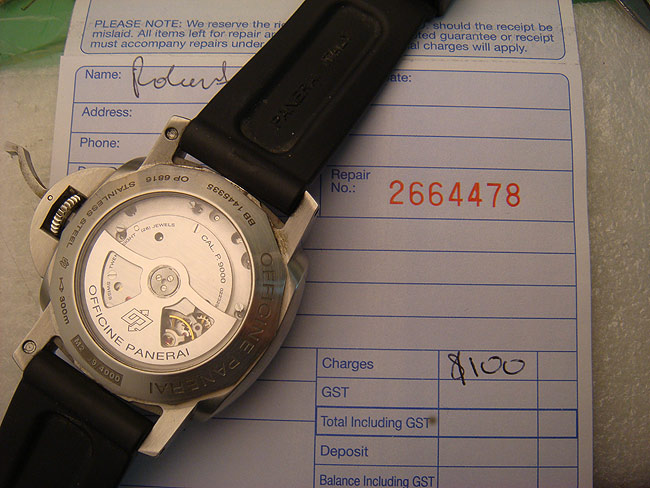
The last repair: job No. 2664478

If I were to print all the replies I received to yesterday's post then today's newsletter would be 70 pages long. The bottom line is, we are all on the same page on the issue of spare parts.

Let me just share with you a couple more details which will illustrate the points I wish to make. Please be patient with me because this post is not as much about my business as it is about yours.

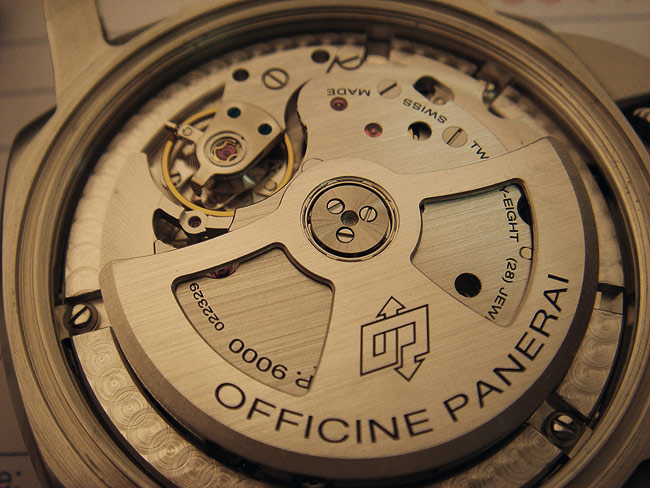
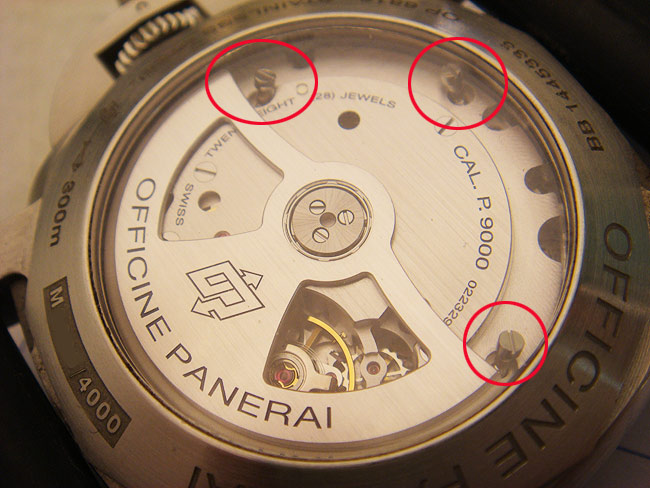
My last job yesterday was a repair to a Panerai which belongs to Rob. Rob is about my age, a polite gentleman and my customer. The watch is worth around $7000. The problem: all 3 screws which hold the automatic winding unit came loose which prevented the watch from being wound.

Since this particular watch comes with a see through case back and since Rob is an intelligent and curious person, he was actually able to diagnose the problem himself. While he wasn't really sure what steps are required to rectify the problem, I am very much convinced that he was expecting the repair to be a simple one, and that it shouldn't take long to fix it. Which was exactly the case: I quickly explained what I would do, and if the were no surprises, Rob could have his Panerai ready for collection by tomorrow. I also quoted him $100.

Of course I could easily charge him twice that amount, and I am sure he would be equally happy, but that would be both disrespectful and unnecessary because I can fix his watch in less than 15 minutes.

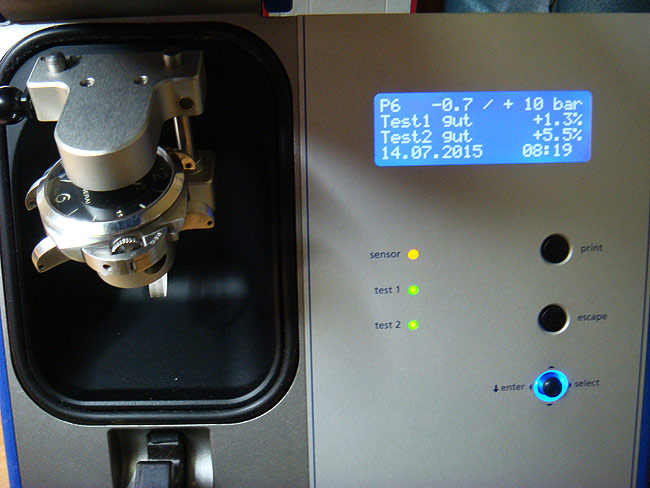
So as predicted the repair was straight forward: after removing the strap and unscrewing the case back with the help of a special tool, all 3 screws were tightened and the rotor was working fine. I also refreshed the case seal, checked the watch for timekeeping and gave it a water pressure test.

Now allow me to pause here for a moment by asking you who is the winner in this case?

Obviously, Rob is over the moon: he got his watch back quickly and cheaply. He is also happy because he knows that if anything ever goes wrong with his Panerai, I am the one who can help him. He feels respected and appreciated.

The other clear winner is the tax office. Out of $100, the tax office is getting an easy $10 in GST. Also, my company profit is taxed at a rate of 30%, PLUS there will be more money going their way once my wages are taxed as well. I guess this is a total of $40 give or take. Not really a bad deal taking into consideration that the Government invested precisely $0 in my education or business.

The third winner is me. Even after paying taxes, I still made a handsome profit for something that was a relatively easy job. Also, I now have Rob as a repeat customer who will spend more money with me in yeas to come, so the value of my business has gone up.

The fourth winner is probably least obvious: it is the Panerai Corporation.

Not only have I restored Rob's watch but I have restored his TRUST in Panerai products. After all, he is a happy PANERAI OWNER and most likely he will buy another watch from Panerai or recommend it to his friends.

Now, Panerai gets this benefit without investing any money into my service or my reputation, yet I am investing all my skills, expertise and reputation into Panerai. Hardly a fair deal as far as I'm concerned.

However - and this is my punch line - the only reason why this fine balance of trust, expertise and respect exists is this: I was able to fix Rob's watch because I actually didn't need any spare parts.

If for example that Panerai needed a new gasket, which is a petty $1 rubber seal, I would not be able to help him at all. If I needed just a simple screw which costs 1cent to make, the outcome would be FAILURE. So by restricting the availability of the supply of spare parts to me, Panerai has full control over Rob, myself and the tax office. Restriction is easy to implement and long-standing and powerful in action.

Now, if you are new to watches, you may ask: but WHY would Panerai or Rolex or any other Swiss brand want an independent Australian watchmaker out of the picture, and ultimately, out of business?

The reason is simple: an independent watchmaker is an extreme pain in the bum for a brand and extremely powerful competitor. I can do my job faster, cheaper and better. I can work on variety of brands so I can provide my customer with much more objective insight. As a mature and far more versatile watchmaker and I personally take pride in my workmanship which ultimately leads to a personal relationship with customers and better repair results.

If Rob took his Swiss watch to a Swiss brand's service centre, his experience and overall satisfaction could have been very different. For big brands, there is no such thing as small repair. 'Quick and cheap fix' does not exist because they don't offer partial repairs. In most cases, additional and unrequested repairs are bundled in so the repair bill is commonly in the vicinity of $1000 or more.

The turnaround time is months! A three to four month wait is common. And these are not my words but yours- often, they will treat you as though you are a complete idiot, someone who will be grateful for being allowed to wear their fine timepiece.

The ultimate outcome: your dissatisfaction with the brand which will never be restored. So the ultimate loser are the brands themselves who in their myopic greed are killing it for everyone.

And here is my second and final punch line: the monopoly on the supply of spare parts is allowed to continue because the Australian Competition and Consumers Commission is incapable of assessing this simple matter adequately. For years, the ACCC's approach to this matter has been pathetic and incompetent: when you, or I, or a group of watchmakers submits a case, the ACCC goes to the brands and simply asks them: are you restricting supply of spare parts? The answer is "No, we are not, we have selected a few independent retailers who have access to our parts". And in cases where the ban is total - which is now the case with almost all Swiss brands- the response is: "the independent watchmakers are not capable of repairing our watches so we are actually doing a big favour to our customers by cutting them out"! And in every case, the ACCC finds this infantile reply - a complete lie- valid enough to close the investigation.

The question the ACCC should be asking the brands is this: how do you actually know that independent Australian Watchmakers are not capable of providing a service to your brand standard, when you have never assessed any of them?

Where is it stated, in black and white, what the requirements to get accredited are? Do you provide any training to independent Watchmakers? If a Watchmaker wishes to invest in tools and equipment, to setup a workshop, and if he passes your test, would you then unconditionally allow access to spare parts? What are the financial commitments that you would expect an independent watchmaker to undertake to meet your brands expectations? Are you pleased to recommend an independent authorized service to your customers?

Personally, I have been told that even if the ACCC ever breaks the monopoly of Swiss brands that I will never get access to spare parts. My sins are beyond redemption.

I have been told by the most well known brand that even if I send my son, who would be then fourth generation watchmaker to Swiss watch school (3+3 years, then a training with specific brand, all at my cost) that even my son will never have access to spare parts. "Never, ever" were the exact words.

Which is fine, and I can live with that. But if that is the case, why are those Swiss brands lying to you? Telling you that we are incompetent when true reason for the restriction is a pure commercial greed?

And why should I continue to prostitute myself by sourcing the watch parts from indirect sources, paying ridiculous amounts of money for a screw, spring or wheel - just to do the 'right thing'?

Make no mistake: the ban on original spares will result in ever increasing number of inferior aftermarket parts. Both small and reputable watchmakers already use those parts exposing themselves to both legal action and customers dissatisfaction. Their customers are not happy, and brands, rightly can finally say: "Well, we told you that independent watchmakers are shonky and not to be trusted".

I for one am out. I am not going to be part of this silly game, trying to juggle my loyalty to customers, love for fine mechanical watches, endless abuse by Swiss brands and the impotent and incompetent ACCC.

I am not going to tell you what to do, what to collect or where to fix your watches, or to write to ACCC, but for the time being, taking your watch to brand service centres is the only option. There is no second choice, second opinion, second quote or second option. You will be charged top dollar so you better like it and enjoy it.

(Although I just interrupted this email for a quick fix of a broken Rolex bracelet, for a lady who lives in country; I actually fixed the bracelet so quickly that she didn't even have time to ask me 'do I owe you something for it?' which is clearly not her fault. Sorry tax office!)

Our government must focus on the most obvious thing: making YOU happy by giving you the opportunity to exercise your consumer rights, of which the fundamental one is the right to a second opinion. Where brute market forces will always prevail, it is government's role to provide at lease some degree of competition because we know that big corporations are very good at abusing the power of monopoly. Don't crush us, don't cut us out: instead, train us, equip us, supply us with whatever we need to show you what we are capable of - and then watch us work for you and your customers.

The only permanent solution is one of mutual respect between brands, watchmakers, government's regulators and watch owners. We are all 'into it'. We owe it to each other.

And we owe it to the next generation of young bright people who one day will look back at the past and ask themselves: why they couldn't fix it before it all fell apart?
Wednesday, July 1, 2015

The Leap Second CAPTURED

I am sure many of you have heard the news that today is an unusual day. Unusual because it is one second longer than every other day this year. This extra 'leap second' was thrown in at 9:59am Sydney time, making the 59th minute a very special 61 second minute. For any time freaks or radio addicts out there this is a big event, because it is single unique second that occurs only once every four years.

Right now, some of you might be asking: "So what's the big deal?"

Well it's simple. For centuries we regarded the sun as the most accurate clock in our universe. We set our timepieces against it. However, in the early 1800s advances in mechanical clocks led to the realisation that earth's rotation around the sun is slwoing down. We humble humans had produced clocks of greater accuracy than every before, an amazing achievement!

Our achievements in timekeeping didn't stop there though. Around 1940 the atomic clock was developed. Millions of times more accurate than a mechanical watch, the atomic clock became our new time standard. We measured the error in Earth's solar rotation: our Earth is slowing down by a quarter of a second every year. This presented a problem: how to keep our Earth 'on time' on its orbit of the sun. The timekeeping was no longer a matter of 'us' being late, but the Earth being late. Thus the leap second was born.

The creation of the leap second has proved controversial. Some scientists say we shouldn't worry about reconciling atomic with with earth/sun time at all. This makes today's leap second extra special, because it could be the last leap second of all. The end of an era in the history of human timekeeping.

I for one couldn't miss it. This morning I locked myself away with my radio. My plan? To capture that second in real time, and frame it as proof for posterity that it really happened.

To do so I tuned my short wave receiver to the International Time and Standard frequency of exactly 15mhz. On that frequency a transmitter located in Hawaii called WWVH sends out a time radio signal. I then processed the received signal with a piece of software that graphically displays the signal's audio component. The snapshot this created is simple proof of this uniquely lengthened 59th minute.

Was it difficult? The best analogy I can think of would be likening it to trying to photograph a meteorite. Not only do you need the best camera equipment, but also you have to hope for perfect conditions, no clear skies, no photo. Even with perfect conditions you would still need to know exactly when and where to look to find your target. In the end if the light from the meteor or in my case the signal from Hawaii was just too weak, then all efforts would have been in vain.

Luckily for me, although the signal wasn't strong, it was just strong enough. I sat listening to the signal from 8am, and sure enough could hear a pre-recorded message telling me that UT1 time would be adjusted for a leap second at 00:00 GMT. The event was on as scheduled, I just needed a bit of luck to catch it.

BEEP. The time signal appeared on the spectrum timeline, seemingly at precisely 10:00am. I took my snapshot and looked closer. The signal sat slightly off the time mark. I've got it!

The addition of just one second in 125 million may seem insignificant. Yet to me it is not. It is a testament to our mastery of time. We may not have any idea what time is all about, or what we are all about for that matter, but at least we are getting better at measuring it.

What an exciting journey!

Monday, June 29, 2015

rebelde Contributes

Some of you will remember that about four weeks ago we said that we were going to organise an auction in which all proceeds would be donated to the University of Sydney's East Timor Health Fund. Unfortunately, we are going through a crazy period where priority is given to workshop activities, and have not found the time to do this. In time it will happen, however, we made a commitment to the fund for now. Therefore I am proud to report that today the rebelde project was able to deliver a cheque to representatives of the University of Sydney. This was a happy event, and we are proud of our association with these intelligent and hardworking people, who have devoted themselves to making a difference.

I am sure that you all know about the law of diminishing returns- that to a person on a low income even a few dollars can have a huge impact on their enjoyment of life, but for someone on a high income, a comparatively huge amount of money won't make the slightest bit of difference. The more money you have, the less you enjoy it. You know how excited you were with your first watch... and then the second... but after that it's almost impossible to find a peice that reignites that initial excitement. That feeling is universally human, it is an inevitable and unfortunate consequence of financial comfort and disposable income. Once you have reached this stage you find that sharing your prosperity becomes a far greater source of joy, than the acquisition of more personal wealth.

What put us in this position was the rebelde project; which thanks to your support is now able to support other projects itself. This is not something I would ever have been able to do even three years ago, but thanks to rebelde, and your excitement for it, we have been able to support the Timor Leste Health Fund, and make a real difference. Again, the full credit goes to those hardworking people on the ground, who left the comfort of living in Sydney to go and work in East Timor. I admire the sacrifice they make to change the lives of others. If there is one thing that Australians are really good at, it is their medical voluntary work overseas. We are extremely proud of our rebelde ambassador Professor Peter McMinn, who will spend this entire year in Vietnam and East Timor conducting crucial research on the Rota-virus, and all other members of the East Timor Health Fund team.

Today I want to thank you all for supporting us, so that we in turn can support them.

Tuesday, June 23, 2015

How to subscribe to my newsletter?

To assist our customers in staying abreast of what is on offer without having to constantly check our website, we publish a couple of newsletters. One of these newsletters contain the details of the new stock we get in, as well as occasional opinion pieces by myself on various issues on and off the field of horology.

This is our free newsletter and can be subscribed to here: Subscribe to Free Newsletter

In addition to this we also publish a Premium newsletter with yearly subscription of $99 a year. This newsletter is the first place any information about watches we get in is published, and is provided to give serious collectors a head start on finding the watches they are after.

The premium newsletter can be subscribed to here: Subscribe to Premium Newsletter

A Post in a Forum...

"I am considering a rebelde. However I saw this post in an online forum, it was brief and read: 'Who is going to pay $14K for a gold rebelde?'. Please reassure me that rebelde is a good investment. A.K."

Dear A K,

I found this advert on Craigslist the other day:

"My kid is having a birthday coming up soon, and there'll be a lot of children around, so I figured I'd better get a pony. If you have a pony to sell, please contact me, and then immediately start putting barbeque sauce in it's bedding or add some Lawry's to it's salt lick - I like to marinade it early and long, so that the flavour is at it's peak by the time I take possession."

The first point I want to make is this: online forums are fun places to visit, especially if you have time to kill, sitting at the airport lounge or while your boss is having a day off and you are left unsupervised with a tonne of important work to do but you just can't pull yourself together. However most of the stuff you find online falls into 3 categories: fantasy and wishful thinking, unsolicited advice or plain nonsense.

No one in their right mind would go online to get medical or investment advice, because the online world is *not* the real world, but mere shadow and mirage of it.

The second point is this: our opinion about the world is based on our own vantage point. Today, I arrived to work on public transport, but some of my subscribers and rebelde comrades arrived in Porsches. Others were driven to work. Many didn't even go to work because they no longer have to work. A few of them will fly large commercial aircraft today because this is what they do for a living. And one thing you can be sure of is this: the world looks completely different from the back seat of the E69 bus than from the cockpit of a Boeing 747.

We are all different. What seems like a hell of a lot of money for you or me, is loose change for someone else. Terms like "expensive" or "cheap" have completely different meanings to different people. Would you pay $600,000 for a chess set? Or $250 for a hamburger? $35 million for a 1962 Ferrari? The PrestigeHD Supreme Rose Edition TV sells for $2,7 million dollars. Pollock's painting No 5. sold for $140 million in 2006. when it changed hands between two collectors. Today, it would be worth significantly more. This is the REAL world: real people CREATING real things, selling to real buyers who have REAL money to afford them.

To answer your question: $13,980 for an 18K gold rebelde is really not that much when you take in to account a/the mere gold-content value; b/exclusivity; c/compare it with any other gold watch out there available for under $14K. I am not mentioning the story behind it, or anything else which is bit more complex to attach value to.

Asking is a rebelde a good investment is same as asking is any watch a good investment? The answer is: we don't know. Some watches do increase in value over the time, others don't. But people who buy 18K gold Rolex or Cartier or IWC or rebelde don't buy them for investment purposes. They buy them simply because they want them. I wish there was a more rational explanation to this phenomenon, but there isn't.

What makes rebelde much different from Rolex, IWC, Cartier and really any other luxury brand, is the fact that each gold rebelde is made to order. That is, unlike all other brands, I don't have a stockpile of watches sitting in a safe, waiting to be sold. You won't find a glossy advert for rebelde. The rebelde project is self-sustaining and we owe money to no one, so I don't need to assemble and sell 500, 50 or even 5. Rebelde 18K gold can not be bought on credit card because I would never exchange REAL gold for a piece of plastic. It can not be traded for another brand - I would not take a Rolex or Panerai for rebelde. This is something you may find difficult to accept or understand, but that's how it is. One day when I'm gone, things may be different, but as long as I am making them with my own hands, this is how it's going to be.

If you are going to pay any attention to what people think of you, or what they think of your product then you will end up with a very functional but very boring and very commercial product. The drip series of paintings established Pollock as a leading figure of new American painting. Pollock was an iconoclast and a rebel, which got him a reputation that made him infamous. His techniques and methods were radical. This in turn was great publicity for his work.

Project 'rebelde gold' is not conceived to please the masses -and particularly not the hordes of anonymous online forum users- but to excite a handful of true supporters. The only thing on my mind is how to make rebelde more water resistant, how to improve my polishing technique, how to get rid of dust particles which are impossible to get rid of, how to drill more perfect holes, cut finer thread, to invest in better assembly tools and equipment, where to find skilled craftsman who share the same ideas as myself, where to find better leather for straps, source more Swiss mechanisms - and then, to find time to design more dials, hands, cases, re-commence work on rebelde chrono, complete Titanium series. And these are just the top priorities on my 'to do' list. Unfortunately there is simply no time to care about other people's opinions or to convince anyone about anything. Those who have nothing to do will always find plenty of time to waste.

Wednesday, June 17, 2015

Production in earnest

The work station set up.

Precision assembly.

Putting the final polish on the cases.

Washed up.

Tuesday, June 16, 2015

Monday, June 15, 2015

***The finished product

***The finished product: rebelde 18k Rose Gold

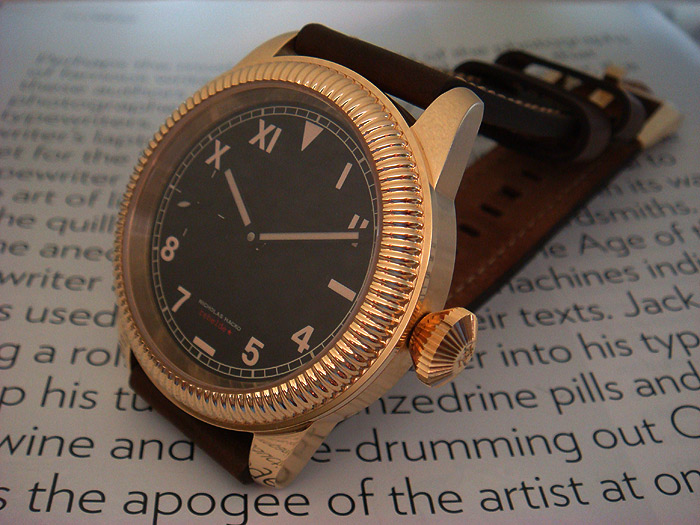
Today is an exciting day. Today, I have fully assembled my first rebelde in rose gold, T03/10. Exciting news for rebelde comrade George C. who will be taking ownership of it shortly. However before relinquishing T03 to him, I thought I'd share what the final product looks like with all of you. The watch is mounted on our new alligator horn strap, which is on offer as an alternative to Horween, exclusively for rebelde gold. These alligator horn straps have been in the making almost nine months now, as our supplier searched for only the perfect horns for our straps. I have also included a couple of close up pictures of the much awaited gold buckles for your perusal. It feels good to finally have completion of the project within my grasp. With no more components left to wait for, a few weeks of assembly is all that's left standing between us and the next exciting chapter for rebelde.


Thursday, June 4, 2015

Preview of Titanium A

***The first preview of rebelde titanium A.

Case size: 45mm. Movement: a very unique chequered finish. 50 pieces only. Brush, gloss and sandblasted finish. Water pressure tested. Ready to move on dial design! Delivery: October 2015.

No Fear

***The next rebelde

The greatest fear for any watchmaker is the fear of scratching a watch dial during the repair or servicing process. The dial is the most prized component of the watch, one which is almost impossible to replace or to even repair, repaint or restore without leaving traces. The possibility of damaging a customer’s dial is a nightmare – even for the most experienced and most skilled watchmaker. This is made many times worse on a unique, vintage or a rare timepiece. While servicing the mechanical ‘internals’ is just a matter of time and dedication, handling the dial is a task bordering on becoming some kind of ritual ceremony: the dial is carefully removed then quickly stored away while the watch is overhauled. The slightest contact with a sharp tool, tweezers or a screwdriver will leave permanent and irreversible damage and this is something that must be avoided at any cost. It is not just a mater of ‘the customer will notice it’ – it is a matter of pride and self respect. And this is precisely why all watch brands strictly control the supply of their dials to independent watchmakers. By controlling the supply of dials, brands retain full control over the servicing of the watch. A simple yet effective ‘tool of oppression’. For a watch brand, the dial design and it’s elaborate execution is sign of pride and workmanship. For 500 years of Horological history, no watchmaker and no brand in the world has ever intentionally produced a watch with an imperfect dial. Not until today.

In front of me and in front of you today is the rebelde “NO FEAR” Pilot’s watch. Each dial is unique having been scratched with no less than 13 different tools and stained with inks in never to be repeated colour schemes. Rebelde “NO FEAR” is limited batch of 10 individually signed pieces. Each one is completely unique and imperfect. Each “NO FEAR” piece is rebelde’s way of saying “we don’t care”. Because we don’t. A rebelde and its owner can not be oppressed. Oh yes, we CAN do perfect – as 256 rebelde owners can testify. But today we chose not to: no other watch brand in the world, ever, stood for ‘NO FEAR’ and ‘NO OPRESSION’ – except for rebelde.

Batch serial: Y01/10 to Y10/10. Total batch qty: 10 pieces.

Case: original 3-piece rebelde Pilot’s, 44mm in surgical steel.

Sapphire crystal, 11atm waterproof.

Swiss UNITAS manual wind movement, signed rebelde.

Gold rebelde cases

***Gold rebelde cases

Another milestone reached: 18K gold rebelde cases are completed. The photos below show the very first assembly of the middle case, bezel and case back. Good news: the Teflon seals and crystals are perfect fit (this was a crucial moment since each component is manufactured by a different specialist). Any out-of-tolerance part would require re-making which would set us back at least 4-6 months! The next step is crown tube assembly, then movement and dial assembly. The watch case is fully serviceable (if needed). I feel very proud and humbled - there are not many watchmakers out there who can proudly assign almost $14,000 to a watch - and certainly none in Australia. Thank you all for your support. Without you, this project would have remained just a dream.

Developments in Gold rebelde

***Counting down the days to Gold rebelde release

It's been a slow process but the final piece of the Gold rebelde puzzle is falling into place. At this very moment the final gold buckle is being finished, and soon they will be in my workshop where assembly can begin in earnest. With the completion of this final component I can now also confirm the final price for Gold rebelde will be $13,980. We're only weeks away now from the first Gold rebelde's leaving my workshop, so watch this space for more developments.

Tuesday, February 10, 2015

Gold rebelde, finally!

***Rebelde gold takes its first breath

After 7 months of development, the rebelde gold watch took its first breath yesterday afternoon. The emotion that we felt collectively in the workshop was not one of joy or celebration, but rather of relief. The gold case passed the water pressure testing of 10 ATM with flying colours. This is a big step for the world’s smallest watch brand, and also a major investment in not only time and engineering, but also in raw materials. With the price of gold at $40 per gram, extreme caution had to be put into construction, so no material is wasted. On the other hand, no compromise to the water resistance and robustness was made. The total weight of the watch, including the movement, is 135g, and I can tell you that it feels good. Style-wise, it is identical to the rebelde N Pilots series, with its trademark ribbed bezel.

Note that this piece will come with a Horween Shell Cordovan Horse leather strap. Because of this, the limited numbers of these straps we have are no longer for sale, as they must be reserved for rebelde gold.

Of course, there are still things to be done. We have just ordered a gold maker’s punch – a tool that we will use in stamping our initials on all gold components. The tool will be laser-cut in England by a toolmaker who has been in the business for decades. The gold buckle is not done yet either. But then again, we don’t expect any surprises there.

***Production time frame The first batch of rebelde gold will be 10 pieces in 18K yellow gold, followed by the batch of 10 pieces in 18k rose gold. Since each case is individually manufactured, piece by piece, we believe that the gold watches will be completed in around 3 to 4 months from now. The gold finished Geneva waves movements are already in stock.

***Price This has been the most frequently asked question so far, and the one for which we still don’t have a definite answer. The reason for this is that the gold price is fluctuating like crazy, and so is the exchange rate between the AUD and USD. While we are unable to speculate on what the price might be in 3 to 4 months by now, we are very confident that $11,500 is likely to be the price.

We are now ready to take your order. It is obvious that numbers 1 and 10 of each batch will not be available for sale, which leaves us with 8 pieces of each available to rebelde comrades. To reserve your piece, a $1,000 deposit is required, with the balance payable at the time of delivery. We will do our best to accommodate your requests for a specific serial, but really, any number is as good as it gets.

If you are interested, the next step is to check out the watch in person by making an appointment. I would be more than happy to show you the watch, let you try it on, and assess it for yourself. The other question that may be on your mind is: Are we going to do any more gold watches later in the year? The short answer is that we don’t know. To start a new batch is not just a simple step of clicking a ‘re-order button’. We need to start again completely from scratch, which will take time and be a substantial financial investment in the project. At the end of the day, it will always be up to you. I have always said that on the day that the last order comes for a rebelde, our brand will end. The brand will only remain alive as long as your orders are coming in. We have no intention of having watches sitting around in stock collecting dust while they wait for potential buyers.

My apologies for the rather poor quality images. As you can imagine, I am really rushing to share this good news with you, but rest assured that the watch does look better in reality than in the photos. Once again, we thank all rebelde owners and those who follow our project with interest for their support. We are enjoying this journey and we hope that you’re having as much fun as us.

Tuesday, January 27, 2015

Clash of the Titans

It is pretty well known and obvious that Swiss watchmakers work hard to maintain their position in the very top segment of global watch production. While the volume of watches produced in Switzerland is only around 1% of global stock, they enjoy 90% of global watch value.

What is less well known is that at the same time, Swiss brands heavily compete against each other. If you attend a watch fair like the Basel Fair, you might be under the impression that there is some grand plan behind all these Swiss brands – a conspiracy that keeps them working together. But nothing could be further from the truth. These brands actually hate each other’s guts.

You may believe that the battle of Titans is between brands such as Rolex and Patek Philippe. Again, the situation is a little more complex. The battle is actually between the House of Swatch and the House of Richemont. The best way to describe this fight is not between two warriors but two armies who spend a great deal of time strategizing and executing their game.

The best example of this fight is the Basel Fair. Held annually in March, it is the largest horological show on the planet, so naturally anyone into watchmaking wants to be present, displaying their latest watch.

Deep down, however, the waters are fairly murky because the Basel Fair is practically owned by the Swatch group, which means that the most prominent display areas at BaselWorld are reserved for brands from the Swatch stable. So when you walk in and see brands such as Omega and Longines with large presentation spaces, you would believe that they are the biggest brands.

Of course, the Richemont group was not happy with such an arrangement, so a few years ago began their own fair in Geneva, Salon International de la Haute Horlogerie (SIHH), in the first month of the year featuring only their own watches. While the SIHH Fair does not have the volume of Swiss exhibitors that the Basel Fair enjoys (only 16 brands are on display), it certainly makes up multiple times for it in the glamour department. It is very hard to describe to someone the prestige of the event, from flowing champagne, free food and entertainment by international stars, to after-party VIP night clubs which spill over into the evening.

However, there is one major difference between the two. While Basel is open to the public, SIHH is primarily designed to entertain Richemont stockists and dealers, as well as a select few journalists who attend the fair by invitation only. A well-oiled machine.

Of course if you happen to be in Switzerland from March 19-26, do not miss an opportunity to attend Basel Fair, as it really is a life-altering experience.

Happy collecting,

Nick