Showing posts with label repair. Show all posts

Thursday, October 15, 2020

Tough - yes, but not unbreakable


Omega Moonwatch plexiglass replacement - this is not a trivial repair. It requires specialist tools, removing the mechanism out of the case, removing the bezel and cracked plexiglass, case cleaning, and installation. Each set requires a very specific set of tools and parts are friction fit (press in fit). And lastly, the final step is a water pressure test. The whole exercise takes about 1 hour. Even the most experienced watchmakers do not take this job as a routine repair. The bad news is that recently our spare parts supplier informed us that a new price list for Omega parts is to be expected any day now. We used to charge $300 for parts, labour and GST inclusive. The bottom line is - be kind to your Moonwatch!

Friday, September 20, 2019

Speedy Friday


This doesn't happen too often, but today we have completed servicing four Speedmasters. All four are customer repair jobs and in each and every case, the reason why we are trusted with the servicing is not because we are cheaper than Omega but because we would do absolutely anything humanly possible to preserve the original dial and hands and the originality and integrity of these watches.

To see all 4 ticking, visit our Instagram: https://www.instagram.com/nicholashackowatch/

Monday, November 7, 2016

Planned obsolescence

***Planned obsolescence is when a product is deliberately designed to have a short life span. 

It is purposely and intentionally designed and manufactured to disintegrate, or to be non-repairable, or simply to under-perform.  At the same time, the manufacturer's marketing department will work hard to convince you that you should remain loyal to the brand and replace the obsolete product with the latest version.

There are countless examples of PO consumer products: from mobile phones to automobiles, computer operating systems, hardware, washing machines to printers – and watches.


The concept has been around for almost 100 years. It originated in Switzerland when the representatives from the world's largest lightbulb manufacturers, Philips, Osram, General Electric and others got together to form "Phoebus", a lighting cartel. Light bulb lifespans had, by 1924, increased to the point of crimping sales. The companies thus jointly agreed to reduce the life of lightbulbs to a 1,000-hour standard. Phoebus members marketed the shorter design life as an effort to produce brighter and more energy-efficient bulbs. However, the only significant technical innovation in the new bulbs was a steep drop in the operating life.

The other form of planned obsolescence is to design a product which is impossible to repair, or when the repair costs are deliberately too high. Turning a traditionally durable product into a throw-away, single-use one is the ultimate in planned obsolescence. It is well documented and researched that some manufacturers deliberately make the serviceman's job difficult, discouraging any attempt of repair. For example - the main bearing of the front-loading washing machine is integrated in the frame and almost impossible to replace. Another example - mass-produced watches have often the entire case factory-sealed.
"Suicide hands" is a term coined by watchmakers frustrated by inferior, self-destructive watch hands fitted on expensive watches.


The creativity of planned obsolescence is limitless: products are fitted with special screws, batteries or seals, or would require very specific tools and diagnostic equipment to be serviced. And surely, as a subscriber to my newsletter, you are well familiar with the outright restriction on supply of spare parts in the watch industry. Not to mention sophisticated take-overs and acquisition of independent watch parts manufacturers with the sole intention to limit the competitor’s access to strategic parts.


The ultimate victim of planned obsolescence is the consumers, forced to replace products which, if designed 'properly' in the first place, could easily last for decades.  Not to mention the economic loss to society and environmental pollution.


In 2015, as part of a larger movement against planned obsolescence across the European Union, France passed legislation requiring that appliance manufacturers and vendors declare the intended product lifespans, and to inform consumers how long spare parts would be produced for any given product. From 2016, appliance manufacturers are required to repair or replace, free of charge, any defective product within two years from its original purchase date. Hardly a victory in my book, but at least it is an attempt to curb planned obsolescence to a degree.


In Sweden, legislation has just been proposed which would cut tax on the repairs of bikes, clothes and shoes. Swedes would also be able to claim half the labour cost of appliance repairs (refrigerators, washing machines and other white goods) from their income tax.


Three years ago, before even the first rebelde was design or assembled, we announced the core philosophy behind the watch: we are going to be known as watchmakers who will offer a robust, reliable and repairable watch. Today, those three core values remain as important as ever. My goal is to be known as the maker of "planned rebirth".


The idea is simple: instead of limiting its lifespan, we intend to keep your rebelde keeping time as long as possible.


The action plan will require a long term commitment and will be based on following:


- unrestricted and unlimited availability of rebelde spare parts
- transfer of skills and knowledge to young watchmakers in areas of design, assembly and servicing
- continuing with design of models which will have interchangeable components. For example, each and every rebelde model (steel/titanium/gold) uses same winding stem, gear train, escapement and main spring. The middle case of Pilots and Control Tower models are identical, and so is the sapphire crystal and case back, etc.).
- ability to become a self-sufficient watch component in-house manufacturer, minimizing the reliance on other parts suppliers.


While the Swiss Phoebus will forever remain a case study of corporate greed and planned obsolescence, I honestly believe that one day, rebelde's "planned rebirth" product design model will be studied as an example of good design philosophy.
 

Your rebelde is here to stay, never to become obsolete. If you share our philosophy then we welcome your business.

TiA 48/50 - $3,000 - available for immediate delivery


TiB 08/75 - $3,000 - available for immediate delivery


Happy collecting,
Nick

Wednesday, July 15, 2015

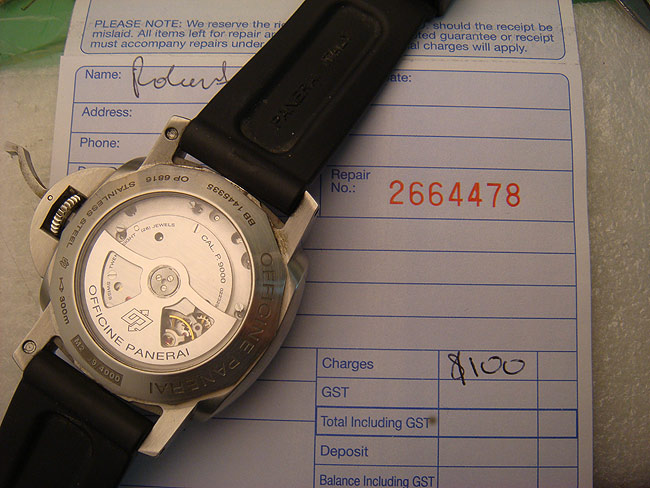
The last repair: job No. 2664478

If I were to print all the replies I received to yesterday's post then today's newsletter would be 70 pages long. The bottom line is, we are all on the same page on the issue of spare parts.

Let me just share with you a couple more details which will illustrate the points I wish to make. Please be patient with me because this post is not as much about my business as it is about yours.

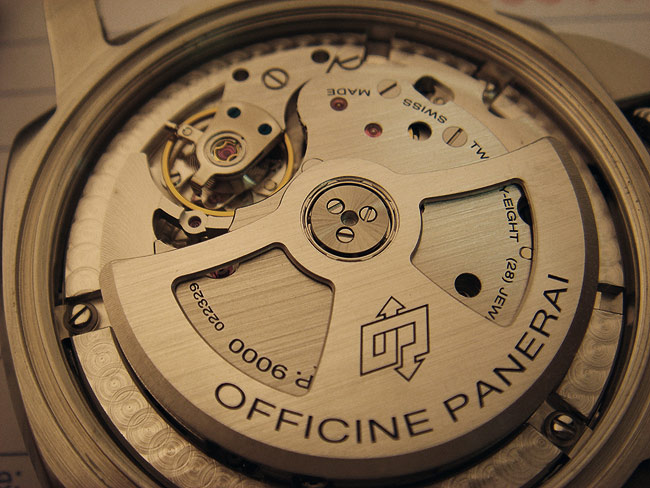
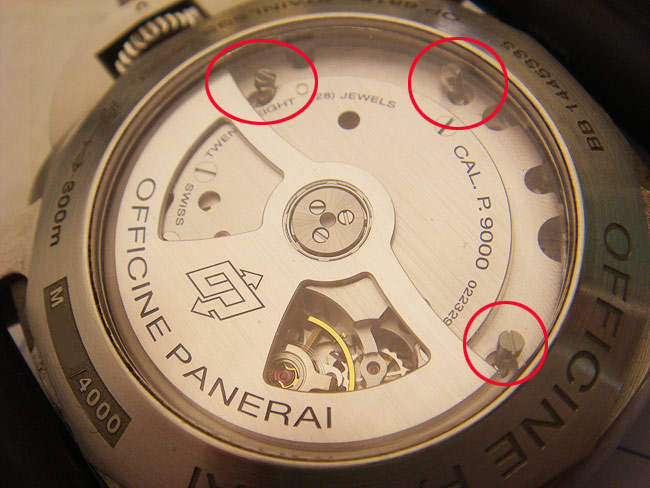
My last job yesterday was a repair to a Panerai which belongs to Rob. Rob is about my age, a polite gentleman and my customer. The watch is worth around $7000. The problem: all 3 screws which hold the automatic winding unit came loose which prevented the watch from being wound.

Since this particular watch comes with a see through case back and since Rob is an intelligent and curious person, he was actually able to diagnose the problem himself. While he wasn't really sure what steps are required to rectify the problem, I am very much convinced that he was expecting the repair to be a simple one, and that it shouldn't take long to fix it. Which was exactly the case: I quickly explained what I would do, and if the were no surprises, Rob could have his Panerai ready for collection by tomorrow. I also quoted him $100.

Of course I could easily charge him twice that amount, and I am sure he would be equally happy, but that would be both disrespectful and unnecessary because I can fix his watch in less than 15 minutes.

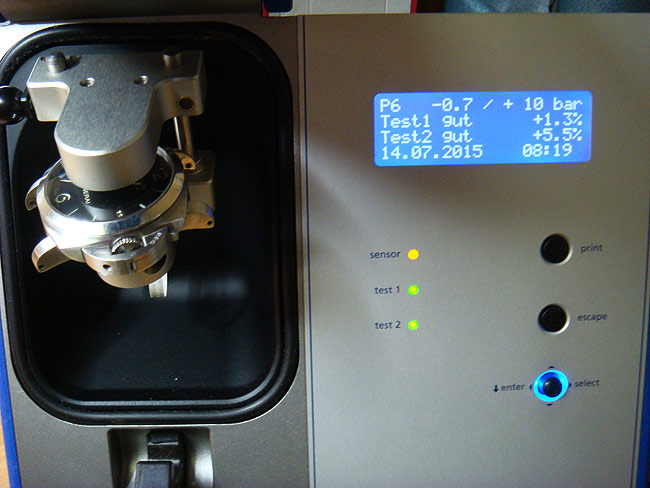
So as predicted the repair was straight forward: after removing the strap and unscrewing the case back with the help of a special tool, all 3 screws were tightened and the rotor was working fine. I also refreshed the case seal, checked the watch for timekeeping and gave it a water pressure test.

Now allow me to pause here for a moment by asking you who is the winner in this case?

Obviously, Rob is over the moon: he got his watch back quickly and cheaply. He is also happy because he knows that if anything ever goes wrong with his Panerai, I am the one who can help him. He feels respected and appreciated.

The other clear winner is the tax office. Out of $100, the tax office is getting an easy $10 in GST. Also, my company profit is taxed at a rate of 30%, PLUS there will be more money going their way once my wages are taxed as well. I guess this is a total of $40 give or take. Not really a bad deal taking into consideration that the Government invested precisely $0 in my education or business.

The third winner is me. Even after paying taxes, I still made a handsome profit for something that was a relatively easy job. Also, I now have Rob as a repeat customer who will spend more money with me in yeas to come, so the value of my business has gone up.

The fourth winner is probably least obvious: it is the Panerai Corporation.

Not only have I restored Rob's watch but I have restored his TRUST in Panerai products. After all, he is a happy PANERAI OWNER and most likely he will buy another watch from Panerai or recommend it to his friends.

Now, Panerai gets this benefit without investing any money into my service or my reputation, yet I am investing all my skills, expertise and reputation into Panerai. Hardly a fair deal as far as I'm concerned.

However - and this is my punch line - the only reason why this fine balance of trust, expertise and respect exists is this: I was able to fix Rob's watch because I actually didn't need any spare parts.

If for example that Panerai needed a new gasket, which is a petty $1 rubber seal, I would not be able to help him at all. If I needed just a simple screw which costs 1cent to make, the outcome would be FAILURE. So by restricting the availability of the supply of spare parts to me, Panerai has full control over Rob, myself and the tax office. Restriction is easy to implement and long-standing and powerful in action.

Now, if you are new to watches, you may ask: but WHY would Panerai or Rolex or any other Swiss brand want an independent Australian watchmaker out of the picture, and ultimately, out of business?

The reason is simple: an independent watchmaker is an extreme pain in the bum for a brand and extremely powerful competitor. I can do my job faster, cheaper and better. I can work on variety of brands so I can provide my customer with much more objective insight. As a mature and far more versatile watchmaker and I personally take pride in my workmanship which ultimately leads to a personal relationship with customers and better repair results.

If Rob took his Swiss watch to a Swiss brand's service centre, his experience and overall satisfaction could have been very different. For big brands, there is no such thing as small repair. 'Quick and cheap fix' does not exist because they don't offer partial repairs. In most cases, additional and unrequested repairs are bundled in so the repair bill is commonly in the vicinity of $1000 or more.

The turnaround time is months! A three to four month wait is common. And these are not my words but yours- often, they will treat you as though you are a complete idiot, someone who will be grateful for being allowed to wear their fine timepiece.

The ultimate outcome: your dissatisfaction with the brand which will never be restored. So the ultimate loser are the brands themselves who in their myopic greed are killing it for everyone.

And here is my second and final punch line: the monopoly on the supply of spare parts is allowed to continue because the Australian Competition and Consumers Commission is incapable of assessing this simple matter adequately. For years, the ACCC's approach to this matter has been pathetic and incompetent: when you, or I, or a group of watchmakers submits a case, the ACCC goes to the brands and simply asks them: are you restricting supply of spare parts? The answer is "No, we are not, we have selected a few independent retailers who have access to our parts". And in cases where the ban is total - which is now the case with almost all Swiss brands- the response is: "the independent watchmakers are not capable of repairing our watches so we are actually doing a big favour to our customers by cutting them out"! And in every case, the ACCC finds this infantile reply - a complete lie- valid enough to close the investigation.

The question the ACCC should be asking the brands is this: how do you actually know that independent Australian Watchmakers are not capable of providing a service to your brand standard, when you have never assessed any of them?

Where is it stated, in black and white, what the requirements to get accredited are? Do you provide any training to independent Watchmakers? If a Watchmaker wishes to invest in tools and equipment, to setup a workshop, and if he passes your test, would you then unconditionally allow access to spare parts? What are the financial commitments that you would expect an independent watchmaker to undertake to meet your brands expectations? Are you pleased to recommend an independent authorized service to your customers?

Personally, I have been told that even if the ACCC ever breaks the monopoly of Swiss brands that I will never get access to spare parts. My sins are beyond redemption.

I have been told by the most well known brand that even if I send my son, who would be then fourth generation watchmaker to Swiss watch school (3+3 years, then a training with specific brand, all at my cost) that even my son will never have access to spare parts. "Never, ever" were the exact words.

Which is fine, and I can live with that. But if that is the case, why are those Swiss brands lying to you? Telling you that we are incompetent when true reason for the restriction is a pure commercial greed?

And why should I continue to prostitute myself by sourcing the watch parts from indirect sources, paying ridiculous amounts of money for a screw, spring or wheel - just to do the 'right thing'?

Make no mistake: the ban on original spares will result in ever increasing number of inferior aftermarket parts. Both small and reputable watchmakers already use those parts exposing themselves to both legal action and customers dissatisfaction. Their customers are not happy, and brands, rightly can finally say: "Well, we told you that independent watchmakers are shonky and not to be trusted".

I for one am out. I am not going to be part of this silly game, trying to juggle my loyalty to customers, love for fine mechanical watches, endless abuse by Swiss brands and the impotent and incompetent ACCC.

I am not going to tell you what to do, what to collect or where to fix your watches, or to write to ACCC, but for the time being, taking your watch to brand service centres is the only option. There is no second choice, second opinion, second quote or second option. You will be charged top dollar so you better like it and enjoy it.

(Although I just interrupted this email for a quick fix of a broken Rolex bracelet, for a lady who lives in country; I actually fixed the bracelet so quickly that she didn't even have time to ask me 'do I owe you something for it?' which is clearly not her fault. Sorry tax office!)

Our government must focus on the most obvious thing: making YOU happy by giving you the opportunity to exercise your consumer rights, of which the fundamental one is the right to a second opinion. Where brute market forces will always prevail, it is government's role to provide at lease some degree of competition because we know that big corporations are very good at abusing the power of monopoly. Don't crush us, don't cut us out: instead, train us, equip us, supply us with whatever we need to show you what we are capable of - and then watch us work for you and your customers.

The only permanent solution is one of mutual respect between brands, watchmakers, government's regulators and watch owners. We are all 'into it'. We owe it to each other.

And we owe it to the next generation of young bright people who one day will look back at the past and ask themselves: why they couldn't fix it before it all fell apart?
Monday, June 1, 2009

The biker's Rolex

It always feels good to kick-start a new week on a high note, but unfortunately, June 1st was an unlucky day for one Rolex owner: his GMT Master II suffered the disastrous consequences of a motorbike accident (luckily enough, the owner got away with only a few minor bruises).

Rolex GMT Master II
Rolex GMT Master II

Externally, the appearance of the watch was horrifying, but that is nothing compared to the internal damage sustained by this Rolex!

Below is the list of parts required to restore this GMT Master II to its former glory:
New bracelet, middle case, rotating bezel, bezel spring, winding crown and stem, new crystal and crystal seal, new set of hands, calendar wheel and the dial. Furthermore, the following internal parts would also require replacement: the rotor, balance wheel, escape wheel and all the wheels in going train, auto rotor wheel and case clamps.

Rolex GMT Master II
Rolex GMT Master II
Rolex GMT Master II
Rolex GMT Master II
Rolex GMT Master II
Rolex GMT Master II

The only parts that were spared from the impact are the bridges, screws, the main spring and a few wheels underneath the dial. In terms of dollar-value, less than 10% of the watch survived and the rest is completely wrecked.

Sure, Rolex watches are tough, but there is a limit to what a mechanical watch can endure.

Nevertheless, the owner still has the original Rolex box and the instruction manual which ironically, are now worth far more than the watch itself…

Friday, May 8, 2009

Golf anyone?

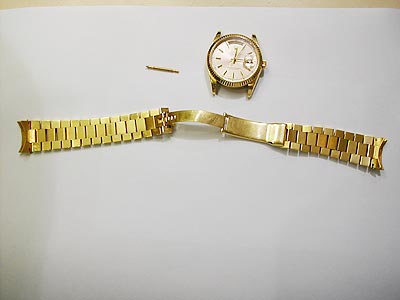
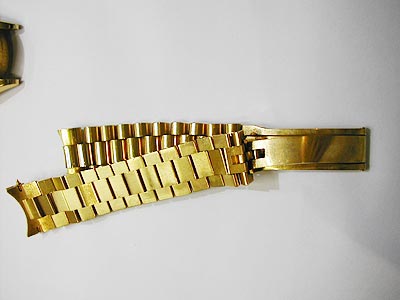
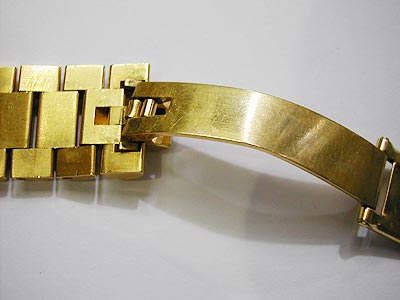
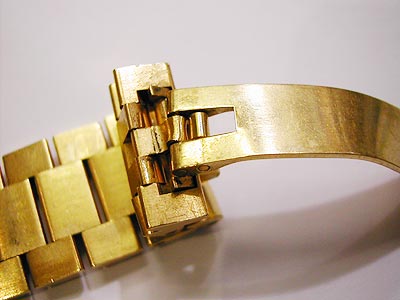
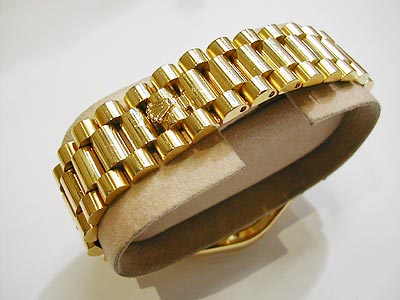
A victim of a freak golfing accident: Rolex President hit by bag of golf clubs. The full impact was absorbed by the wearer's wrist (ouch!) but the bracelet was badly deformed.


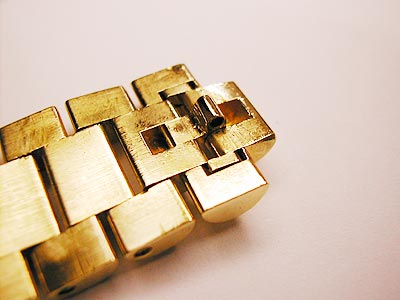
Out of shape - plastic deformation of clasp and bracelet


bent clasp spring


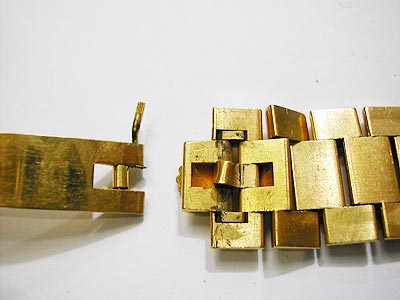
broken clasp pin


bracelet spring loaded bar


plastic (irreversible) deformation, top end


bottom end: shredded


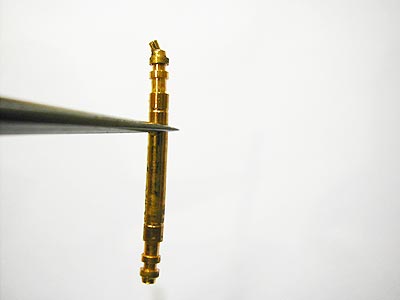
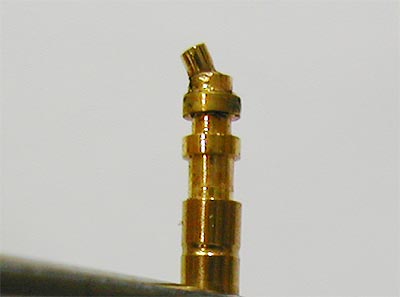
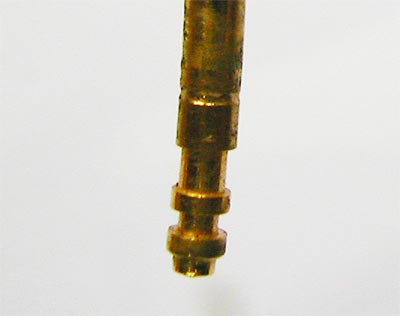
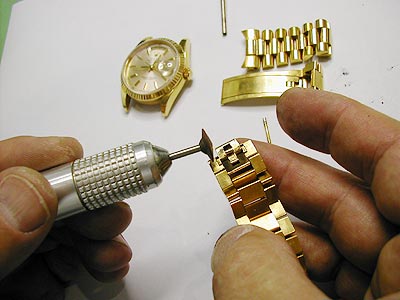
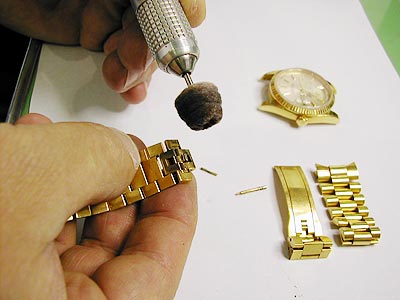
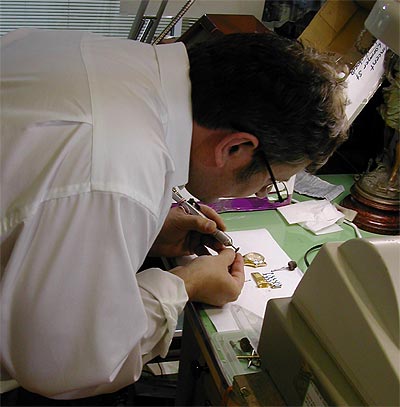
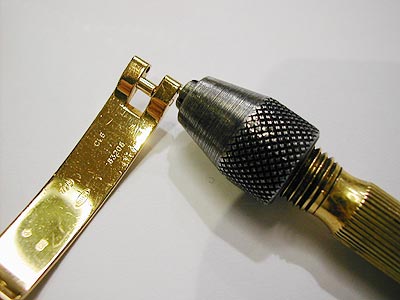
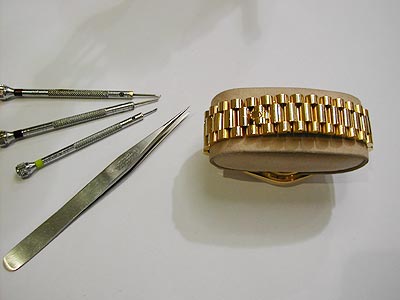
repair process: repair to clasp, manufacturing of new clasp end and new pin in 18K gold. Slicing, welding,


and polishing


new end piece welded to bracelet


more 'fine tuning'


new gold pin, checking for size


and finally assembled bracelet. Total repair time: 2 hours.


Golf anyone?


[Q]: Does Rolex offer repair service for 18K gold watch bracelets?

Rolex Switzerland does offer bracelet refurbishment service for all 18K models. A few months ago, I was quoted $A15K for a new Presidential bracelet and about $A6K for complete refurbishment with turnaround time of 6 months.
I have seen quite a few 20-30yrs old bracelets after they were refurbished by Rolex, and I have to say they look stunning. However in my opinion, refurb. is only a good choice if you intend to hang onto your watch (sentimental reasons etc). Otherwise, a trade-in toward a new model is usually a better and cost effective solution.

[Q]: Is it safe to assume that a SS model, (sports, datejust, etc) would have come through this unscathed?

Maybe not unscathed, but would definitely better withstand the same impact with far less plastic deformation (permanent change in shape without fracture, resulting from the application of sustained stress beyond the elastic limit). If I am to play golf, my golfing watch of choice would be a plastic Swatch :-)

Bottom of the Harbour haven for Rolex

What would you say if I told you that there is a place where you can find a treasure trove of Rolex watches just waiting to be picked up? It's true. That's got your attention, hasn't it ? What will keep your attention is the knowledge that your Rolex may be the next to end up here. Yes, your trusty Submariner or Seadweller that you think is almost indestructible. “It's a Rolex you say, what could go wrong?”. And where is this Ali Baba's cave ? It's much closer to home than you think. It's called Sydney Harbour!

Personally, I know of at least a dozen or so Rolex watches that have been lost between the Harbour Bridge and the Heads. Imagine it … all of them are now sitting at the bottom of the harbour glinting up to the surface, yearning to be reunited with their careless custodian. Why is it so ? Well for one simple reason - the bracelet broke.

Before you start blaming Rolex for making inferior bracelets, let me tell you that after repairing thousands of Rolex watches, I have come to the conclusion that a lot of trusty Rolex owners simply don't give a second thought to the condition of the bracelet. It's rare that anyone bringing a watch in for service asks me to inspect the bracelet for wear and tear.

The one that nearly got away

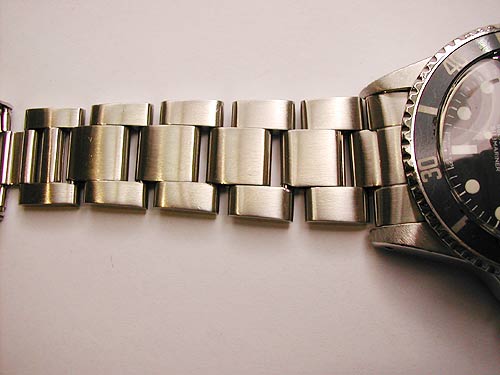
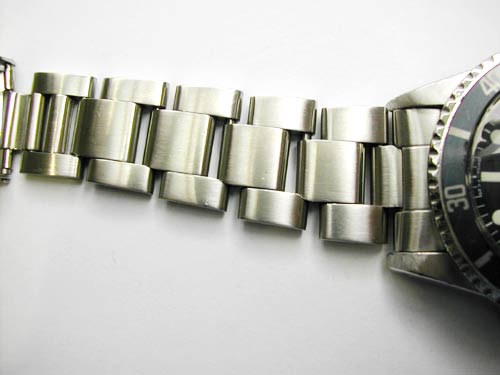
Here are photos of a Rolex Submariner [ref 5513] that came in for repair just recently. This is the very watch that prompted me to post this story on the web to alert you watch collectors and watch aficionados. It's a good example of a bad example if you follow my logic. The proud, but misguided owner specifically requested that the bracelet must not be touched or repaired "because this will spoil its originality". He went on to add that he does not mind the 'stretch' because he prefers to wear it 'loose'. Well after all, it doesn't look too bad, does it?


Except that on the wrist, his bracelet looks more like this: What he chooses to call a loose or comfortable bracelet is actually a worn out bracelet where the links are cutting into each other to the point where the gap between them is now 2-4mm.


The reason for such an extensive wear is mostly due to a build up of dirt, grit, perspiration, skin acids, UV creams etc that over time act like a grinding paste that is accelerated with the constant flexing movements of the bracelet on your wrist. Steel links are very effectively ground to death by you wearing your watch too loose.


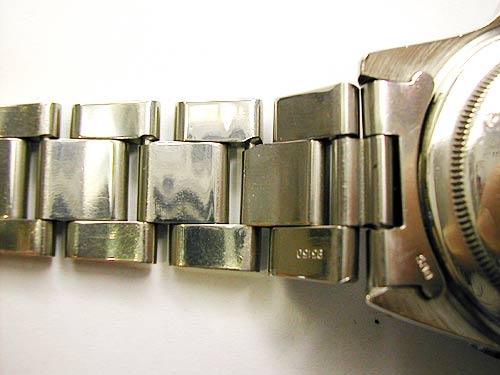
When the bracelet was separated from the case, another booby trap emerged. The spring loaded bar (pin) was worn out to the point where it was as thin as a paper clip. Just as a little test, grab a paper clip and bend it a few times and see what happens. That could be what your Rolex is relying on to not become an orphan. Interestingly, the other end of the pin is still in reasonably good condition, but it only takes one break at one end to lose your watch.


Out of sight – out of mind

Take a closer look at x15 magnification.

"She'll be right mate" attitude at its best! No, she won't be right. It's just crazy luck that this poor victim has survived the last fishing trip.


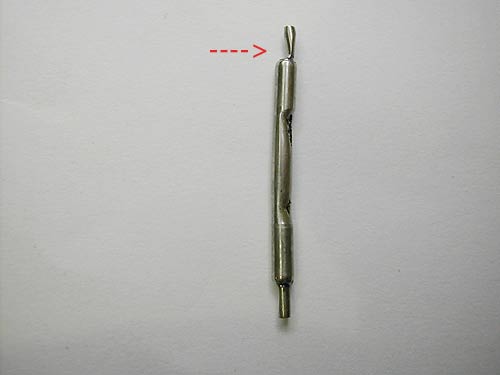
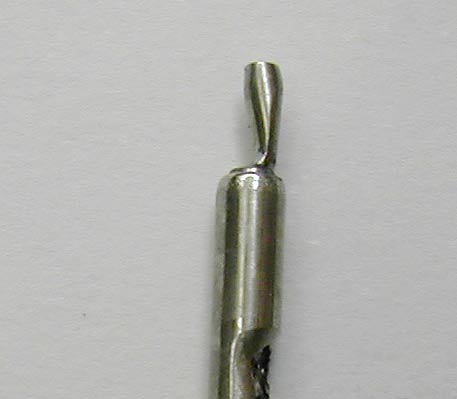
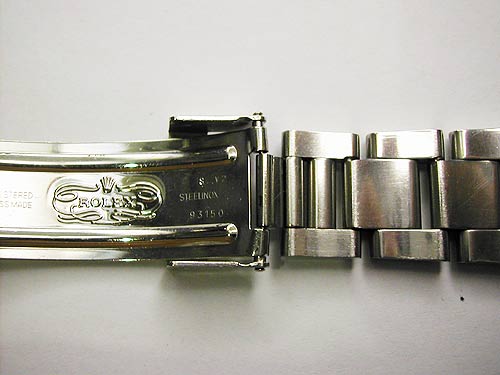
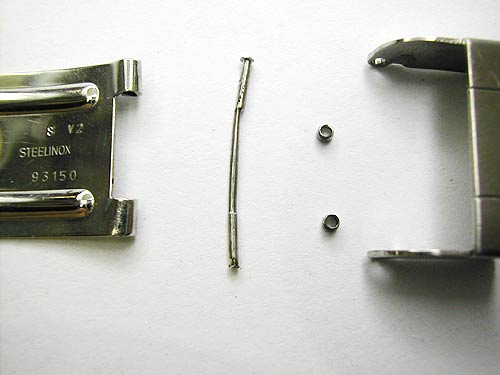
Another weak point is steel bar ('rivet pin') that holds the flip lock clasp assembly.


The entire weight of watch and bracelet is relying on the strength of this piece of wire. In a new bracelet this steel wire is exactly 1 mm thick. Here, at its weakest point it is now only half that - 0.55mm. It does not take much to snap ½ millimetre of pitted, corroded and flexed worn out piece of metal wire.


Keeping the watch bracelet in "original and unaltered condition" should not be your utmost priority. Bracelet links, clasp parts and spring loaded bars should be serviced or replaced whenever your watch is due for an overhaul or immediately when you notice any damage or wear.

A lot of watch fanciers also adore classic & vintage cars. Is that you ? Ask yourself, “would I keep my car's brake pads, tyres and shock absorbers in 'original' condition or should I replace them whenever they are defective?”

Here is what you should do to avoid the disappointment of losing your valuable and cherished Rolex:


  • Service your watch on a regular basis - ideally every 3-4 years. Keep it clean - have the bracelet cleaned in ultrasonic cleaner at least once every 12 months.

  • Avoid excessive polishing. DO NOT polish bracelet with metal polishing paste unless you can clean it in ultrasonic cleaner after. Metal polish will dry into a fine powder and embed itself in the bracelet and it will also act as abrasive material.

  • Wear your watch reasonably tightly. Steel Submariner or Seadweller is NOT a piece of jewellery but a precision machine.

  • Rinse in tap water after a day out in the elements.


As you all realise, your well looked-after Rolex will last for generations. The best way to preserve something in 'original precision condition' is to look after it. When it is time for your Rolex to be passed on as a treasured family heirloom, don't be the one who will be remembered by your family by the question, "Whatever happened to that glorious Rolex he had ?”

Happy fishing, sailing, boating, kayaking, diving, surfing, hang gliding, parachuting, aerobatics or whatever is your extreme pursuit!

Text and photos copyrighted.