Monday, June 1, 2009

The biker's Rolex

It always feels good to kick-start a new week on a high note, but unfortunately, June 1st was an unlucky day for one Rolex owner: his GMT Master II suffered the disastrous consequences of a motorbike accident (luckily enough, the owner got away with only a few minor bruises).

Rolex GMT Master II
Rolex GMT Master II

Externally, the appearance of the watch was horrifying, but that is nothing compared to the internal damage sustained by this Rolex!

Below is the list of parts required to restore this GMT Master II to its former glory:
New bracelet, middle case, rotating bezel, bezel spring, winding crown and stem, new crystal and crystal seal, new set of hands, calendar wheel and the dial. Furthermore, the following internal parts would also require replacement: the rotor, balance wheel, escape wheel and all the wheels in going train, auto rotor wheel and case clamps.

Rolex GMT Master II
Rolex GMT Master II
Rolex GMT Master II
Rolex GMT Master II
Rolex GMT Master II
Rolex GMT Master II

The only parts that were spared from the impact are the bridges, screws, the main spring and a few wheels underneath the dial. In terms of dollar-value, less than 10% of the watch survived and the rest is completely wrecked.

Sure, Rolex watches are tough, but there is a limit to what a mechanical watch can endure.

Nevertheless, the owner still has the original Rolex box and the instruction manual which ironically, are now worth far more than the watch itself…

Friday, May 29, 2009

A tribute to Frankenstein

Here is a rare beauty that you won’t see often: a stunning IWC Portugueser, dating back to the early 1930s. The 48mm steel case seems like it has been manufactured only yesterday – a timeless design!

This impressive watch is fitted with an 8-day power reserve, manual wind movement.

1930's IWC Portugueser

1930's IWC Portugueser

1930's IWC Portugueser

Before you rush to click on my email button to ask the proverbial "how much for cash" question, allow me to disclose one minor detail: this watch is unfortunately fake!

Yes, the watch’s movement is indeed a genuine IWC movement from the 1930s; but it is designed and manufactured for a pocket watch! In addition, the completely fake dial is accompanied with original hands and the stainless steel case has been recently manufactured either in India or China.

Some sophisticated con artist might call this a tribute to IWC watches or a marriage but to me, this is nothing but fraud because it was produced to deceive.

For a watch to be a genuine piece, all of the components need to be created under the same workshop by the same maker at the same time. Unscrupulous "watchmakers" who assemble watches from new, old, inappropriate of after-market parts remind me of Dr. Frankenstein, the man who created a monster.


Frankenstein

Monday, May 25, 2009

Australia's Greatest Art Fraud

A criminal investigation is under way into the art dealer's affairs after he vanished with at least $30 million in artworks and money.


According to the Sydney Morning Herald, three customers "bought the piece (the above paint) from (dealer) and are adamant they own it. Yet none is in possession of it and collectively they are missing $120,000".
http://www.smh.com.au/national/australias-greatest-art-fraud-20090523-biv6.html?page=-1
You must read the entire article - it is definitely and eye opener into murky inner workings of Australian art trade.

You might ask yourself, "how can someone scam so many people with just one single painting?". Well, nobody knows for sure, but my first guess would be abuse of trust and accountability as a plausible factor that could induce people in being conned.

Almost every day, I receive phone calls from prospective customers who wish to sell their watches. In essence, this type of transaction is a straight-forward one - upon inspection, I would make an offer to purchase the watch for a certain amount of money. If the offer is accepted, the personal details of the customer as well as the serial number of the watch are recorded and filed, and a cash-cheque, payable at the Bank across the road, is issued.

Nevertheless, clients sometimes ask me if I would agree to take a watch on consignment. The answer is always NO. And I have more than one reason for not wanting to be involved with consignments.

A consignment is an agreement between the seller and the dealer, where the title of the goods (ownership of the watch) remains with the seller, yet the watch is physically in the dealer's possession. The dealer is entitled to sell the watch on behalf of the seller, keep a profit margin from the final sale amount and pay the rest to the seller.

For laypersons, it would seem that consignment is indeed an advantageous agreement for the dealer: the latter does not need to spend a cent in the process and if the watch does not find an owner, he can always return the unsold item to the seller.

Unfortunately, this is not always the case: When entering into a consignment agreement, the dealer takes on full responsibility for the watch in case of loss or theft, accepts to undertake any eventual repair or restoration and provides a guarantee on performance to the buyer. Being 'locked in price' and 'left at the mercy' of the seller, who can at any time opt out of the consignment contract for any reason whatsoever, is like walking on thin ice. And if I didn't have enough money to buy that watch in the first place, then obviously I cannot afford it (and obviously should not be trusted to take care of it!)

But there is still one more fundamental reason why I would never consider consignment:I do not want to be trusted unconditionally. Taking care of other people's goods is nothing but a burden.

So here is my advice to sellers and fellow dealers that could help everyone save time, money and headaches:
limit your level of trust to an absolute minimum - or even better: trust no one! Always exchange your goods for a real and tangible asset - cash.

"I owe you" is as bad as "you owe me".

Friday, May 22, 2009

The Number One Watch Enemy - Water (again)

I have dealt with numerous cases of watches with severe water damage and I have to admit by experience that this is by far the most frustrating part of running a watch repair business.
The photos below show the extent of water damage penetrating to the case of this poorly-treated Swiss beauty.

Water Damage to watch

The watch owner swore on stacks of Bibles that he always locks the winding crown before washing his hands. From the amount of rust in the case, I seriously doubted the veracity of his words.

According to him, the authorised service quoted $6,500 for repair (I did believe in this part of his confession), but I am afraid I do not have good news either...

Will keep you posted on this one. Stay tuned.

Time keepers and Time wasters

All watches and clocks in my workshop, including the most expensive mechanical timepieces worth many thousands of dollars, are set to correct time by my master clock - an inexpensive battery-operated Swiss junket carriage clock in a rather ugly case. This unattractive little quartz clock amazingly keeps excellent time - I only have to reset it twice a year when daylight savings kick in.

In recent years, I have found myself setting watches against my personal computer(PC) clock. I am obviously aware that my PC clock is not a standard benchmark for this purpose as it is often many seconds away from the exact time (sometimes even a minute or two) but for customers, this is rarely a problem. A small portion of picky customers would set their watches to radio signal time; nevertheless, the rest could not care less.

Today, my assistant Denis arrived late for work and blamed my computer, giving me a "it's your fault" excuse. He also pointed out that all the 3 PCs in the office set are on different time, as well as his watch and two mobile phones. Obviously, it was time to get our clocks on time.
A quick google search for 'atomic clock' lead to the World Timeserver. According to the website description, "Atomic Clock Synchronisation is the best way to make this happen". Sounds just right! So I clicked on the link
http://www.worldtimeserver.com/atomic-clock/

The Atomic Clock Sync v3.0 has a very intuitive and smooth installation process and a few seconds later, I was ready to press the Sync Now button.
Atomic Clock

However, this seemed too good to be true and I got the following error message on my screen:
"Unable to connect to RPC server".
What a bummer!

So, until we get a grasp of what the RPC server is, we will continue to set our timepieces against our trustworthy Swiss junket clock. And Denis has been asked to set his watch 5 minutes fast, just in case.

Tuesday, May 19, 2009

Make it a Rolexmas!

MAKE IT A ROLEXMAS
- The Marvelous ROLEX Wrist Watch

The Worlds Best by Every Test

Extract from the front page advert in Daily Mail dated November 24, 1927.

" A lifetime Gift for Christmastime - Because it is the best! The Rolex has emerged from every recognised test as the best time keeper in the world, a fact that is vouched for by Twenty World Records." And not to mention that obviously "...ALL GOOD JEWELLERS throughout the British empire stock Rolex Watches. Genuine Rolex watches have the name on the dial, or on the movement or under the case."

Not much has changed for the past 80 years - some Swiss makers are still living in their fantasy watch world, fabricating exaggerated claims and fighting endless battle against counterfeiters.

Daily Mail 1927 - Rolexmas

What caught my attention in this Rolex advertisement was the price range of Rolex watches, from "3 to 100 pound", which was a little fortune for a watch from a relatively unknown maker at that time. Clearly, Rolex had been an ambitious maker from their very early days and to their credit, Rolex understood the power and importance of marketing, way before their competitors.

Pendule de Voyage

The reasons why carriage clocks are so popular amongst horologists are many: they are decorative, old and interesting, entirely practical as timekeepers with a reasonable degree of accuracy (some keeping better time than your modern Rolex watches!) With charm and fascination of their own, fine examples are becoming more valuable with every year that passes.

After the last post and recommendation on a watch book referred by me as 'Watch Bible', a number of subscribers asked if there was a similar book about carriage clocks.

Before answering this question, let me just say that it is important to understand that unlike wrist watches which are produced for less than 100 years, domestic clocks have been around for at least 600 years. Although modern carriage clocks became fashionable in the early 1800s, the history of carriage clocks is far from being fully documented. Therefore, a proper reference book on the subject is yet to be written.

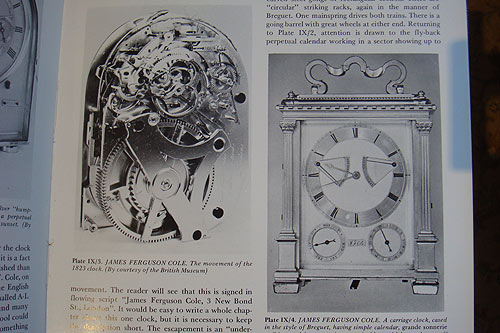
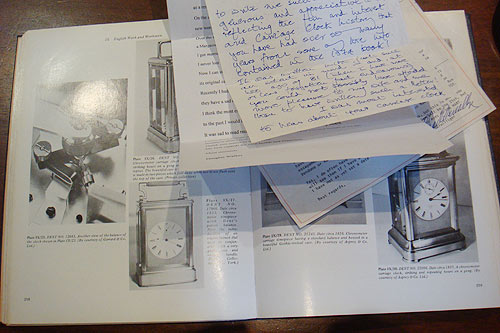
However, a keen student of Horology should make every effort to acquire the book by Charles Allix and Peter Bonnert "Carriage Clocks - their history and development". This rare and hard-to-find book was published in 1974.


Pendule de Voyage

A couple of years ago, I was fortunate enough to receive Allix's book from a fellow horologist, Mr. Doug. Not only is he a keen collector, but also a true gentleman. Doug personalised my copy in a manner that truly reflects his kindness:

"Dear Nick - here, at last, is the carriage clock book. Charles Allix only published one edition. I sincerely trust that you will get as much pleasure and add to your store of knowledge as did I over the 25 years that I collected carriage clocks. Regards, D W."

With the book, I also received letters that Doug exchanged with Allix which provided further insight about the fascinating world of collecting. I take the liberty to quote just one paragraph from Doug's letter below:

"...whilst there (London, 1978) I bought two miniatures (carriage clocks) from Charles Frodhsam On the day I was leaving to return to Sydney I saw your book in a book store and a whole new world opened to me, thanks to you. Over the next 9 years I acquired 22 clocks including quarter strike by Leroy, a Jacot, a Margaine and Drocourt... I can't stress enough the pleasure and education that you have brought to me and countless others over the years..."


As A.G. Randalll wrote, "all who can recognise a labour of love when they see one will find in the Axells book clear evidence of more hard work, devotion to detail and sheer love of the subject than they have come across for a long time."

And that's what horology should be all about!

Rolex Case Polishing

Restoring or refinishing a stainless steel watch case is not as difficult as may be thought. Unfortunately most watchmakers are either not interested in doing it properly or were never taught how to do it. Those few who have mastered the skill of hand-polishing would rather die than to reveal their secret of the trade! The trick in obtaining mirror-like finish is simple : a/ to use correct polishing medium and b/ to master polishing skills by following the correct procedure.

This tutorial is aimed not only at watchmakers, but also at watch dealers and collectors wanting to familiarize themselves with the process of hand-polishing. The procedure shown below was passed to me by my father (and to him by his brother Mihajlo Hacko, Master Watchmaker since 1948. who still does his own watch repairs!)
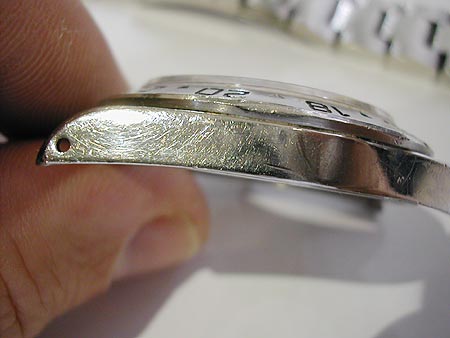
Rolex Case polishing

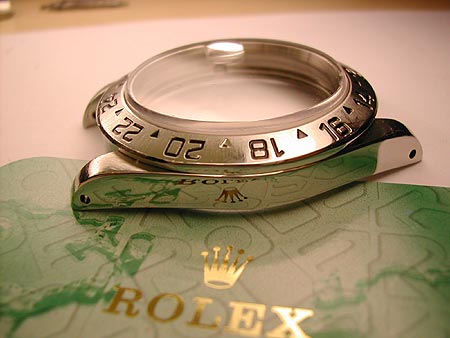
Guinea pig: 15 years old Explorer II Ref 16570, long overdue for decent case re-polishing.
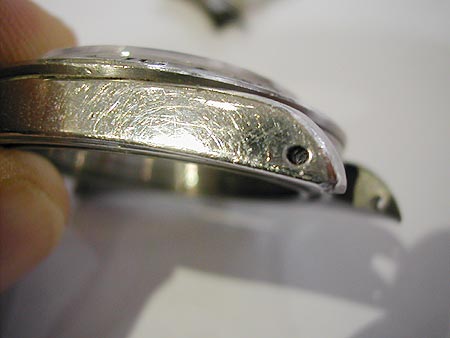

Rolex Case polishing

I prefer to do all case polishing by hand.


Step 1:
To get rid of scratches, start with coarse sand paper, grade 220.
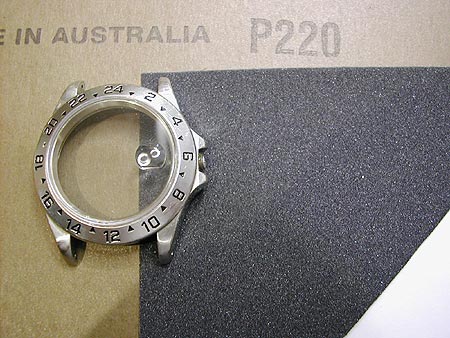

Rolex Case polishing

Keep it parallel and keep polishing until you remove ALL scratches, no matter how deep. This step is very important.
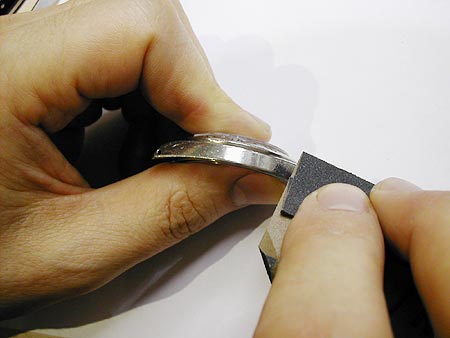

Rolex Case polishing

All scratches are gone, but the surface is very coarse and dull. That's OK. The most important thing here is to remove ALL scratches and to have the grain lines parallel with the case.
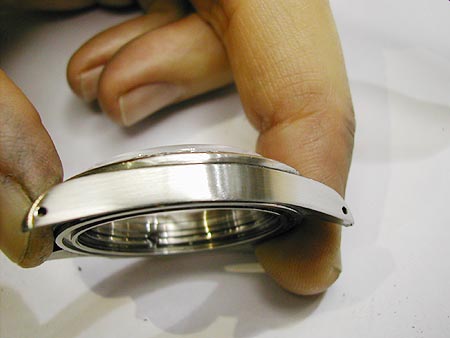

Rolex Case polishing

Step 2: Switch to dry paper grade 800. I use German made, but most sand papers of similar quality will do the trick. You can buy this grade at any automotive shop supplier.
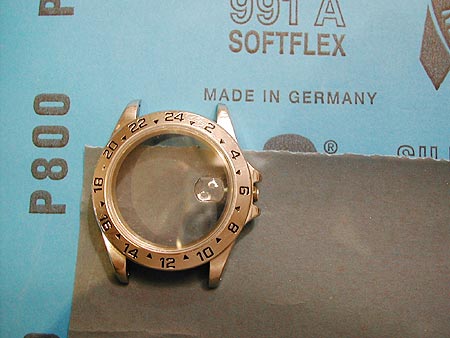

Rolex Case polishing

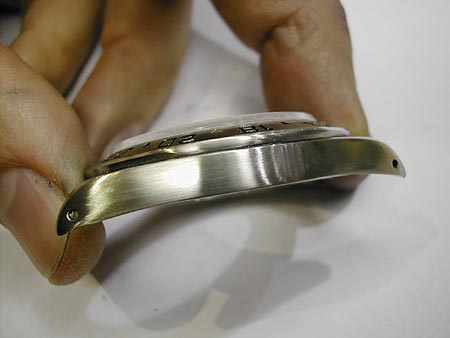
Don't rush - take your time (at least 5 minutes per side). The surface is still dull but we are heading in the right direction.(note how more light is now reflected from the steel surface)

Rolex Case polishing

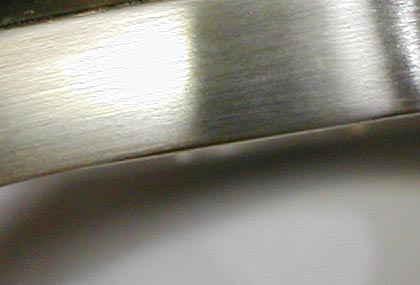
Same surface, magnified. Keep it parallel! If I can do it, you can do it too :-)

Rolex Case polishing

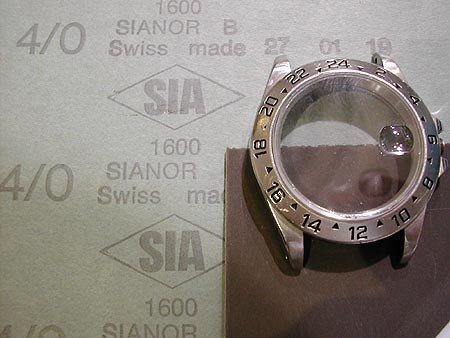
Step 3: very much the same, now with finer grade dry paper - here I use Swiss made 1600 powder coated jewellers paper available from jewellers suppliers. This is jewellers stuff, so they prefer to call it 4/0

Rolex Case polishing

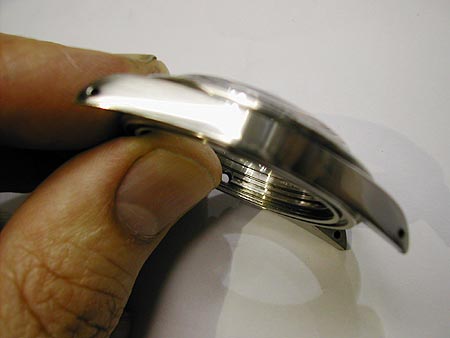
Take your time, don't rush - 5 min. per side

Rolex Case polishing

The steel surface now reflects even more light and looks fairly smooth.
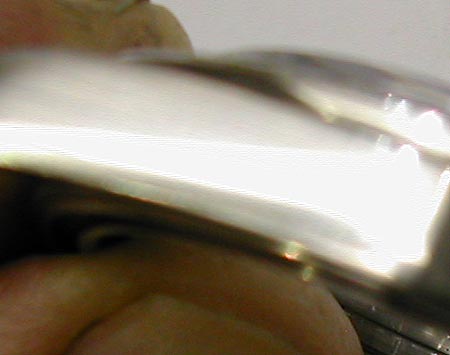

Rolex Case polishing

Step 4: More of the same. Medium: 3M Film sheet polishing (plastic)grade 60 microns and 10 microns (2-3 minutes each).


Available from jewellery suppliers only. 3M film feels like ordinary plastic sheet, definitely not your ordinary sand paper :-)
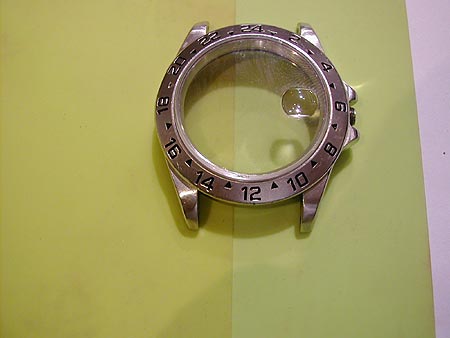

Rolex Case polishing

If there are still any visible imperfections go back to Step 3.


magnified
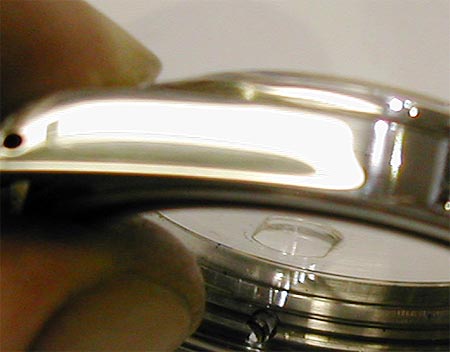

Rolex Case polishing

Step 5: polishing on buffing wheel


Rolex Case polishing

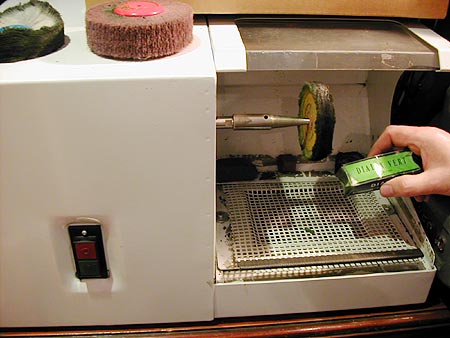
There are far too many different polishing cotton wheels available; go for medium soft cotton disk, 10cm diameter.
Apply some chromium oxide rouge (known as Green Steel Rouge)
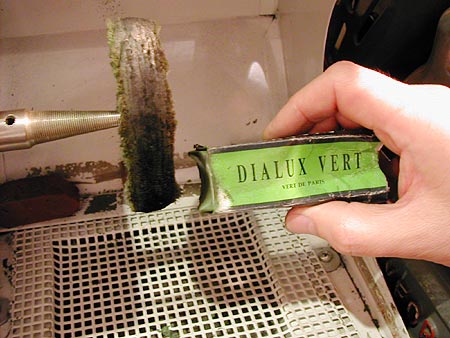

Rolex Case polishing

Keep polishing. Be careful not to over-buff edges!
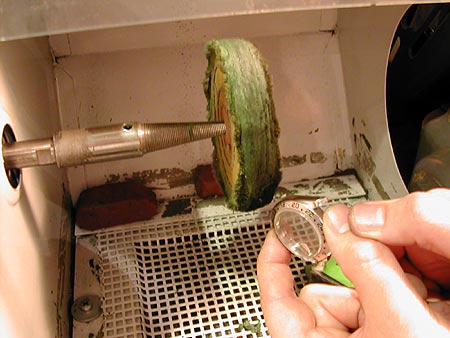

Rolex Case polishing

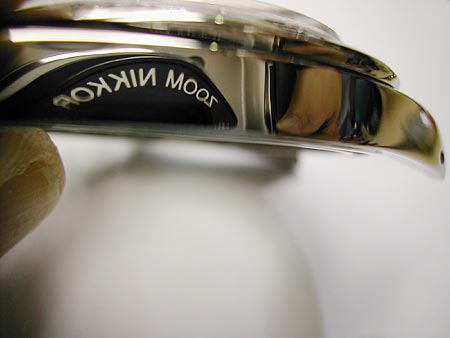
Once you achieve mirror-like finish, clean in ultrasonic.
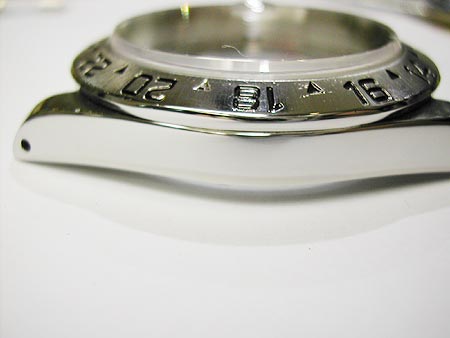

Rolex Case polishing

piece of cake!


Rolex Case polishing

one more shot


Rolex Case polishing

Cheers !


Rolex Case polishing

Tuesday, May 12, 2009

How To Kill a $11,000 Watch in Two Easy Steps


Step 1: wear it for 10 years without servicing
Step 2: unlock the winding crown and jump into the pool


The reason for the state of the Rolex Submariner, as depicted above, is simple.
The watch owner failed to overhaul his watch when the watch was due for service.

Consequently, the delicate rubber crown seal wore off and water got into the watch through the winding crown.

As a matter of fact, all of this trouble, including a $6,000 repair bill, could have been avoided by simply replacing the rubber seal, at the cost of $10.


To blame Rolex for those shocking pictures is ridiculous.
Owners should take their responsibilities and respect overhaul service when the watch is due.
However, I am afraid that we will see those same horrific pictures for the years to come, as there is no cure for stupidity.

Monday, May 11, 2009

The Curse of the White Towel

Early morning breakfast without reading the daily papers is inconceivable. Having nothing better to do, my attention was caught by a small label sticking out from a cotton towel laying on the kitchen table:


"Wash separately before use. Wash dark colours separately. Warm gentle machine wash at max temp 40C. Do not use oxidizing/chlorine based bleaching agents. Avoid excessive use of fabric softeners and detergents containing optical brighteners. Warm tumble dry.
Do not iron or dry-clean. 100% cotton..."


Before you stop reading and conclude that I'm going cuckoo, I just want to make a point out of this random, ordinary observation. Isn't it amazing how much information the $5 dollar towel manufacturer provided on the label concerning "duty of care", required to keep the towel in top condition for the years to come?

Yet, how many high grade, elaborated and expensive watches come with any information such as "How to care" manual, service papers, or even technical information?

Here is an example of an International Guarantee card, enclosed with a $2,500 high-grade mechanical Swiss watch:


"This ... watch has been manufactured at Bienne Switzerland with choice materials only. For two years from date of sale, this watch is guaranteed against all defects, except those resulting from willful neglect."

How pathetic!

Believe it or not, the most common factor that cause the premature death of watches is not poor design, bad engineering or inferior parts used in production... The real 'cause of death' is simply a lack of regular maintenance and basic understanding of the watch's functionality.

It is a common mistake from all watch manufacturers to spend too little time (if any) in educating new owners upon acquiring their precious products. Instead, more effort and money are invested in advertising brand names, less on how to care for the watch.

Obviously, watch manufacturers are not very keen to tell you the truth:
Your mechanical watch is NOT capable of keeping flawless time,
it is most likely NOT water or shock resistant
and it requires maintenance on a regular basis, performed by an expert watchmaker.

If your watch would come with a label, like the ones produced by Caninngvale Australia, it would read something along those lines:


"Your watch is miracle of mechanical engineering. Although beautiful and expensive, it is very fragile so extra care is needed to assure proper performance. It is built to last for ever, as long as you take care of it -so complete overhaul on a regular basis is absolutely essential. Do not wear it while showering, surfing, swimming, being in the sauna, playing golf or sailing.
Do not wear it while operating electrical tools, bungee jumping or on public transport after midnight. If you do so, then you'll get what you deserve, or more precisely you'll lose what you don't deserve in the first place.

Branding is nothing. Your watch is not of investment value because watches in general are poor investment. However if you look after it like you should, it will have enormous sentimental value to your kids - until the day they run out of cash."


So there you go - I can't help but help.