Tuesday, May 30, 2017

Another Act of Rebellion


***Another Act of Rebellion


If there is one thing about the rebelde project that I would change in a heartbeat, it would be the word 'rebelde' itself. 
If you're from an English-speaking background then you will have a hard time pronouncing this Spanish word properly. Because in English that 'e' at the end of rebelde is silent, yet in Spanish it is the last tone that gives the word its unmistakable meaning; an on-going battle, a rebellion against mighty forces that want to enslave you.

But then again perhaps there is no better substitute, no better word that could describe the struggle of a small independent watchmaker that is trying to break free of Swiss shackles. And today is another of those small victory days; a break-away day from Swiss jewel suppliers.

A quick introduction into watch jewelling: a watch jewel is a synthetic bearing which holds (hugs?) the pivots of the watch wheels. The quality of the watch and its ability to keep time is directly related to the quality of its jewels. The watch jewels are incredibly small yet polished to perfection. There are only a handful of watch jewel manufacturers in the world and most of them are either Swiss or use Swiss materials.


The dependency of Swiss-made jewels in the watch industry is such that even the most famous watchmakers (both large and small) would not even consider making jewels in-house. The technology, knowledge and expertise required in jewel making is simply beyond their reach.


If you're a small watchmaker trying to create your own watch mechanism, then the gear-train design would be a catch-22. Before you can design the wheels you would need to know the size of your jewels. But there is no such a thing as a standard jewel size because jewels are made to specific requirements. In other words, you cannot go to a jewel manufacturer and say that you would like the same jewels as they make and supply for Rolex. The jewel manufacturer would ask you to provide your own specific measurements. What makes things more complex is that even a simple mechanism would require 10 different jewel sizes. Multiply that figure by the minimum order quantity requirement and then by the price per jewel and you will come up with a figure of around $60,000 - for just one calibre.


This is a scary figure. But if rebelde is to become known as a maker of its own in-house, Australian-made movement, then this investment is unavoidable. Today we received samples of a Japanese jewel manufacturer, a leader in their field, who is interested in our order. The good news: we will have our own jewels and they won't be made in Switzerland. While we haven't even commenced the design of our in-house movement, we believe that we can have a working prototype in less than 5 years. It will take many small victories like this one to get there, and this is why we count on your continued support.


Viva la revolution!   


Happy collecting,
Nick


Wednesday, May 24, 2017

Australian Machining Fair - But Australian Manufacturing?

***Australian Machining Fair - But Australian Manufacturing? – by Josh

Two weeks ago I attended the Austech fair in Melbourne, an Australian Manufacturing Initiative to bring OEM's, subcontractors, hobbyists and the general public together to show off manufacturing in Australia. Although this description of the event is not an accurate way of describing the goal of Austech, it is quite easy to see that it is perceived this way. Machine tool suppliers, tooling manufacturers, auxiliary equipment suppliers (lubricant, cooling, dust collection, chip extraction etc) were all there en masse. 

It was interesting for me to go to a show with no specific goal, other than to see if there was anything that would be applicable to the watch industry. Looking back you could say that this was a little optimistic. Often the very difficult part of "setting yourself up" is buying the right things. Therefore, knowing what to buy can be just as hard, if not harder, than physically buying it. We did end up acquiring a few new items that will be living in the Brookvale facility, although I'd have to say the few industry connections that were formed at the fair are far more valuable than the purchased items themselves.


Meeting with a few Australian subcontract companies and talking to people who have been where we are and have experienced the difficulties of starting up a manufacturing process in Australia was a very exciting experience. Seeing them talk about their successes despite an incredibly challenging Australian engineering landscape was highly encouraging. For example, Mastercut, located on the Gold Coast who, against all odds, is doing export work as well as OEM work in Australia. Mastercut specialises in photochemical etching and laser-cutting thin metal sheets. Their minimum order? One piece or a thousand. Not directly in our industry, but they may be a perfect partner for our clock dials! (Stay tuned.)

It wasn't all rosy. The fact that in a hall of 300 exhibitors and only a handful represented true Australian manufacturing was disappointing. Seeing stall after stall of overseas subcontractors bidding for your part was a reality check. How much is actually made in Australia? At the risk of sounding Australia-centric and almost nationalistic, I feel very strongly that the little we endeavour to make should stay within our borders.
Sometimes we get what we pay for. Parts may be cheaper from all over the world, but will we really settle for a 90 day lead time, low quality control and in some cases blatant misinterpretation of engineering drawings and requirements?
 

Austech left me in a bittersweet place; excited by the small pockets of Australian technology but concerned about the larger issues surrounding a possibly struggling sector. How can we encourage the growth of high skill labour and trades? What can we do to make higher quality goods? Is there a possibility of "Australian Made" being a common and expected title?
The driving force is the consumer, your choice on where to spend your dollar. It might require a few more dollars to buy the Akubra hat, Maton guitar or rebelde watch but in the long term, those dollars will come back to you in one way or another. Another job created, another Australian supported.
Happy collecting,
Josh

Monday, May 22, 2017

*** How square is your square? - Polygon machining


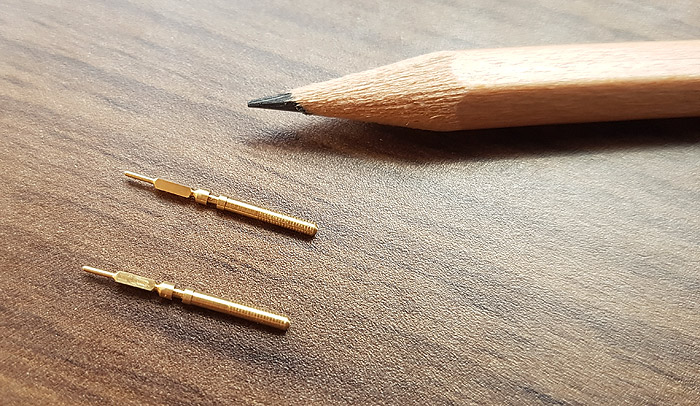
Some watch components are more demanding than others. For example, a winding stem is one of those components: despite its relatively large size, it needs to be machined as close as possible to design values. The stem is threaded, round and it sits inside the main plate between two centres, it carries two wheels and is held in place with yet another component. Functionality wise, it does two things: time setting and winding. And one of the critical elements is the polygon section - a highly polished 'square' - a track for a sliding pinion. 
Making a component is one thing; but finding out the exact size of the machined part is the real moment of truth. And polygon cutting will not only tell you how good your machine is, but how good your raw materials, your tools, the rigidness of the machine, alignments- down to coolants, lubricants and room temperature are.


I am not going to bore you with details; briefly, the polygon is the result of 3 main actions: rotating cutting tool, traveling of the tool along the axis and the rotation of the material. All 3 movements are tightly coordinated (think of a juggler juggling 3 balls). The final tolerance is the sum of the errors of each movement (and many others!).
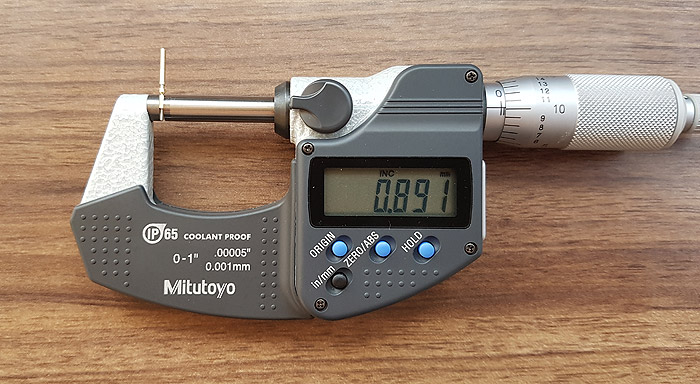
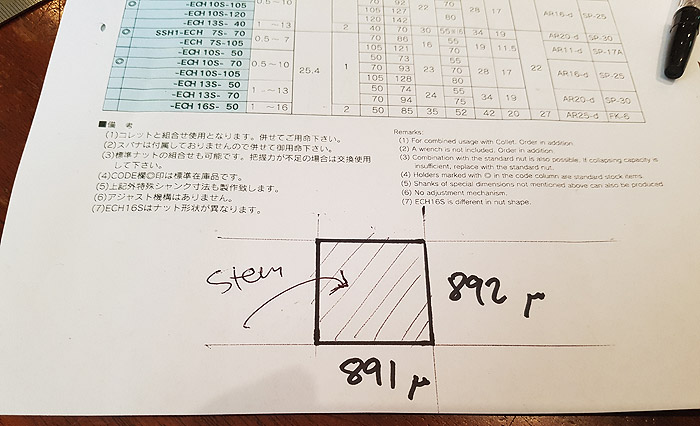
I am very pleased to report that our end result is amazingly 'tight'. The sides of the stem square are 891 and 892 microns so the difference is just 1 micron (1 thousands of a millimeter).


Actually, since I am measuring distance between two planes, discrepancy per side is only half of the micron!
To put things in perspective: the thickness of a human hair is 50 microns, so half a micron means slicing the hair 100 times - along!
The bottom line: when it comes to precision, our new toy is exceeding our watch manufacturing requirements: the lathe and bar feeder are rigid, the material is spot on and the ambient temperature for sub-micron machining is just fine. The setup and the environment are not supplied by the machine maker - it is something we had to create ourselves, and judging by the first measurements, it looks like we've got it right. A small curiosity: the surface finish of the polygon is very close to mirror finish and the stem does not require any post machining finishing. Production time: 54 seconds.
We are now ready to find the answer to yet another burning question: what is the smallest watch component we can manufacture?


Tuesday, May 16, 2017

Using the Right Tools

***Machinists say that if a job is too difficult then you are using the wrong tool.


And you don't have to be a machinist to agree.
Remember how much trouble you had that time trying to remove a screw using the wrong screwdriver, or drilling a hole with a worn-out drill bit. Not only was the end result pathetic, but you were left frustrated, swearing you'd never do it again. When it comes to micro-machining, and especially the manufacture of watch parts, then using the right tool is essential.

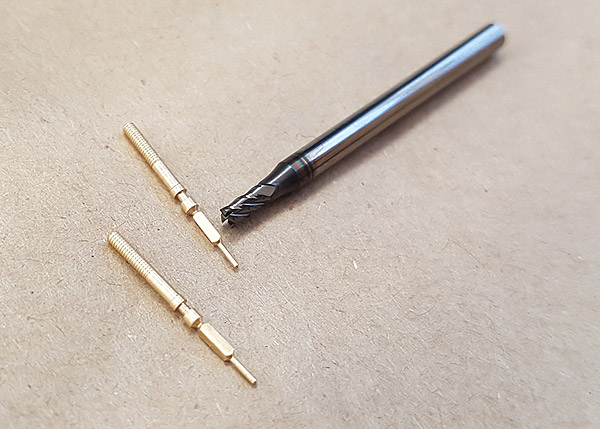
Going through the boxes of newly arrived tools from Switzerland, I was once again amazed by the beauty of the polygon cutter. This little baby is used for milling a square section of the winding stem and, if run at the appropriate speed and with the correct feed rate, it would not only cut the square but it would also leave the surface highly polished so that no further machining would be required.
The blades diameter is only 2mm and it was manufacured in Switzerland by DIXI Polytools, specialists in tungsten carbide and diamond cutting tools, who have been in the business since 1946.
Yes, the tool cost a small fortune but there is no substitute for it. If you want to end up with a component that is a piece of art, you have to start with a tool that is a work of art itself. Next time I will share a few photos of this end mill in action – stay tuned!


Happy collecting,
Nick

Thursday, March 30, 2017

What is horology (and what is it not)?

***What is horology (and what is it not)?
 

To put it very simply, when we talk about horology, we talk about two things: 1. the chase for perfection in timekeeping and 2. the art of watchmaking. The quest for "the best timekeeper" is really a matter of progress, science, technical advancement and some extremely clever engineering.
Therefore, if you wish to enhance your appreciation for that first side of horology – the quest for PRECISION AND ACCURACY, you should sell your Rolex and Patek and buy a Japanese HAQ [High Accuracy Quartz] watch. My personal recommendation: Citizen CTQ57 Chronomaster or Grand Seiko 9F series. You can walk around knowing you have one of the most accurate wrist watches that still contains mechanical parts.


Now, you may rightly ask: well, if this is horology, why in the world don’t we just do that: get rid of the Swiss junk and invest in the most advanced Japanese stuff?

The problem is that accuracy is only half of horology. The other half is the "art of watchmaking"; and somehow, by art, we think of our ability to shape metal in a very traditional way, the very difficult way; the way it was done 200 years ago. And what we call art is really a combination of watchmaking skills, precision engineering, accuracy and artistic beauty.

Confused? You should be.

Because horology does not really make sense:  if modern mass-produced (yet super accurate) Citizen and Seiko watches are not artistic, why are the equally mass-produced, mechanically inferior Swiss wrist watches artistic enough to be considered worthy of horological importance?

Is a Swatch watch horology? Is it Rolex? Lange? Hublot? Rebelde? TAG? Surely Omega Moon watch is - at least, this is the watch mentioned in this newsletter almost daily! Would I be able, as a novice watch enthusiast, to ever figure out which one to buy and collect? Why is horology so confusing?

Before we go any further, let's spend a moment or two on a totally different subject. (I am simply trying to alleviate your pain).

If you ask me "What is cycling?" I can immediately think of four things: Tour de France - the fittest athletes with unbreakable stamina and strength pushing themselves beyond physical endurance while racing through the most picturesque French landscape. The second association: an overweight man on a training bicycle with a large bag of potato chips, gold chain around his neck, watching music videos at a $3,000-membership gym. The third picture: a kid pedalling like mad, down the paddock trying to reach 55km/hour on a homemade bike, ending up in hospital with a broken arm. Fourth: a lycra-clad, adrenaline-pumped Sydneysider, blocking peak hour traffic on the Spit Bridge in the bus lane.

Now, let's just not kid ourselves: the exercise bike is not cycling and the suicidal Sydneysider should be looked up in a mental institution. But the kid cycling down the paddock could be the next Cadel Evans, and the broken arm story is something he will be retelling for the rest of his life.

So here is my punch line: from now on, every watch you see, buy, or read about will fall in one of those 4 categories: Tour de France winners Cadel Evans and Chris Froome, the fatso with golden chain, the cool kid or the high-tech madman. Some of them you want as your friends, others you should avoid at any cost.

So, horology is really what YOU think it is; and your horology is surely different than mine. Often it does not make sense and it takes a bloody long time to work out what to keep and what to sell.

But if you do apply my 4-cyclist rule, you will have no problem working out who's who and what's what in the world of watches. Give it a go: Lange, Rolex, Rebelde and Hublot. I couldn't make it easier but do send me your answers. (Too easy? Then try this foursome: F P Journe, Oris, Panerai and Vacheron). Have fun!


Like in the Tour de France, the very top of artistic horology is all about performance, complexity (we call it 'complications') and traditional skills. The ‘top’ watch is the one that combines all of the above, and much more. If this helps - think of the Melbourne Symphony Orchestra:


Think of the team work, perfection to detail, appearance, harmony, excitement. How much talent and painstaking practice is required to secure a place in the orchestra? Attending a performance is a feast for the ears, eyes and soul - and even if you are not 'into it', it doesn't take much to appreciate the seriousness of the performance.

So does the watch mechanism below look like the Symphonic Orchestra? You bet!


Note - it is the watch mechanism that gets us excited - not the watch case or even the dial; and definitely not the size or colour of the strap. When we are talking about the top of the top, we are looking for brands and manufacturers who are really good at making a complex mechanism in a very traditional style: the style of the 'old masters'.


There are hundreds of watchmakers who call themselves 'watch manufacturers' and that may be the case, however, when it comes to the Crème de la crème, in my opinion, the true engineering brands which deserves that top spot are:
Lange and Sohne, Jaeger Le Coultre, Vacheron Constantin and Patek Philippe - the Masters of Grand Complication.


So when you are assessing a watch, the first question should be this: what is the complexity and workmanship of the mechanism?

grand complication is a watch with several complications, the most complex achievements of haute horlogerie, or fine watchmaking. Although there is no 'official' definition,, one common definition is a watch that contains at least three complications, with at least one coming from each of the groups listed below:
 

Timing complications Astronomical complications Striking complications
Simple chronograph Simple calendar Alarm
Counter chronograph Annual calendar Quarter repeater
Split-second flyback chronograph Perpetual calendar Half-quarter repeater
Independent second-hand chronograph Equation of time Five-minute repeater
Jumping second-hand chronograph Moon phases Minute repeater


Currently, the most complex watch on the market comes with no less than 57 ‘complications’, containing 2,826 individual components – with an assembly time of 8 years.


To be continued…

Happy collecting,
Nick

Landfill or Lifetime

***The choice is yours!
 

In February, we lost our washing machine. After 7 years of service, the poor thing just died. And last week we lost the mighty Fisher and Paykel fridge. The death was slow and painful - and for a couple of days we thought we could save it. "I am calling the repairman" - Tanya was determined. But then common sense prevailed: the technician’s quote and the cost of parts and labour would only extend the life of the poor fridge for a year or two. Beyond that, the fridge would simply become too old, non-repairable, a burdensome machine. Not to mention all the inconvenience which goes with such a repair job: the waiting time on a service phone line, mid-day appointments which would require one of us taking a day off just to babysit the fridge, awaiting the serviceman. And that would be the best case scenario: what if the required parts are simply no longer available or not in stock? More scheduling, more hassle and more wasted time.

Australia is the fifth highest waste producer per capita in the world. Each Australian family contributes enough rubbish each year to fill a three-bedroom house from floor to ceiling. Yes it is true - we are getting better at recycling stuff. But here is a shocking statistic: only 1% of all items purchased are still in use 6 months later! Somehow, we got really good at both over-consumption and excessive production of short-lived, disposable items.

However, there are a handful of businesses who still take pride in making goods which will last 'forever'. I've googled three - in Texas!  A Texas Instruments graphing calculator would easily last you 15 years. No wonder they hold a 93% share of the graphic calculator market - they are built to last. I had one as a kid, and you had one too. A leather Saddleback wallet can last decades and it is fully 'repairable'.  Velvet Forge offers a solid straight razor that's made out of stainless steel and is resistant to rust and wear. The razor comes with a leather carrying case, and the company has your back for a lifetime of resharpening. Guaranteed for a lifetime!

And then there is that crazy watchmaker in Australia who designs his own watches, assembles each timepiece by hand - one at a time - and offers a 50 year guarantee on performance and 50 year free parts and labour servicing with each watch. The watch requires no power source other than old-fashioned winding, it is fully waterproof and has a little mechanical heart.

Landfill or lifetime? As always, the choice is yours.

Happy collecting,
Nick


Intriguing History of the Reverso

Thursday, March 16, 2017

Your New Smile

***Your new smile


About 10 years ago, at the time when our shop was located in Mosman, I went to see a local dentist for a minor 'dental repair'.
“Really a minor problem”, he said, “painful never the less, but while you here, I would like to share some good news”, he said.
Good news in a dental chair? “Have they finally invented a painless drill”, I naively asked.
“Well, the good news is, that in just a week or so, you can leave this practice with a brand new smile!”
It was obvious that I didn't need a new smile but I couldn't resist asking how much that new smile would cost.
“Only $32,000” he said cheerfully. “We will start with the lower jaw then move up, left, right and centre - and you will have the smile of a news presenter!”
Needless to say, I got the tooth fixed for $120 across the road.


You see, there are plenty of idiots out there happy to take advantage of you. Watchmakers are as bad as everyone else, so keep reading. 

About once a week I receive a service report from a subscriber who just submitted their watch to a "reputable" Swiss brand service centre. And most of them appear to be prepared by the “you'll have a new smile” watchmaker: your watch needs a battery replacement, but it is also scratched. We recommend case polishing. While we are polishing the case, we will also do a complete movement overhaul (your watch is due for one!). We also noticed that your dial is oxidised, as well as hands, so we will replace them. The total repair cost is $1,100.

So you took the watch for battery replacement only to find out that your watch is a piece of crap which can be brought to former glory for a mere $1,100.

Before I go any further: please do not send me your service report estimates! All of them come with a disclaimer clearly stipulating that you are NOT ALLOWED to share this information with anyone. So legally, you are breaking confidentiality law. (Sorry legal people, you know what I mean).
Equally I am not allowed to comment on reports or to mention names. Also, even if your watch does not need any of above, it would take lots of money and time to fight such reports. Now, it goes without saying that since 'the reputable brand' is not going to supply any spare parts to me, in most cases, I won’t be able to help you. This is the beauty of a monopoly: it kicks you in the guts and then robs you of the opportunity to source a service from a non-authorized third party. 


One of the trademarks of sophisticated thieving is the use of scary terms which are not commonly understood. Oxidation is a perfect example. Your apple turns brown in matter of minutes when sliced; steel rusts in rain in a matter of days and a silver watch dial does the same - coated or not, protected or not - over the period of a few years. In other words, oxidation is just a very natural process, and the end result - as on the watch dial and hands - is more of a cosmetic nature than of any functional concern. And here is my punch line: if you magnify any surface enough, you will see that discoloration, so technically and legally, it's there. But if you are happy with your smile and with your micro-oxidized dial, which you cannot even notice with a naked eye, then you should tell your Swiss brand that you don't want them replaced. This is your consumer's RIGHT and don't let it be taken away from you.

The final question is the one in relation to servicing. Does your watch needs a complete overhaul when in reality you just want a battery replacement? Well this one is easy to work out.

If your car runs out of petrol and you take it to the "brand" car maker service (without telling them that you've just run out of petrol!), then you can bet your last dollar that the service report would take the opportunity to list a number of parts which would require immediate replacement: filters, maybe a clutch, surely brake pads, right down to the rubber wipers. They will have no problem claiming that your 10 year old car is no longer performing "as when it was brand new" (which is obviously true) so legally, they are not breaking any law trying to sell you that new smile. The only reason why such reports are rare is because your Government knows that you need your car to get to work (so you can pay your tax) and therefore protects you from predators and monopolists.

But your government could not care less about your fancy watch so your only protection is to stand up and rebel against unwanted and unnecessary watch repairs yourself. Tell them to go to hell and just replace the darn battery or otherwise you'll take it to someone else who will.

Happy collecting,
Nick

The Most Boring Job in the World

***The Most Boring Job in the World


Being a rebelde service person has to be the most boring job in the world.
They’re simply not coming back. No broken crystals, no missing winders, not even a torn strap. 542 rebelde watches simply refuse to stop ticking. Which can be a bit disappointing if your only job is to turn up for work, waiting for a broken watch to arrive into the rebelde workshop for servicing. You might think this is a joke, but it’s not. It’s a serious problem we have – if the watches are not breaking how can we improve them?
 

You too can become a happy watch owner - order your rebelde today.
Available styles: www.nickhacko.blogspot.com.au/2017/03/rebelde-2017-production.html
Delivery time: 4-6 weeks


Monday, March 6, 2017

False Dreams

***False Dreams


Probably the most common question we get asked: is the watch I intend to buy a good investment?

The question is not just a regular reoccurrence but also a very important one. I do my best to address this subject every now and then - yet somehow there are many subscribers who simply struggle with the whole 'investment' concept.

I'll keep it brief, but please try to digest it at your leisure: if busy, save and read later.

The first question you need to answer for yourself (and I can't answer it for you): are you an investor, collector, enthusiast or just a happy watch owner?

Of course, you can be all of the above at the same time, but here is the catch: unless you have an excess amount of cash you are willing to invest, then you are not an investor. Unfortunately we live in a world where many are sold a false dream called "borrow to invest". You can actually call yourself an investor without even having any money! The financial institutions are happy to lend money so you can "invest" in shares or buy your fifth "investment" property. Imagine a world where any 18 year old kid could obtain a law or medical diploma and start his own practice today - just by promising that one day, in 5 or 10 years, he will actually complete the studies. As ridiculous as it sounds, this is precisely what you can do if you wish to enter the speculative world of quasi-investing with money you don't actually have.

So if you are putting a watch on a credit card then you don’t have to worry about its "investment potential" because such a transaction is not an investment. By the time you pay that watch off, any potential investment return will be long gone, your bank will have made a nice profit on their loan and ironically, it won't even send you a thank you email.

Now the reality is that many of my customers actually do have a solid disposal income, including a significant amount of cash which could be potentiality invested. However, watches are not an income-generating asset. You cannot milk it; skin it; the watch cannot employ or educate people; it cannot be lived in, leased or rented out. Your watch will never find a cure for cancer, develop an app or figure out an algorithm to speed up the data flow. Actually, the amount of income they generate over time is precisely zero. So watches are an extremely poor income generating asset and, if anything, you would want to avoid them as an investment all together, at any cost.

If you are bit confused then you are actually paying attention. How come, then, that watches are always sold for more than what they were worth new, a decade ago? Surely, some of them are a great asset?

Unfortunately, based on my lifetime dealing in watches, such phenomenon is a myth. Only a fraction of watches in circulation actually increase in value. The majority don't. And picking a winner is like predicting the future - the outcome is highly unpredictable and often surprising.

There is however a clear pattern: those rare winners which have increased in value over time would tick most of these boxes:
- they are ‘locked in time’ (a unique design, discontinued, or of a certain size or shape)
- they have a GREAT STORY (provenience, past ownership)
- fantastic condition (all original components, good working order, cosmetically near mint)
- well-documented and well-researched pieces (i.e. there is a book or numerous articles about the watch)
- limited production run (only a few pieces made)
- feature a unique horological innovation, or was a trend-changer
- made by a famous, reputable maker

It goes without saying that collectors who have made money on watches have done that for a reason. They invested their time rather than their money doing the research, closely following the market trends and buying at the right time, snatching the pieces that do not often appear on the market. But it is clearly obvious that their motive was not only the monetary gain. They didn’t do it for money but for pleasure.

Someone said that luxury yacht owners are happiest twice in their lifetime: first, on the day they buy the yacht, and then again on the day they sell it. The same goes for most watch owners. But it shouldn’t be like that – you, as a watch owner can be perfectly happy with your choice every day of the week, for the rest of your life. Simply, follow the above guidelines, do plenty of research, take your time and learn how to say ‘no’. Instead of volume, focus on quality. Collect thematically – rather than just stockpiling the watches, build your collection in a meaningful and organized way (for example: focus on a particular brand, style or model – more about that some other time).

Over the years I have had countless opportunities to add more pieces to my modest private collection, but I restrict myself to no more than 2 watches per year. Actually, in 2015 and 2016, I only bought one watch each year and I could not be happier with my choices.

In my next newsletter I will be pleased to tell you which watches I bought and why. And then, I will also tell you which watch I regret selling – and which one is on my ‘to buy’ list for 2017.

To subscribe to Nick's free newsletter click here:
www.clockmaker.com.au/free_newsletter

rebelde 2017 production

***Rebelde 2017 update


Pleased to report that the first 11 rebelde FIFTY watches have been assembled and delivered to their new proud owners. Shortly I will commence the assembly of the Pilots Chocolate dial, V batch. Those on the waiting list should receive their watch by the end of March. The rebelde W Control Tower is now scheduled for April 1. Pretty much as planned with no hiccups or major delays.

We still have some cool serial numbers available for all three models and your orders are welcome. Call Robyn or Laura on 02 9232 0500 for further inquiries.

For more information, go to our rebelde homepage: www.rebelde.com.au


Happy collecting,
Nick

Friday, February 17, 2017

Germany Update, Part One

***Josh and Tyler reporting from Germany: "No snow, beer too cold!"


Well, not quite - but probably not too far off either. Yes, the boys are having fun, and so far, plenty of good news. Our CNC lathe is ready; the official training has commenced and coding is well under way. With a bit of luck, by the end of the week they will be making their first watch components!
Sydney delivery and installation date is now June 1, which is in accordance to the previous estimate. The other good news is that the 316L steel samples obtained from an Australian supplier are within the required tolerances. So at least we won't have to air freight 4 metre long rods from Germany – or at least not for components smaller than 3mm.

The lathe itself is the crucial watch parts making machine, and this particular model is well used by both German and Swiss makers. Anyone from Nomos to Lange has it in operation so we know that machine is capable of producing the finest watch parts. Of course, it will take us many months - if not years - to master it, but we are definitely heading in the right direction.

Another piece of good news is that we should be able to make even more complex parts than we originally anticipated: the 6-axis lathe can accept some special 'attachments' capable of cutting very fine pinions as well as gears. However, we will be limited by the diameter – for components larger than 3mm in diameter (main spring barrel for example) we would need one more CNC lathe...


Exciting days ahead - so stay tuned for more!


Happy collecting,
Nick

Thursday, February 16, 2017

Doomsday

***Doomsday

In 2014 an Englishman knocked on my door. He introduced himself as a writer, working on a new title called ‘How the World Became Obsessed with Time’. He looked smart and sounded sharp, so I decided to give him a chance. We chatted for about 45 minutes on a subject he found fascinating; a small anonymous watchmaker from Australia taking on the Swiss heavyweights. Quite frankly, I forgot all about him and our conversation before the lift even hit the ground floor. 

Until last week that is, when a customer mentioned that he’d read about the rebelde project in a book. “What book?” I asked. “The one written by Simon Garfield – the best-selling British author”, he replied.


Wasting no time, I went online and lo and behold, I actually found the book. To my shock and horror, not only was I mentioned, but Simon had wasted three and a half pages penning down our conversation. I even got myself on the top of the index: Hacko, followed by Harrison (George, the watchmaker), Hermes, Hillary (Sir Edmund) and Hitler (yeah, that one).


Of course, I could not bring myself to pay the full retail price of GBP 16.99, so I found a ‘used copy in good condition', for just US $4. I’m not going to spoil your enjoyment of what is said, but I would recommend that you do the same. The book is definitely worth a read.

Timekeepers is a vivid exploration of the ways we have perceived, contained and saved time over the last 250 years, narrated in Simon Garfield’s typically inventive and entertaining style. As managing time becomes one of the greatest challenges we face in our lives, this multi-layered history helps us understand it in a sparkling new light.


Timekeepers: How the World Became Obsessed With Time
 By Simon Garfield
ISBN: 978 178 211 3195


Monday, January 30, 2017

The Buy Back

The core message of the Bloomberg article on the Swiss watch industry was hardly news: Swiss export was declining in every month of 2016. However, what caught me by surprise was this bit: according to the Federation of Swiss Watch Industry, watch manufacturers have bought back USD $1.3 billion worth of stock from their authorized dealers! Clearly, the manufacturers would rather buy back the stock and fill in their storerooms than to tempt dealers to discount. This is a surprising new strategy that will prevent a price drop but it will also further reduce production output. Rest assured that whoever decided to scramble serial numbers (and prevent buyers finding out the manufacturing date) is now regarded as a true industry visionary.

On the contrary, readers’ feedback to Bloomberg's article was less amusing. In essence, general wisdom revolves around two points: a) luxury watches don't sell because millionaires are frugal and b) not only do smart millennials no longer need watches to tell the time, but they are averse of showing off their status by wearing expensive watches. As far as I am concerned, both explanations are equally inaccurate.

While some millionaires are indeed misers and penny-pinchers, the majority of them actually do enjoy their life. The overwhelming majority of millionaires travel business and first class, not economy. Many of them live in luxury homes and love their hobbies, and don't mind spending their hard-earned cash on the things that give them pleasure. However, what makes them stay millionaires is the ability to delay the purchase and completely ignore the 'urge for instant gratification'. Millionaires rarely buy goods at the retail price level and would never pay a premium. They are simply waiting for that very special deal - whether it is a house or their favourite stock, a car or a watch - and are ready to close the deal when it suits them. They also have that very special power: the ability to instantly recognize the true (intrinsic) value of a goods or service and know the difference between value and price.

The myth that youngsters are no longer interested in fine timepieces is equally pathetic. I am yet to see a person - of any age for that matter - who is blasé, indifferent or apathetic once they strap on their wrist a 'live' ticking marvel of mechanical engineering and learn about its history. "I LOVE it" is the most common reaction, and often, that very timepiece becomes the first of many in a journey of sophistication and appreciation. The reason why millennials prefer iPhones to Pateks is that most of them simply have no disposal income and have not yet been enlightened and exposed to the wonderful world of horology. Youngsters have their priorities, and rightly so; education, family, mortgages and travel should always have the priority over investing in depreciating (yet so enjoyable!) assets. I say: give them enough time, and most of them will eventually 'get there'.

I for one am waiting for the Swiss watch treasure chests to fill in, flow over, spill out and to reach the grey market, and then to reach us, the ordinary people.
The sooner the better!

Tuesday, January 10, 2017

Rebelling Against the Swissness


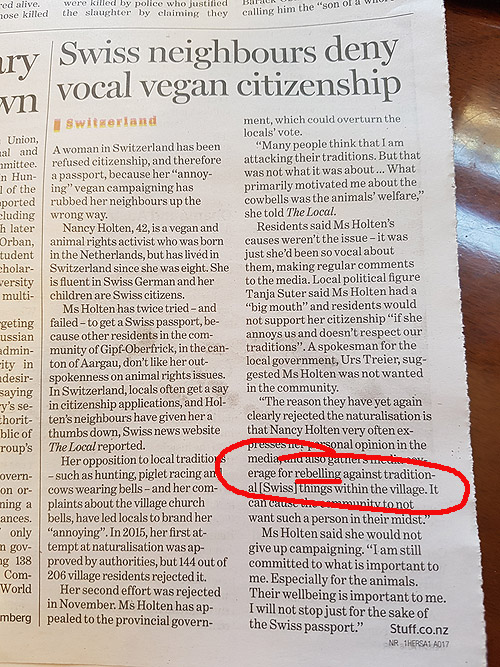
Nancy Holten, 42, from the Canton of Aargau is a vegan and an animal rights activist.

She has been living in Switzerland since she was 8 years old. She is fluent in Swiss German and her children are Swiss. But Nancy’s application for Swiss citizenship has been rejected more than once.

Her sin: annoying her fellow villagers with her activism. Things like looking out for the wellbeing of animals. Cows wearing heavy cow bells; piglets racing and hunting; annoying church bells. Her outspoken comments in the media have made her “unwanted in the community”, and consequently, the fellow villagers are ‘rejecting’ her naturalization.

A spokesman for the local Government puts it nicely: “…Mrs Holten is rebelling against traditional Swiss values within the village…”.

Ah, bloody rebels…

Monday, January 9, 2017

rebelde in action!


Thanks to comrade Jesper, owner of a rebelde Control Tower Mark II, for sending this awesome photo in of his rebelde altitude test.


The temperature was -17C and he's pointing at Grossglockner, the highest mountain in Austria at 3,798m. He was pleased to report there was no condensation or issues with performance.

Pleased as we are, we're but not a bit surprised. Thanks to its super robust case, the rebelde is one of those rare beasts capable of withstanding extreme temperature changes while remaining fully water resistant, even with the crown pulled out.

Some of you might remember a little experiment with the first assembled rebelde which was frozen for 3 hours, then defrosted, yet which didn't miss a beat. Quite frankly, that was the moment I knew we were onto something here at rebelde HQ.

Friday, January 6, 2017

Free Expertise: Fool's Gold

I am sure that every lawyer on my mailing list would agree with me that self-representation in Court is not the brightest idea. There is that old saying that a lawyer who represents himself has a fool for a client. If lawyers use lawyers, what chance would a person like me have to win a court case?

We take it easy on Friday - trying to close the busy and stressful week as peacefully as possible. And so do you. My intention is neither to upset you nor to lecture, but I do have to point out something that for most people is obvious - and yet, for some, not so.

If you have bought a watch from a private seller then you are defining yourself in a court of second-hand dealing. Basically you are saying to yourself - and to the seller - that you are confident enough to conduct the deal; that you are 100% sure that the watch is genuine and you have no doubts in regard to its provenance (and that you are not dealing in stolen goods).
Which is all fine, and yes, in the majority of private deals, the saving justifies the risk.

However, you can't have it both ways: if you are defending yourself in court, you can't just call a lawyer halfway through the trial and ask for a free tip. And if you decide to buy a watch on eBay or Chrono24 then please don't call me either. It's not that I don't want to help - I just can't. I cannot tell whether the watch is genuine or not based on a low-resolution picture.
And quite frankly, no one can.

Buying a year old TAG or Omega watch which comes with the box, papers, receipts and valuation documentation is not that difficult. Such transactions are often straight forward ones.
Parting with cash on a 10 year old watch which comes with no box or papers is a skill. Making the same decision on a 60 year old vintage Rolex is an art form and believe it or not, there are probably no more than a dozen people in Sydney whom you would trust to conduct a deal on your behalf. Vintage watch experts are hard to find!

In my early days I used to deal a bit with a well-known Sydney dealer who would call in from time to time to 'check if I have anything valuable'. It was always interesting to watch him inspecting my stock - to the fine detail. He would take his time with the loupe, inspecting the dial and hands, and even made me disassemble the mechanism just to be sure everything was genuine. He was not a watchmaker himself, so I could tell that his expertise was gained after many years of dealing in watches, trials and errors, and without doubt, he paid the price of self-education. To this day, I respect his attitude - and the way he bought watches taught me that being 'extra careful' is the way to go. I can proudly say that I have never bought a fake Rolex and I hope I'll never will.

When it comes to vintage watches like Patek, it is fair to say that I am only a half-an-expert. Firstly, the Australian Patek market is miniscule and there are simply not enough watches in circulation to learn the finesses of the brand. Secondly, the return on investment is not worth my trouble. I would rather buy 10 Breitling than one Patek. And quite frankly, I don't know of any dealer in Australia who can honestly claim that he is an authority on the subject. To be a true Patek dealer you would have to set up your shop in Tokyo or London, New York or Geneva.

Louis Breguet was the most famous watchmaker of all time. Actually, he was so successful that even during his life, there were 10 fake Breguets for each genuine piece. You can only imagine how difficult it is to authenticate Berguet timepieces now, 200 years after they were created.

Only experts who have devoted their entire life to work of Breguet and who have restored his timepieces could call themselves an authority on the subject – a handful of watchmakers, museum curators and horological historians. And you can be sure that none of them would offer their expert opinion free of charge, based on a poor quality image or an eBay listing.

There are lawyers and lawyers, dealers and dealers - and each to their own.
Horology is enjoyed best when you deal with experts you can trust. And often - especially to someone who is just discovering the beauty of watch ownership - buying a brand new piece from your favourite brand shop is the way to go.

Saturday, December 31, 2016

2017/2018


In front of me are three rebelde watches. Freshly assembled, fitted on raw handcrafted straps and ticking quietly, they mark a new chapter of the rebelde project. These very three watches are the final result of a lengthy design process and will be our core ‘product range’ for 2017-2018.

The hard work is done, and as I type this the last dials are being manufactured. All other components are already in stock with assembly to commence shortly. The only remaining thing to be done is this email. For some strange reason, I now have to sell these watches to you by telling you how great, robust and reliable they are, and to convince you that as Australian designed and assembled watches they present excellent value for money.

Unfortunately, I simply can’t. Any marketing attempt feels both unnecessary and meaningless because the watch should sell itself on its own merits. I can’t tell you why you should buy rebelde; this is for you to figure out. If you’re not attracted to the project and the watch, then no amount of words and photos will change your mind. You either want it or you don’t.

The first of three is the rebelde50. Designed in the style of a 1930’s pilots watch, it’s really our flagship model, a watch designed to buck the trend of planned obsolescence in modern products and one that will last for generations with our guarantee that we’ll be here to keep it running for at least 50 years (for free) – a commitment that shows just how serious we are about what we do. We’re not going anywhere.

The second piece is our rebelde pilot’s watch with a chocolate dial. It’s so fresh that we don’t even have a name for it. Fitted in a 44mm stainless steel case, it comes with a swiss rebelde signed movement. This is one of our most wanted models and the good news is that we’ll guarantee the price a price of $2500 for both 2017 and 2018. However, the production run will be smaller than the previous one, limited to 50 pieces only.

The third rebelde is a reissue of our very first Control Tower model featuring the maxi dial. It comes in a 44mm stainless steel case and has a slightly upgraded movement. Again, the price is locked in at $2500 and the production run over the next two years will be limited to 75 pieces.

I do apologise for the low quality images below, but that itself is intentional. If you like what you see on the photo below then you’ll really appreciate the watches in the flesh.

So where do we go from here? Well, we invite you to come visit us and check out the watches in person. If you’re ready to place an order straight away then email us your preferred serial number and we’ll do our best to accommodate any such request. The first pieces will leave the workshop in March 2017, and yes, there will be some wait time, because as with all previous rebelde’s, each and every piece is assembled by me alone.

To all rebelde comrades and comrades to be, I wish you all the very best for 2017 and I remain grateful and humbled by your continued support.


p.s. Nothing breaks my heart more than the news of a stolen rebelde. Over the weekend, rebelde TiB 11/75 has been stolen along with a number of other watches in Melbourne. Please keep an eye out for any rebelde advertised for sale privately and let us know if you hear anything.

Happy collecting,
Nick

Thursday, December 15, 2016

Tool of the Week - Blankenhorn Depth Gauge

***Tool of the Week 


Yesterday a piece of equipment that we’ve long been wanting finally arrived. Many of you are aware of and have seen the optical comparator that’s sitting on our office floor (we’re now close to having a stand for it so that it can be put in the factory), but as advanced as that machine is, it’s only one part of the measuring process. It can measure distances and angles on a 2D plane, but can’t measure depth. The new Blankenhorn Depth Gauge that arrived yesterday allows us to do just that.


The depth gauge is an instrument consisting of two components; a mechanical micrometre dial indicator and the highly polished granite base table which holds both the part and the indicator.

We spent a good part of yesterday testing the machine, measuring all sorts of parts and pieces (human hair included), and were thoroughly impressed by it. It’s easy to use and has both high precision and repeatability. What’s especially interesting is that it’s purely mechanic - like our watches - and yet is capable of micron-level precision greater than many more expensive digital means.


Prior to purchasing the Blankenhorn Depth Gauge, we had been searching for a similar piece for some time, and it was by sheer chance alone that Nick and Josh discovered the brand. When they were visiting the machining fair in Germany just two months ago, Blankenhorn’s small booth was tucked away to the left at the entrance to the fair. They almost walked right by them as did most attendees, but being in no rush and having endeavoured to check out every booth possible, they decided to walk on over.

They based their purchase on first impressions alone, the representatives of the company convincing them of the quality of their products and that several large watch manufacturers, IWC included, use them. Neither Nick or Josh had heard of the company before, nor could they verify the veracity of the representatives’ claims, but Nick decided to take a leap of faith and went ahead regardless.

And he’s glad he did. Our expectations were well and truly exceeded, the depth gauge not only measuring just as it should, but also being extremely well made; something that’s not always a given. It’s clearly built to last. German engineering at its best.

The calibration certificate that came with the gauge was issued from a third party AQRAT calibration laboratory, located in Esslingen in Germany, which is a nice touch. We’ll almost certainly need more measuring equipment as we move into part manufacturing, and we now know where we’ll be looking first.


Wednesday, December 14, 2016

The Peak of Watchmaker Screw Manufacturing

***The Peak of Watchmaker Screw Manufacturing

The shiny tiny bit on the tip of my finger is a very special horological component. It is a screw. But what makes it special is the fact that it is one of the smallest screws in a watch mechanism. It comes from an Omega Flight Master manufactured in the 1970s and here is the curiosity: the screws you find in watches made today are not any better, shinier, more precise or even smaller. Watchmakers have been making such small screws for at least 200 years. And despite all the advances made in manufacturing technology, we reached the peak of screw making many decades ago.


Many visitors to our premises wonder why that big machine is sitting on the floor in the middle of the office. The answer: it’s awaiting its transfer to our newly built workshop. And what it does? Well the optical comparator allows us to see and measure the exact dimensions of even the smallest components like the above mentioned screw. And in laymen’s terms this screw is just over half a millimetre thick (or precisely, 600 microns), with the thread pitch of just 0.2mm. This 'piece of knowledge' is the very starting point in designing our own screws. Before we can draw and construct we must master the skill of taking precision measurements. And the beauty of our big machine is it can measure dimensions 10 times more precisely than we can even read.

The above screw as seen under the comparator. 


The CAD drawing of the same screw.

What an exciting journey!


Note from Laura, Nick's assistant: when I first saw the screw I didn’t even believe that it was a screw. It was explained to me that the purpose of it is to hold a tension spring attached to a barrel which also holds a small gear in a chrono-hour counter train. And here is the photo of the actual assembly showing two of those tiny screws doing their job. 

Monday, November 7, 2016

Planned obsolescence

***Planned obsolescence is when a product is deliberately designed to have a short life span. 

It is purposely and intentionally designed and manufactured to disintegrate, or to be non-repairable, or simply to under-perform.  At the same time, the manufacturer's marketing department will work hard to convince you that you should remain loyal to the brand and replace the obsolete product with the latest version.

There are countless examples of PO consumer products: from mobile phones to automobiles, computer operating systems, hardware, washing machines to printers – and watches.


The concept has been around for almost 100 years. It originated in Switzerland when the representatives from the world's largest lightbulb manufacturers, Philips, Osram, General Electric and others got together to form "Phoebus", a lighting cartel. Light bulb lifespans had, by 1924, increased to the point of crimping sales. The companies thus jointly agreed to reduce the life of lightbulbs to a 1,000-hour standard. Phoebus members marketed the shorter design life as an effort to produce brighter and more energy-efficient bulbs. However, the only significant technical innovation in the new bulbs was a steep drop in the operating life.

The other form of planned obsolescence is to design a product which is impossible to repair, or when the repair costs are deliberately too high. Turning a traditionally durable product into a throw-away, single-use one is the ultimate in planned obsolescence. It is well documented and researched that some manufacturers deliberately make the serviceman's job difficult, discouraging any attempt of repair. For example - the main bearing of the front-loading washing machine is integrated in the frame and almost impossible to replace. Another example - mass-produced watches have often the entire case factory-sealed.
"Suicide hands" is a term coined by watchmakers frustrated by inferior, self-destructive watch hands fitted on expensive watches.


The creativity of planned obsolescence is limitless: products are fitted with special screws, batteries or seals, or would require very specific tools and diagnostic equipment to be serviced. And surely, as a subscriber to my newsletter, you are well familiar with the outright restriction on supply of spare parts in the watch industry. Not to mention sophisticated take-overs and acquisition of independent watch parts manufacturers with the sole intention to limit the competitor’s access to strategic parts.


The ultimate victim of planned obsolescence is the consumers, forced to replace products which, if designed 'properly' in the first place, could easily last for decades.  Not to mention the economic loss to society and environmental pollution.


In 2015, as part of a larger movement against planned obsolescence across the European Union, France passed legislation requiring that appliance manufacturers and vendors declare the intended product lifespans, and to inform consumers how long spare parts would be produced for any given product. From 2016, appliance manufacturers are required to repair or replace, free of charge, any defective product within two years from its original purchase date. Hardly a victory in my book, but at least it is an attempt to curb planned obsolescence to a degree.


In Sweden, legislation has just been proposed which would cut tax on the repairs of bikes, clothes and shoes. Swedes would also be able to claim half the labour cost of appliance repairs (refrigerators, washing machines and other white goods) from their income tax.


Three years ago, before even the first rebelde was design or assembled, we announced the core philosophy behind the watch: we are going to be known as watchmakers who will offer a robust, reliable and repairable watch. Today, those three core values remain as important as ever. My goal is to be known as the maker of "planned rebirth".


The idea is simple: instead of limiting its lifespan, we intend to keep your rebelde keeping time as long as possible.


The action plan will require a long term commitment and will be based on following:


- unrestricted and unlimited availability of rebelde spare parts
- transfer of skills and knowledge to young watchmakers in areas of design, assembly and servicing
- continuing with design of models which will have interchangeable components. For example, each and every rebelde model (steel/titanium/gold) uses same winding stem, gear train, escapement and main spring. The middle case of Pilots and Control Tower models are identical, and so is the sapphire crystal and case back, etc.).
- ability to become a self-sufficient watch component in-house manufacturer, minimizing the reliance on other parts suppliers.


While the Swiss Phoebus will forever remain a case study of corporate greed and planned obsolescence, I honestly believe that one day, rebelde's "planned rebirth" product design model will be studied as an example of good design philosophy.
 

Your rebelde is here to stay, never to become obsolete. If you share our philosophy then we welcome your business.

TiA 48/50 - $3,000 - available for immediate delivery


TiB 08/75 - $3,000 - available for immediate delivery


Happy collecting,
Nick

Friday, October 21, 2016

Apprentice Corner: Top 10 Watch Videos

***My Top 10 Watch Videos

Something a bit different today - I thought I’d share with you some of my favourite watch videos on youtube. Narrowing it down to just 10 was no easy task, but I decided to choose those that display the genius, passion and perseverance that goes into watchmaking.


#1: Vacheron Constantin - Ref. 57260 - The Most Complicated Watch Ever Made

I can’t tell you how many times I’ve watched this video. Hundreds of times, at least. The reference 57260 represents the absolute pinnacle of watchmaking. Only Vacheron Constantin (and possibly Patek Philippe), with over 200 years of accumulated expertise, could pull off such an incredible piece.
There is, and only ever will be, one of these pieces. Vacheron Constantin doesn’t care how much money you’ve got (though you definitely need deep pockets), nor do they care how famous you are. They have to WANT to make a watch for you. We don’t know who they made it for or how much it cost, and though I’ll never get to see it in person I nonetheless consider it a real privilege to see the watch in action. Inspirational.
I’ve heard that Vacheron is working on something else, still a number of years away, which will top this. How do you beat perfection? I can’t wait to find out.

https://www.youtube.com/watch?v=InYrmk3Ezb8

#2: Patek Philippe 5175R Grandmaster Chime Watch

No explanation needed. Be prepared to pick your jaw up off the floor after witnessing only some of the work that went into this extraordinary piece.

https://www.youtube.com/watch?v=SGPjFFMD3c0

#3 The Single Men - Masters of the Incredible and the Beautiful

Many of the greatest independent watchmakers and CEO’s of larger companies are interviewed in this fascinating documentary. A must watch.

https://www.youtube.com/watch?v=thAKJnp0ntU


#4 Talking Watches With Roni Madhvani

Of all the people interviewed in Hodinkee’s Talking Watches series, Roni Madhvani is most certainly the least well known. And yet, at least to me, his collection is by far the most interesting - but then again I’m a huge fan of watches with bizarre shapes and daring dials. I mentioned one of the watches he displays (the Patek 3412) in a previous book review, so it was exciting to finally see one ticking away. His collection is absolutely stunning and so very unique.

https://www.youtube.com/watch?v=4lJIIHGyD_A

#5 Invenit et Fecit - A short documentary on F.P.Journe

F.P. Journe is a modern trailblazer. He’s a truly rebellious watchmaker who has established an extremely successful brand while remaining completely independent. His watches aren’t for everyone (though you really need to see one in person to get a proper idea of how nice they are), but they’re completely distinct and can be mistaken for no other.
This documentary provides not only an interesting insight into the man himself but also a good overview of the nature of the industry over the years.

https://www.youtube.com/watch?v=8ciWgA1QiMk


#6 Our Maison - "Beyond the gesture" by Jaeger-LeCoultre

I’ve never heard anyone say something bad about Jaeger-LeCoultre. They make my favourite watch - the Reverso (okay, equal favourite with the Rolex Prince); they’re innovative, distinct and have a commitment to quality that is second to none.

https://www.youtube.com/watch?v=ahdP3uPqAOU


#7 Clockwatch: The Daniels Wristwatch

Who was F.P. Journe’s hero? George Daniels. This is the one name that we talk about constantly here. Simply put, George Daniels (1926-2011) was the greatest watchmaker since Abraham Louis-Breguet. Nick, Josh and I read through his seminal Watchmaking book almost every day (I’ll do a review on that one in a couple of years when I finally manage to get a proper grasp on it all!), seeking answers, advice and guidance as we work towards manufacturing components right here in Sydney. This video is a nice little introduction into the legendary figure.

https://www.youtube.com/watch?v=H_XK2sR30Kw


#8 Talking Watches With John Goldberger

Probably the next least-well known person Hodinkee has interviewed, John Goldberger is perhaps the most knowledgeable collector around. I previously reviewed one of his books and mentioned that the only reason you need to buy the book is because Mr. Goldberger produced it. He’s such a cool character and one could listen to him talk for days. So cool, in fact, that he casually grabs a cheese knife, dusts it off on his jacket and then proceeds to bust open a two million dollar Rolex 4113 without a moment's hesitation.

https://www.youtube.com/watch?v=NgSYZIUrRkw


#9 John Mayer On The IWC Big Pilot, Past And Present

I didn’t want to include three videos from Hodinkee because I wanted to highlight some of the great content produced by other watch news sites, but alas, I’m a huge fan of both John Mayer and IWC so I just had to include this one. I guess I’ll just have to make another list!
There’s nothing overly interesting here, it’s just a guy having a nice ol’ chat about a brand and model he’s super passionate about - something I myself love doing with other collectors. It’s always a blast.

https://www.youtube.com/watch?v=SdKqR_CBRBk

#10 Born To Design Franck Muller Watchmaking - SolidWorks

Franck Muller is a brand that is totally unafraid to push the boundaries in all aspects of watchmaking. Their designs are utterly unique and the mechanics within are always innovative and made to the highest standard. This video is especially of interest since we’re also using SolidWorks to design our watches.


https://www.youtube.com/watch?v=cNgIsYbcJ3M