Showing posts with label Restoration. Show all posts

Tuesday, December 23, 2025

Rolex Explorer Restoration, Part 2.


A couple of weeks ago, we left you with images of a completely rusted-out Rolex Explorer in pieces. At first glance, it looked like a hopeless case but as any restorer knows, the real story is in the details.

The process begins with carefully removing every component from the main plate. Rust, stubborn and unforgiving, is painstakingly scraped away by hand with a soft wooden stick. Each crevice is coaxed clean, then the plate is soaked in oil, scrubbed again by hand, and finally given a gentle ultrasonic bath- a sort of spa day for this weary timepiece.

Next comes the delicate task of removing all broken and corroded steel screws. The main plate itself is brass, plated with rhodium to give it that signature “white” sheen, and here lies the trick: steel parts are best dissolved rather than forced out. A soak in vinegar for two to three days works like magic, leaving the brass unharmed while the rusted steel vanishes.

Before this acidic bath, of course, every jewel and steel pin is carefully removed, tucked away to return later. The result? A main plate reborn, etched clean, jewels reinstalled, and ready for the next chapter.
And now begins the real adventure: sourcing original vintage Rolex parts. Some will arrive as pristine new-old-stock treasures, others salvaged from donor watches -each piece a tiny victory. With 50 to 60 parts required, patience is key. Delays are inevitable, and the occasional wrong part is almost a rite of passage.

But that’s all part of the journey. Restoration is never a sprint, it’s a conversation with time itself.

Yet all this epic restoration could be a piece of cake if Rolex would simply release spare parts to independent watchmakers. There are millions of those spares sitting neatly stacked in Swiss bunkers. And if not, all those parts could easily be re-made, distributed, and supplied. But Rolex won’t budge.

The hypocrisy and corporate greed of Swiss mega-brands is just pathetic. Not just in the corporate sense, but in their indecency, blaming watchmakers for a “lack of skills.” Ask Rolex, “Why won’t you supply spares to watchmakers?” and the answer is always the same: Only Rolex Service Centre can service a Rolex watch to Rolex standards.

But that’s a lie. As I type this, our team of machinists is making superbly complex, ultra-tight-tolerance parts for the space and medical industries - fields with standards far stricter than anything in horology. Day after day, batch after batch, we produce those parts and supply them with full metrological reports as proof they meet every engineering and performance specification. Replacing a worn-out part in a watch isn’t rocket science; it’s just a job for a technician.

I asked AI to generate a picture of an old watchmaker screaming “Release the parts!”
And the image it produced - an old man working in a dim, primitive workshop, fixing outdated watches — is exactly the picture Rolex wants you to have in your mind. “Don’t take your watch to those old, small, untrained, unsightly, non-corporate watchmakers,” they say. “They’ll cause more damage, they’ll fit fake parts, they don’t know what they’re doing.”

How about this, Rolex: just release the parts. We’ll take care of our customers to the standards they expect and demand, at a price they’re happy to pay, with turnaround times in weeks, not months.

Release the parts - and shut up.

(To be continued.)

Monday, March 1, 2021

The smallest automatic watch movement in the world: Omega Cal 661


In 1961 Omega released a new watch mechanism: Calibre 661. By the number of components per volume, it was the smallest ever industrial manufactured automatic movement in the world. To this day, this record is still unbeaten!

The watch arrived in rather poor condition suffering both water damage, broken escape wheel and worn out auto rotor post. Most annoyingly, it also suffered from a 'jellified' rubber casing gasket. While most vintage Omega watches manufactured in 60s and 70s do suffer from this issue, this DeVille was definitely the worst one I've worked on in years.

The restoration project commenced in December 2020 and was completed 3 months later, on February 26, 2021. Sourcing the original parts was a challenge. The main goal of this restoration was to preserve as many original parts as possible, especially the original dial and hands. The escape wheel was re-fitted (riveted) on new a pinion. The timekeeping result was rather pleasing with a healthy amplitude. The final touch: a new-old-stock leather strap by Hirsch found in the junk box.

To viewers interested in the total restoration cost: $460 was spent on replacement parts and the labour cost was $1,100 (Australian dollars). Was it worth it? This is always a question only the watch owner can answer for him/herself. Turning a broken and discarded watch into a family heirloom which once again keeps time is always money well spent.

My special thanks goes to Michael who spent countless hours recording and editing this video.

I suggest you watch it on your 'big screen TV' rather than on a small hand held device. In any case - and this is not a spoiler - the 'before' and 'after' shots will impress you.

Link: https://www.youtube.com/watch?v=emdXChe8fTI

Thursday, October 22, 2020

To Jim, from Dad & Mum - Christmas 1934


Broken and discarded, then found by Jim's grandson, this 1930s Swiss A.S. watch is now ready for a new lease of life. Without any doubt this was the most difficult restoration project so far. 

A. Schild S.A. was a watch movement maker operating from the 1890s through to the 1970s.

Adolph Schild began producing watch movements Grenchen, Solothurn after 1896. Schild produced many different movements and became one of the largest movement makers in Switzerland by the 1920s. Schild movements were used by many manufacturers in the 1950s through 1970s, including such familiar names as Harwood, Fortis, Enicar, and even Jaeger-LeCoultre.

The quartz crisis of the 1970s hit Schild especially hard, as inexpensive Japanese and quartz watches cut into the market for volume-produced three-handed watches. By 1979, in order to survive the Japanese onslaught, Schild merged with ETA.

What made this restoration painful is the fact that there was not a single component that was not either affected by rust, broken, out of shape or simply worn out. Thanks to two other AS554 donor movements, the end result was luckily a success.

Make sure to watch until the very end to see what's coming next!

Check it out here: https://youtu.be/iJv5vGt2Us0

Wednesday, October 7, 2020

Rusty vintage Rolex: how to cure 'under the crystal' rust?


If you are into vintage Rolex submariners fitted with plexi glass (models 5513 and 1680) then you are well aware of a rather annoying problem-  rust visible 'through' plastic glass. This unsightly imperfection is actually too common; finding a perfect vintage Rolex submariner showing no sign of rust and pitting underneath the bezel is almost impossible. Pitting is a form of extremely localised galvanic corrosion that leads to the creation of small holes in the metal.

Actually, even the smallest amount of rust located directly underneath the crystal is perfectly visible, thanks to glass acting as a magnifying lens. The only way to get rid of the rust is to remove the bezel, bezel tension ring and then the plexiglass itself and clean all pitted surfaces.
Here is a photo of the middle case after rust removal. Unfortunately the pitted case is no longer waterproof.

The possible solution to restore water resistance would be to grind out pitted spots, fill in the cavity by laser welding and then re-grind the surface. However this intervention is a rather major undertaking and would only be done with the owners approval only.

For your enjoyment only


The story of Breitling began on 1884 when a 24 years old watchmaker Leon Breitling founded the small watch manufacturing workshop in Saint-Imier, Switzerland.

Leon Breitling specialised in the production of chronographsBy early 1930 Breitling had 40 different chronographs on offer.

In 1939 Breitling signed a large contract with the British Air ministry to make flight chronographs for the Royal Air Force. After WW2, Breitling was an official supplier to Douglas, KLM, BOAC, Lockheed, Air France and United Airlines.

To this day, Breitling chronographs are regarded as true pilot's watches known for their reliability and precision.

Featured in this video is the restoration of a 1953 Breitling Ref. 178 with 18K rose gold case and a Venus 170 mechanical column wheel chronograph. The previous restorer was unable to get the chronograph running and in desperation simply glued both pushers to the case, permanently disabling them. Cleaning the grim of the dial and deoxidising movement parts was a serious challenge. The entire restoration took 9 working days to complete. 

Video recorded and edited by Michael Johnston.

Watch it here: https://youtu.be/zD3ZuTp8PcA

Tuesday, September 29, 2020

Do you have attention to detail?


The 1953 smashed Breitling restoration project has just got more interesting. Here is the original photo and also the photo of the dial after cleaning. 
Can you see what’s wrong with it? Today this would be unthinkable but back in 1953… well let’s just say nobody is perfect.

Make sure to subscribe to our YouTube channel – you do not want to miss this soon to be released video.
https://www.youtube.com/channel/UCvYdh0ITL1KyPMmHD84kwXw
By the way the mechanism is Venus 170 which was designed in the 1940s and contains more than 120 parts (Breitling call it reference 103).
And as this old Breitling advertisement says - chronographs are no monkey's business!

Wednesday, September 16, 2020

You'll Love It


As per your request - here is the restoration of the musical pocket watch. A week in the making, this was a challenging project. I will let you be the judge. 

https://youtu.be/5fbAMqEexrY

Please make sure to watch it on your big screen TV, it is in 4K!

Monday, August 19, 2013

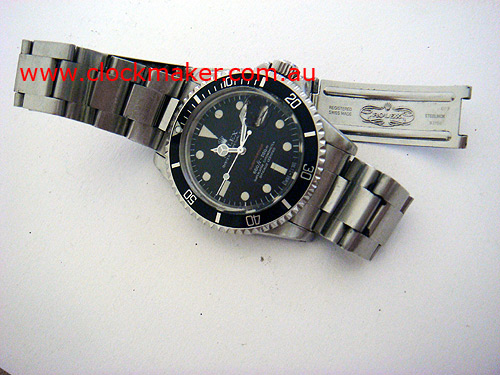
Rolex Submariner 1680 Red - restoration, part II

Rolex 1680 The Red Sub

While we are still on the quest for the 'missing puzzle' - Which shop sold Rolex watches on Norfolk Island in 1970s? the owner of the Red Sub was anxious to get his baby back, so I got straight into Red restoration.

Before you see the photos, couple of points on what a true and faithful collectors of vintage Rolex watches regard as the 'honest way' to restore a watch:

- Mechanism: complete overhaul. Worn out or broken parts are to be replaced. For the same reason you would replace a brake pads on 1972 Porsche, you should replace movement components which are essential and responsible for time keeping. Remember: if it doesn't tell the time, it's not a watch!

- case parts: light polish only. This is done by hand, of course. Plexy glass: again, polish only. Original bezel insert should be retained for two reasons: originality and distinctive vintage look.

- bracelet: a worn out bracelet must be replaced! Again, you would not restore a vintage car and drive it around 'preserving' the 50 years old set of tires. Old bracelet should be preserved, but not attached to a newly restored watch.

- case seal: rubber seal should be replace. This is not optional! While vintage watches are no longer expected to be water resistant, seals are meant to be replaced regardless.

- dial and hands: this is actually the most important bit. The dial and hands should NEVER be replaced. Dial replacement is sacrilegious! Not only the new dial would spoil the look but it would significantly devalue the watch.

In other words, a proper restoration means bringing the watch in good working order wile preserving as much of it's character and originality, whenever that is possible. Like with any restoration, the end result should never become irreversible.

Once again, vintage watches should not be worn in water. When worn daily, extra care and attention should be taken. After all, we are just guardians- beautiful pieces will outlive it's custodians and will be passed on to the next generation of careful are respectful owners.

At least we hope so.

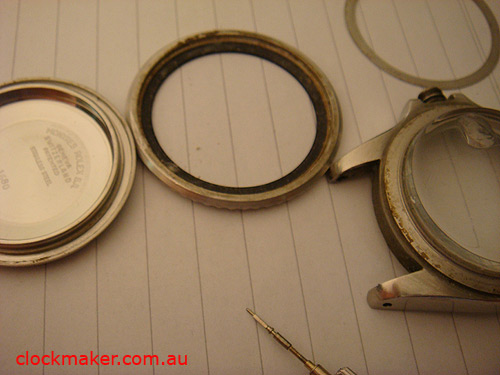
Case disassembly
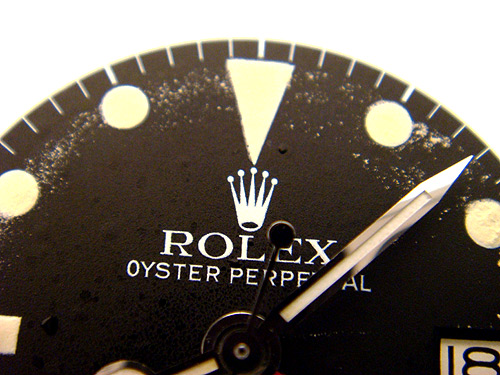
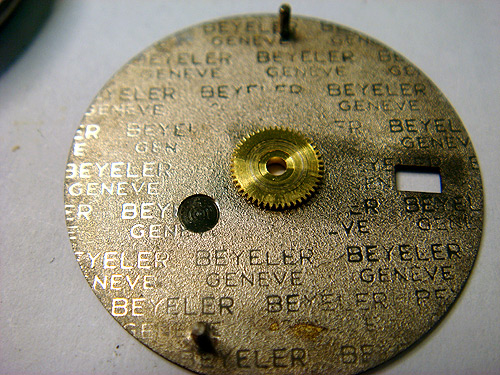
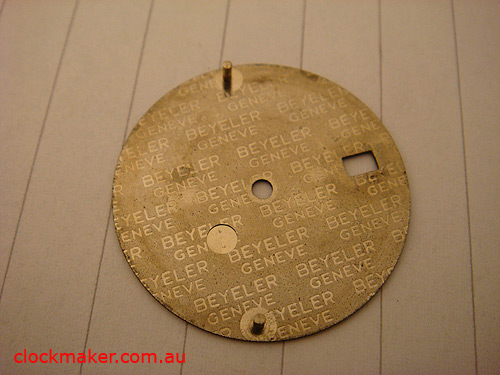
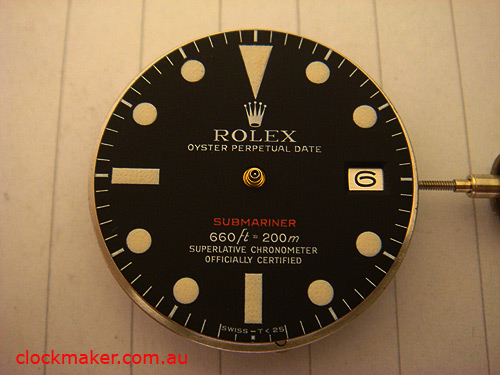
the 'red' dial was manufactured by dial maker Beyeler, Geneve
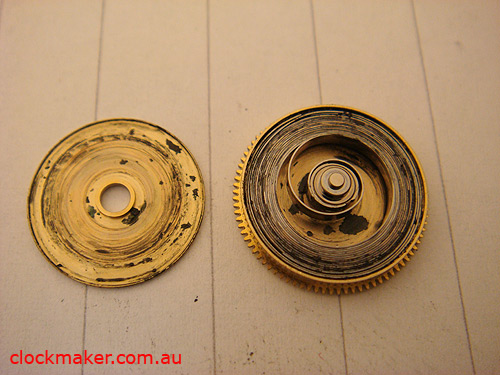
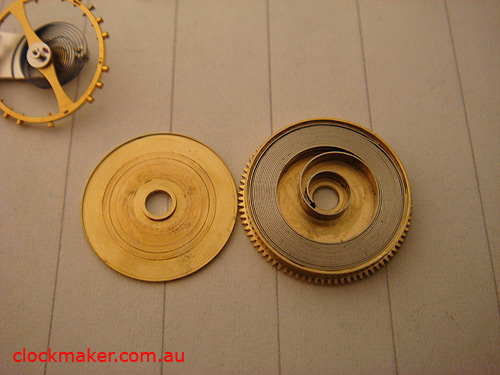
the mainspring was dry, long overdue for cleaning, polishing and lubrication
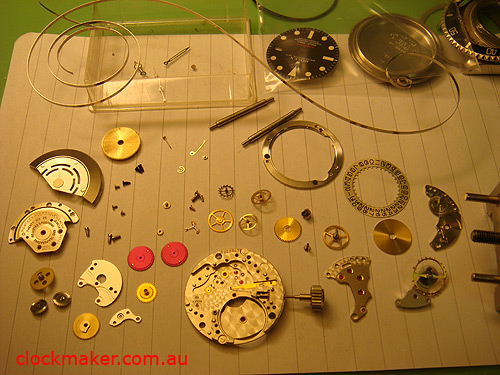
movement disassembled, components ready for cleaning
main spring polished and lubricated
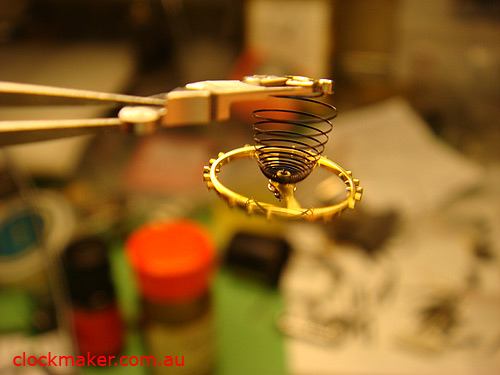
balance wheel
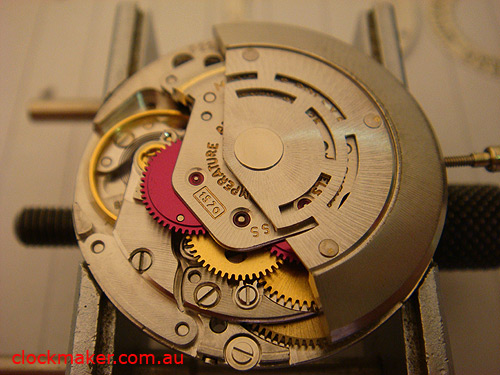
movement assembled
dial
hands assembly
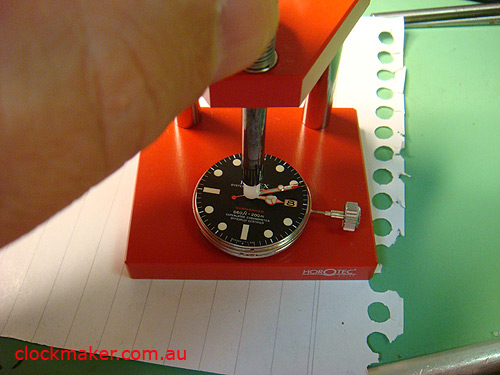
checking for clearence
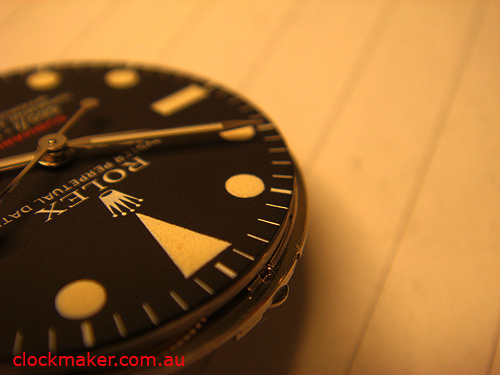
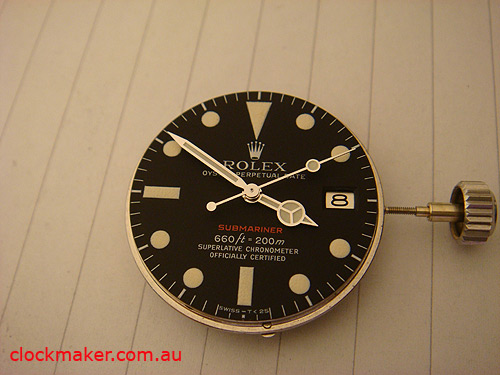
movement assembled !
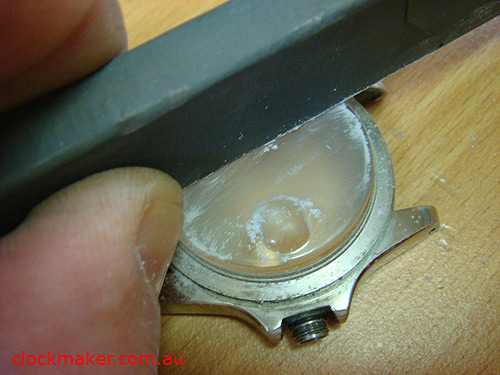
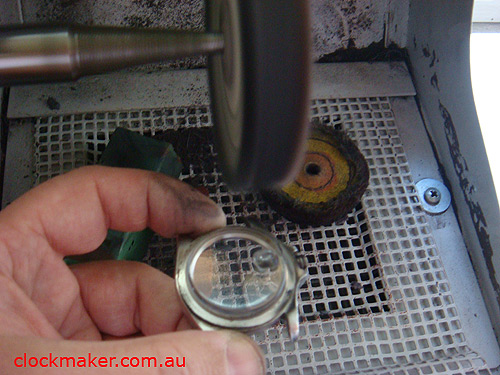
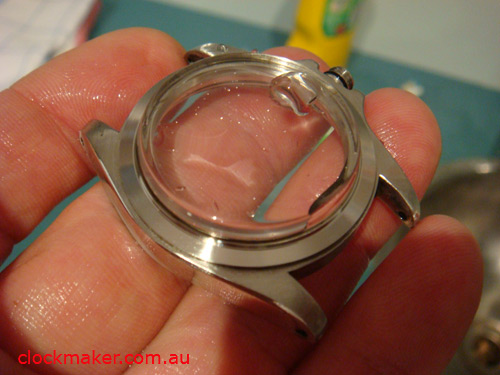
Plexiglas polishing
by hand :-)
more plexi polishing
"brushing" the lugs - refinishing
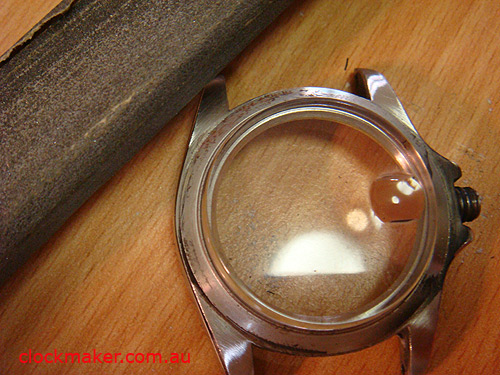
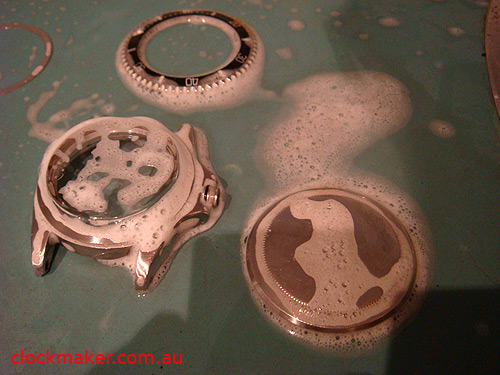
case cleaning
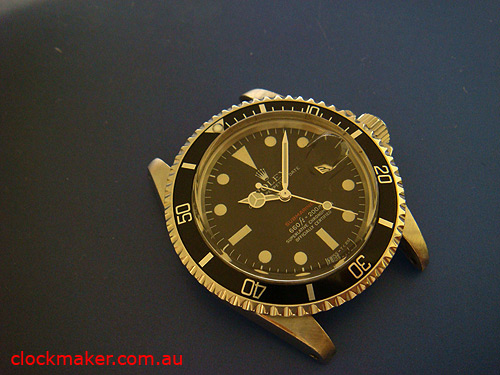
not bad :-)
almost there
ready to go!
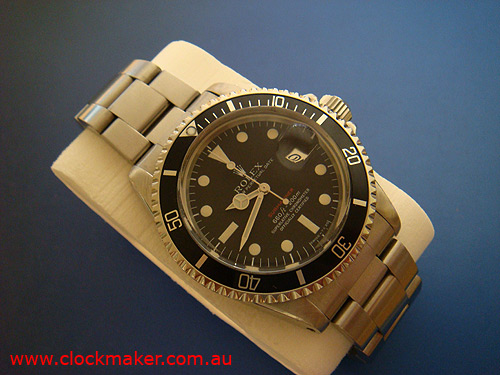
As you would imagine, this quick 'show and tell' blog entry covers only some of steps involved in restoration which took approximately 6 hours. Holding the camera with one hand and assembling the watch with other is challenge I am yet to master :-)
Monday, May 6, 2013

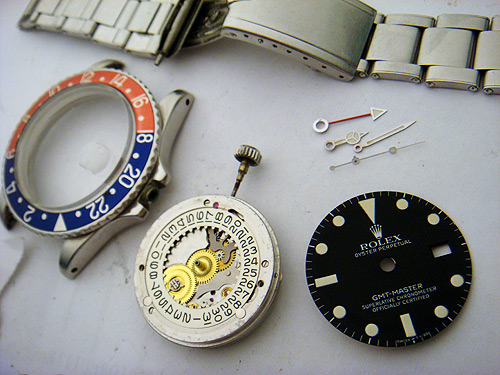
1967. Rolex GMT Master Ref 1675 : yet another water damaged watch :-(

Arrived at our workshop at 4pm today, still full of water. Last serviced in 1998.

Obviously with no time to spare, all other jobs were pushed aside.

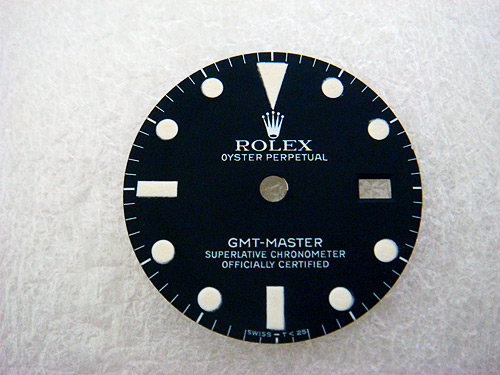
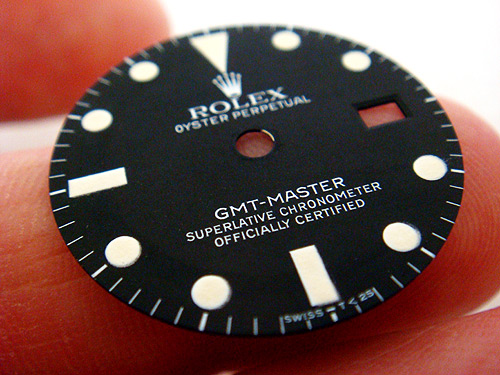
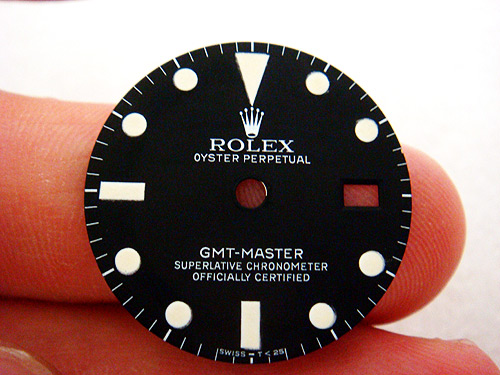
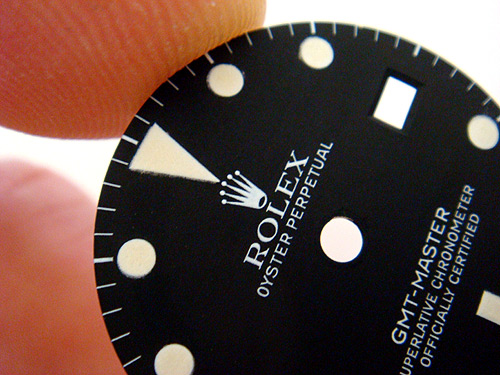
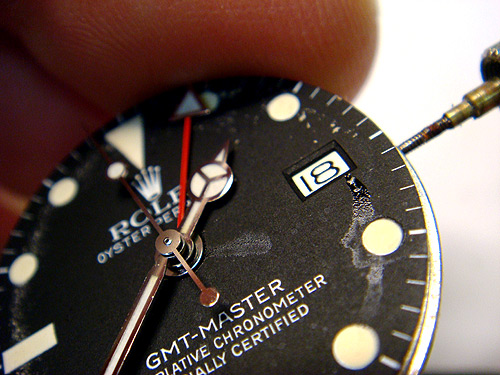
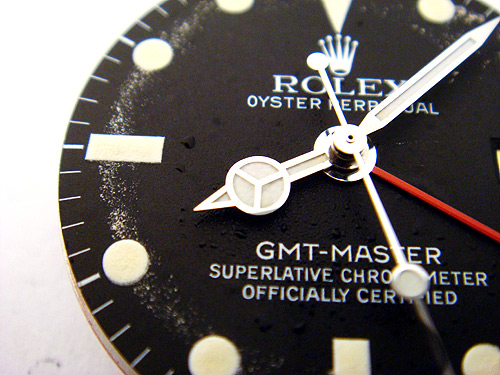
Once the movement was out of the case, the full extent of the water related damage was revealed: luminous material was partially diluted and spread all over the matte dial. And exposed to normal room temperature, it quickly dried, attaching itself to the dial surface.

The only way to clean the debris was to dampen the dial once again and then carefully remove excess luminous material, while trying to preserve the hour markers, writing and minute track intact.

The entire operation took about 30 minutes and the dial was then washed once again and left to dry at room temperature.

Beyeler, Singer, Stern, Lemrich and Metelem are just some of the Swiss dial makers who produced dials for various Rolex models.

This particular dial is a nice example of a fully signed Beyeler tritium dial. The GMT hand is a later replacement, but the watch features its original riveted bracelet.

The watch was bought in early 1970 for $400 and still belongs to it's original owner.

Overall result? We'll - you be the judge.

Another vintage 1675 dial preserved for the future :)